Parallel Clamps vs Pipe Clamps
Key takeaways
- Parallel clamps buy you square glue-ups and flat panels; pipe clamps buy you reach and raw pressure for less money. Here is how we judge the two, and where each earns rack space.
What's inside
As an Amazon Associate I earn from qualifying purchases. This post may contain affiliate links at no extra cost to you.
Most glue-up failures are not glue failures. A panel comes out of the clamps with a gentle crown, a face frame racks a sixteenth out of square, or a carcase ends up wider at the top than the bottom. Nine times out of ten the clamp did that, not the joint. That is why parallel clamps vs pipe clamps deserves more than a price comparison. The two designs push on wood in different ways, and they fail in different directions.
We judge clamps on mechanics: jaw geometry under load, resistance to racking, how evenly pressure lands along a joint line, and whether the clamp stays put during a one-person glue-up. Cost belongs in the discussion too, but cost per inch of capacity is a more honest number than the price of a single clamp.
As an Amazon Associate we earn from qualifying purchases at no extra cost to you. Product prices and availability are accurate as of the date shown and are subject to change.




| Criterion | Parallel clamps | Pipe clamps |
|---|---|---|
| Jaw geometry | Wide faces stay square to the bar under load | Small pads that can tip and rock |
| Rack resistance | High by design | Depends on setup and cauls |
| Pressure | Ample for PVA and easy to modulate | More than any glue joint needs |
| Capacity | Fixed by bar length | Set by the pipe you cut |
| On the bench | Stands upright on its own | Rolls unless you add feet |
| Cost per inch | Highest in the shop | Lowest of any clamp type |
| Sweet spot | Doors, face frames, drawers | Long panels, benchtops, repairs |
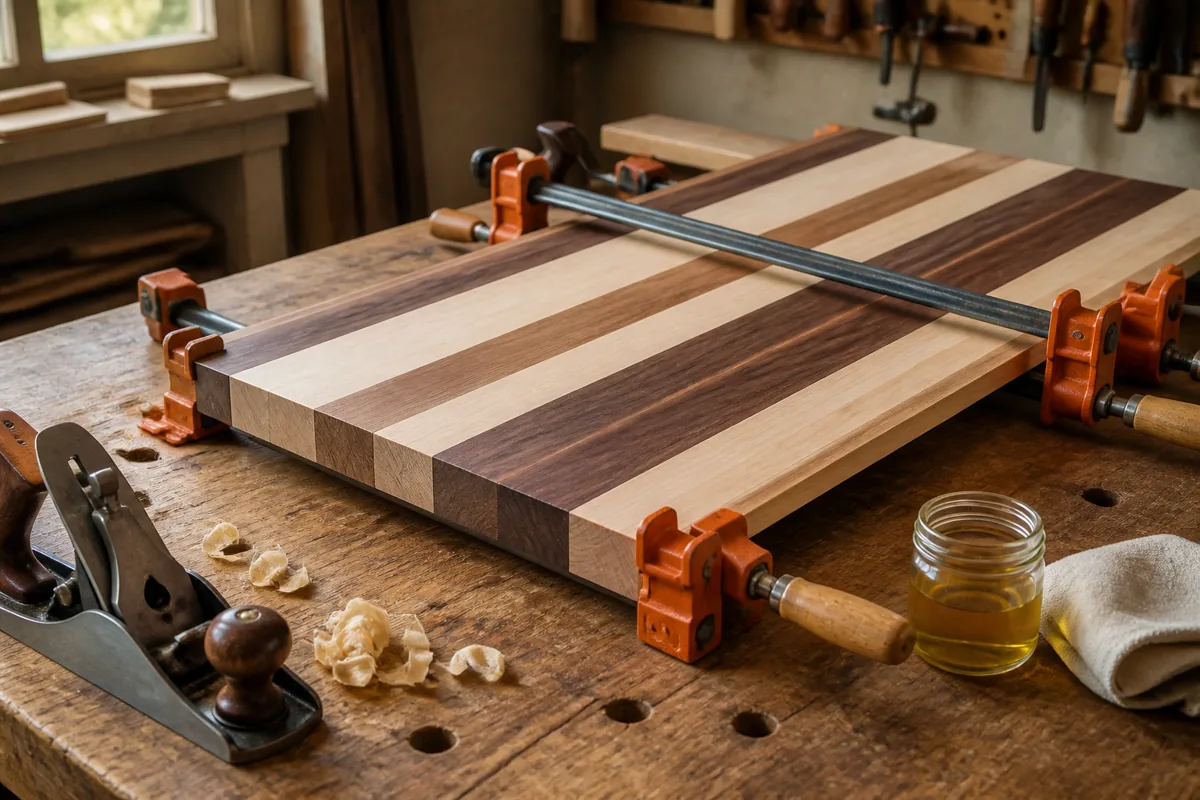
Parallel Clamps vs Pipe Clamps: The Mechanical Difference
A parallel clamp is a heavy rail carrying two jaws whose faces are machined parallel to each other and square to that rail. The sliding jaw rides in a long shoe that resists tipping, so when you load the screw the face stays flat on the work instead of pivoting onto its tip. Every advantage of the type follows from that one idea.
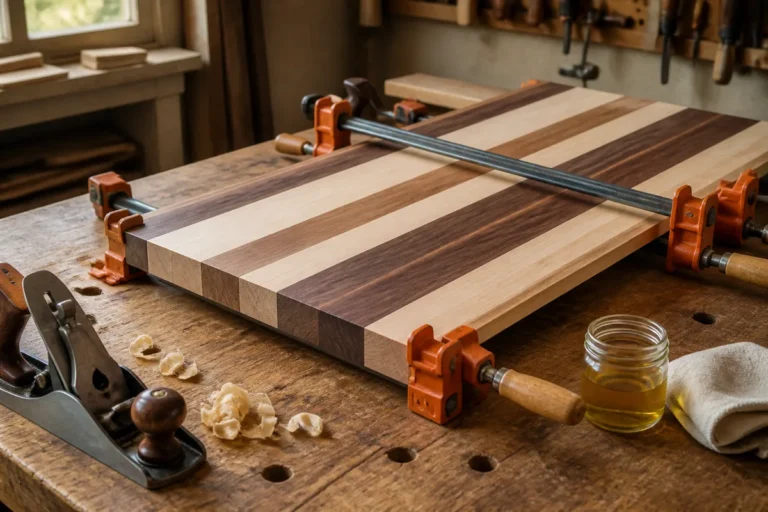
A pipe clamp is a different animal. You buy two cast fixtures, a screw head and a sliding clutch tail, and thread them onto a length of 1/2 in. or 3/4 in. black pipe cut to suit the job. The clutch plates bite the pipe at an angle, which is cheap, clever and good for enormous force. The trade-offs are built in: small pads, a screw axis offset from the pipe centerline, and a round tube that flexes.
Where the force actually goes
Put a 3/4 in. panel in a pipe clamp and the pad sits roughly centered on the edge, which is fine. Put a thick benchtop lamination in the same clamp and the force lands low while the wood above wants to rise. That is a bending couple, and it shows up as the crown you find after the glue cures. A parallel clamp spreads the same load across a jaw face several inches tall, which keeps the resultant nearer the middle of the stock.
Rack, Deflection and Panel Flatness
Racking is the second failure mode and the one that ruins case work. If a jaw can rotate on its bar, the clamp will pull a square assembly into a parallelogram while you chase diagonals. Parallel jaws resist that because they cannot swing without binding in the shoe. Pipe clamps rely on you to alternate them above and below the work and to keep the pipe no longer than the job needs, since a long pipe under load behaves like a spring.
Cauls close most of that gap. A pair of slightly crowned battens across a panel does more for flatness than upgrading clamps, and we would rather see eight pipe clamps with good cauls than four parallel clamps with none. What the premium really buys is repeatability.
Parallel clamps in 24 in. and 36 in.
If you buy only two pairs, make them 24 in. and 36 in. Those cover cabinet doors, face frames, drawer boxes and most small panels. Look for a flat-bottomed rail that stands the clamp up on the bench, replaceable jaw covers, and a handle you can turn with glue on your hands.
Pressure, Reach and Capacity
Pressure is the criterion most people get backwards. A fixture on 3/4 in. pipe generates far more force than a PVA joint can use, and once the seam is closed with even squeeze-out along its length, extra torque only starves the glue line and crushes fiber under the pads. Parallel clamps deliver plenty for edge joints with better feel, which matters on softwood and veneered panels.
Reach is where pipe clamps win outright. Capacity becomes a hardware store decision rather than a catalog decision, and one long stick of pipe spans a benchtop no bar clamp in a normal shop can handle. Couplers will join two lengths, but the coupling is a hinge and a weak point. In the other direction, parallel clamps have far deeper throats and can reach in from an edge to pull a joint inside the assembly, where a pipe clamp pad barely clears the pipe.
Where parallel clamps earn the premium:
- ✔ Jaws stay square, so panels come out flat with less fussing
- ✔ Broad faces spread pressure and bruise softwood less
- ✔ Deep throat reaches in from the edge
- ✔ Stands upright on the bench for one-person glue-ups
And the honest list of pipe clamp annoyances:
- ✘ Small pads tip and mark the work
- ✘ Pipe deflects on long spans and needs cauls
- ✘ Rolls off the bench and pinches fingers
- ✘ Black pipe rusts and stains maple and white oak
Pipe clamp fixtures for 3/4 in. pipe
Fixtures are sold as heads and tails only, so budget for pipe cut and threaded on one end. Choose 3/4 in. over 1/2 in. if panels are your main work, since the larger section deflects noticeably less. Buy in even numbers so you can always alternate above and below a glue-up.
Cost Per Inch and Building the Rack
Clamp math is never about one clamp, it is about how many you can put on a panel at once. Plan roughly one clamp every six to ten inches of glue line, tighter for thin stock or edges that are not perfectly jointed. A long parallel clamp costs several times what a fixture plus pipe costs, so the same money either leaves you short in the middle of a glue-up or gives you enough to do the job properly.
For a shop starting from nothing we would buy pipe clamps first for quantity and length, then parallel clamps in the two lengths you actually use, then F-style clamps for small work. Use black pipe rather than galvanized, since the zinc is slick under the clutch plates and gets chewed up. Wax the pipe to slow the rust that prints onto light woods, and scrape squeeze-out off before it cures.
Pipe clamp pads and stand-off feet
Snap-on pads keep the castings from bruising the work, and stand-off feet lift the pipe off the bench so the clamp stops rolling. Together they cost a fraction of one parallel clamp. Add a set before you decide the clamps themselves need replacing.
Frequently Asked Questions
Do I need parallel clamps if I already own pipe clamps? Not necessarily. If your panels come out flat with cauls and alternating clamps, the system works. Upgrade when squaring case work has become the slowest part of assembly.
Should I buy 1/2 in. or 3/4 in. pipe? Use 3/4 in. for panels, benchtops and casework, because the larger section deflects much less over a long span. Half-inch is lighter and cheaper and fine for short assemblies, repairs and jigs.
Can pipe clamps handle cabinet doors? Yes, with help. Add jaw pads, alternate clamps front and back, and check a diagonal as you tighten. It is slower than reaching for parallel clamps, not worse.
Verdict
On mechanics alone the parallel clamp is the better clamp: square jaws, broad bearing surface, deep throat, and it stands up on the bench while you spread glue. On cost per inch and sheer capability, pipe clamps are the better buy, and nothing matches a length of pipe for reach. The answer is sequence rather than either-or. Build capacity with pipe clamps and cauls, then add parallel clamps in the sizes your work actually demands. A shop with enough clamps of the wrong type still beats a shop with two of the right ones.
Check prices on Amazon →