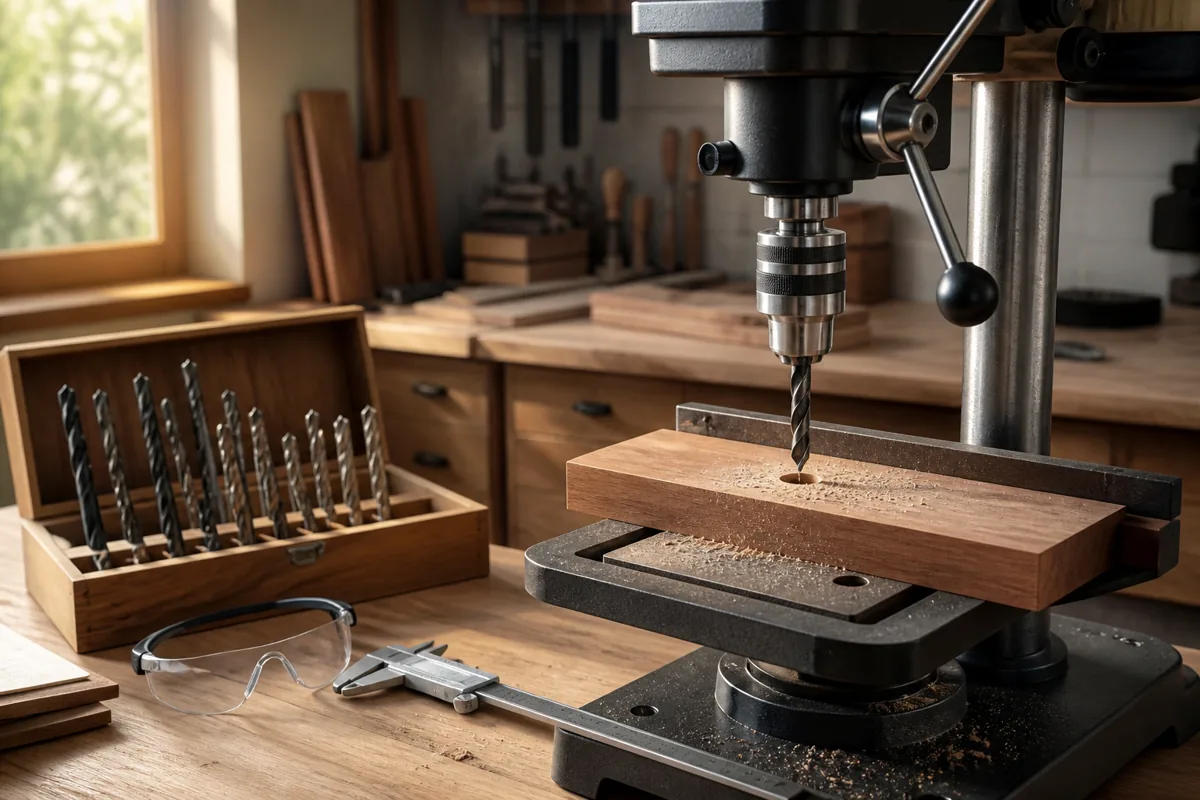
Best Drill Presses for Drilling End Grain Without Wandering
What's inside
As an Amazon Associate I earn from qualifying purchases. This post may contain affiliate links at no extra cost to you.
A drill press can make a clean hole in end grain, but it cannot stop a bit from following the grain by itself. The useful features are a rigid column and table, low spindle runout, a fence or clamping setup that holds the work square, and enough speed range for the bit. For most shops, a well-aligned benchtop press is enough; a floor model mainly earns its space when you need more throat depth, travel, or capacity.
As an Amazon Associate we earn from qualifying purchases at no extra cost to you.

Contents
Why end-grain holes wander
End grain exposes the ends of the wood fibers, which can steer a conventional twist drill off course as it enters. A sharp brad-point bit usually starts more reliably because its center spur locates the hole before the outer spurs cut the rim. A Forstner bit can also produce a flat-bottomed hole, but it needs a stable setup and a slower speed, especially in large diameters. A dull bit, excessive pressure, or a workpiece that shifts can still cause a bad start.
Before buying a press to solve wandering, check the process: mark the center carefully, use a sharp bit, clamp the stock, and feed steadily. For a hole that must be precisely positioned, a drill press is more repeatable than a handheld drill, but the fence, table, and bit choice matter as much as the machine.
What to look for in a drill press
Rigidity and alignment: A heavy base and stout column help resist movement. Check the table for play and verify that it can be squared to the spindle. Spindle runout—the amount the bit wobbles as it turns—can show up as an oversized or ragged hole. If possible, check it with a dial indicator; a small amount is normal, but obvious wobble is a reason to pass.
Speed range: Small bits can run faster than large ones. As a practical starting point, use roughly 2,000–3,000 rpm for bits around 1/8 inch, 500–1,000 rpm for a 1-inch Forstner bit, and about 250–500 rpm for a 2-inch Forstner bit. These are starting ranges, not rules: follow the bit maker’s guidance and slow down if the bit heats, burns, or chatters. A press with several belt-speed settings is less convenient to change than a variable-speed model, but often costs less and works well if you do not switch sizes constantly.
Capacity and travel: Throat depth is the distance from the column to the spindle center; it determines how far from an edge you can drill. Quill travel limits how deep you can drill in one stroke. A 2-inch travel is workable for many furniture and shop tasks, while deeper holes may require repositioning the stock or choosing a press with more travel. A large swing rating does not guarantee a more accurate machine.
Table and hold-downs: A tilting table is useful for angled holes, but it must return square reliably. For end grain, a flat table and a secure fence are often more valuable. A drill press vise, clamps, or a shop-made cradle prevent the work from spinning if the bit catches. Never hold small stock by hand.
Which press type fits the work?
| Type | Best fit | Trade-off |
|---|---|---|
| Basic benchtop press | Small parts, dowel holes, general furniture work | Limited throat depth and often less table area |
| Higher-capacity benchtop press | More reach or larger bits without giving up floor space | Heavier and costlier; stand and mounting need attention |
| Floor-standing press | Frequent deep, large, or awkwardly positioned holes | Higher cost and a larger footprint; not automatically more accurate |
For occasional 1/4- to 3/8-inch holes in end grain, a basic, well-aligned benchtop drill press is usually enough. Spend more only if you need additional throat depth, quill travel, a broader speed range, or a more substantial table. A floor model makes sense when those limits regularly interrupt real work—not just because its size suggests greater precision.
Setup that keeps the bit on center
Lay out the center with a marking knife or a sharp awl rather than relying on a broad pencil mark. The small divot gives a brad-point spur a defined starting place. If the hole must align with a mating part, make a test hole in scrap from the same board or a similar piece. Grain direction and density vary, so a test on different stock is less useful.
Clamp the piece against a fence or stop so the hole location stays fixed, and add a backer board beneath it to reduce breakout at the exit. For narrow or round stock, use a V-block or a purpose-built cradle. Set the table square to the bit for a perpendicular hole, then lower the bit by hand with the machine off to check alignment before switching it on. Do not rely on the table’s angle scale for a critical 90-degree setup.
Start with light feed pressure. If the bit begins to wander, forcing it harder can enlarge the entry or bend a small bit. For a deep hole, withdraw the bit periodically to clear chips; packed chips create heat and can pull the bit off line. Stop if the wood starts to burn or the bit chatters. Forstner bits are particularly prone to heat in deep end-grain holes, so reduce speed and clear chips more often as the hole deepens.
Bits and accessories worth buying
A sharp brad-point set is a sensible first purchase for clean, located holes in wood. Choose a set that covers the sizes you actually use rather than a large assortment of soft bits. Forstner bits are the better choice for wide, flat-bottomed holes, but they require a slower spindle speed, secure clamping, and a press that does not flex under load. Browse brad-point drill-bit sets for everyday holes or Forstner bit sets for larger, flat-bottomed bores.
A fence, clamps, and a backing board often improve results more than an upgrade to a larger motor. A drill press vise is convenient for small parts, but it can lift or twist stock if it is not secured to the table. Check that the vise, fence, and workpiece all sit flat before drilling.
When a drill press is not the answer
If the hole must be centered on a narrow piece and the stock cannot be clamped securely, a drill press may not solve the problem. A guide block or drilling jig can provide better support, while a router jig may be preferable for some large, shallow bores. For occasional small holes, a handheld drill with a rigid guide can be adequate; buying a floor press for that job is hard to justify.
For a stationary woodworking shop, prioritize a press that stays square, holds the work safely, and offers suitable speeds for the bits you use. A modest benchtop machine with a sound setup is often the better buy than a larger press that takes up space but does not improve the accuracy of your process.
