Best Planers for Milling Thick Furniture Components
What's inside
As an Amazon Associate I earn from qualifying purchases. This post may contain affiliate links at no extra cost to you.
Thick furniture parts are a planer problem only up to a point. A benchtop machine may handle a chunky leg or breadboard end, but its width, cutterhead, and infeed and outfeed support can limit the work before thickness does. For larger stock, a stationary floor planer offers more capacity and stability. The right choice depends on the widest part you need to surface, how often you’ll use the machine, and whether you need a finished face or just consistent thickness.
As an Amazon Associate we earn from qualifying purchases at no extra cost to you.


Contents
Start with the workpiece
Check the maximum width and thickness of your actual parts, not just the lumber you usually buy. Many benchtop planers accept stock around 12 to 13 inches wide; larger floor machines commonly handle 15 inches or more. Maximum thickness varies, too, so confirm the machine’s capacity against your design and any thick stock you expect to process later.
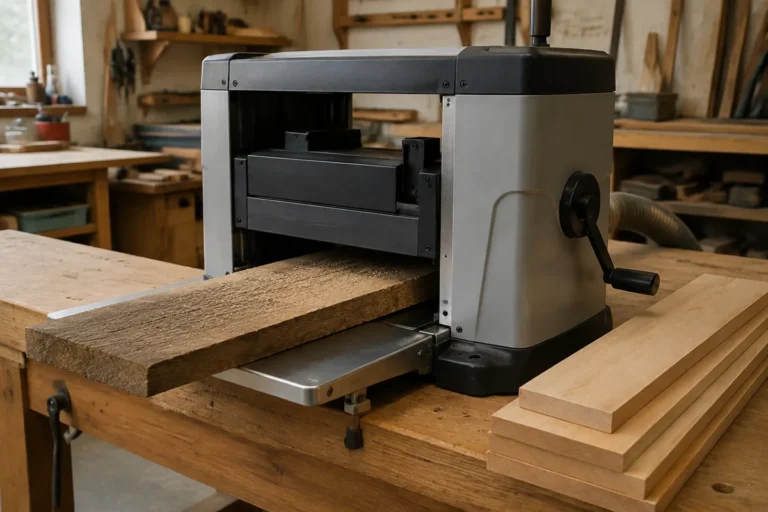
Capacity is not the same as a usable setup. A long tabletop and solid infeed and outfeed support help control heavy boards, which can weigh dozens of pounds. Without support, a board can tip as it enters or leaves the cutterhead, producing a dip or snipe near its ends. A roller stand or helper can reduce the problem, but neither substitutes for a stable, level setup.
Benchtop or floor model?
A benchtop planer is a reasonable buy for occasional furniture work, a small shop, or parts that fit within its width limit. It costs less and is easier to move. The trade-offs are a smaller cutting capacity, a lighter frame, and often more noise. Light machines may also shift or vibrate if placed on an inadequate stand.
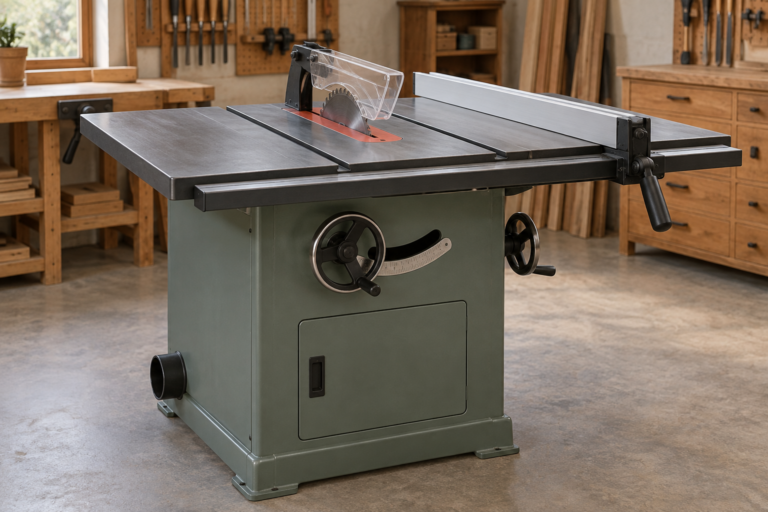
A floor planer is worth considering if you regularly process wide panels, thick slabs, or batches of furniture parts. Its mass and longer support surfaces can make feeding more controlled. It takes up more room, costs more, and may need a dedicated electrical circuit. Verify the voltage and amperage requirements before buying, particularly for larger machines; a machine that requires 220-volt power is not a simple plug-in replacement for a benchtop unit.
Compare the options
| Type | Best fit | Main trade-off | Check before buying |
|---|---|---|---|
| Benchtop, roughly 12–13 in. capacity | Occasional work and narrower parts | Limited width and lighter support | Maximum thickness, stand, and dust collection |
| Floor planer, roughly 15 in. or wider | Regular furniture work and wider stock | Higher cost, weight, and space needs | Power supply, cutterhead type, and service access |
| Wide-capacity industrial planer | Production shops and very wide components | High purchase and installation cost | Floor space, electrical requirements, and dust system capacity |
For a first planer, compare 13-inch benchtop planers with the width of your largest parts. If those parts exceed the machine’s capacity, moving the stock through at an angle is not a dependable workaround: it can leave uneven edges and does not increase the cutterhead width.
Cutterheads and surface quality
Straight-knife cutterheads are common and often cost less up front. They can leave visible ridges, especially in figured grain, and require sharpening or replacement when the knives dull or get nicked. A single damaged knife can leave a repeating line down the board, so inspect the surface before assuming the wood itself is the problem.
Helical or segmented cutterheads use multiple small inserts. They typically cost more, but a chipped insert can often be rotated or replaced individually. Their cutting action may leave a smoother surface on difficult grain, though they do not eliminate tearout, snipe, or the need for sanding. If the surface is rough, check grain direction, sharpness, feed rate, and cut depth before treating a cutterhead upgrade as the solution.
Thickness thick stock without trouble
A planer makes one face parallel to the opposite face. It does not reliably flatten a twisted, cupped, or bowed board on its own. Flatten one face first with a jointer, a sled on a suitable machine, or hand tools; then plane the other face parallel. Feeding distorted stock directly can preserve the distortion or make a bad cut worse.
Take light cuts when stock is wide, hard, or figured. A cut of around 1/16 inch is a sensible starting point; reduce it if the motor strains, the board chatters, or the surface tears. Follow the machine’s manual for maximum cut depth and feed speed, since limits vary. For a glue-up, plane all matching parts to the same final thickness and check them with calipers or a reliable gauge rather than trusting the height scale alone.
Very thick stock can also exceed the opening height or become awkward to handle safely. Never force a board through a stalled or overloaded planer. Disconnect power before clearing a jam, keep hands away from the infeed and outfeed openings, and use an assistant or support equipment for heavy pieces.
Buying checklist for a furniture shop
Choose capacity with a little room beyond your common part width, but do not pay for an industrial machine if your work fits a smaller one. Compare the cost of knives or inserts, available replacement parts, and how easily the cutterhead can be serviced. Check whether the planer includes a stand or whether you need a rigid bench, and plan dust collection: planers produce a large volume of chips quickly. A small shop vacuum may clog or struggle; check the manufacturer’s dust-port size and collection recommendations.
If you make wide or thick furniture components often, a 15-inch floor planer may be a better long-term fit than replacing a smaller machine later. For occasional narrow parts, a benchtop planer with a segmented cutterhead can be a practical compromise if its width and thickness ratings cover your work. Confirm the listed capacity, electrical supply, and support requirements before ordering; the name of a product category is not a substitute for checking the specifications.