Best Planers for Quiet Operation in an Attached Workshop
What's inside
As an Amazon Associate I earn from qualifying purchases. This post may contain affiliate links at no extra cost to you.
Contents
What “quiet” means with a planer
A thickness planer is rarely a quiet machine. The cutterhead, motor, and boards moving over the bed all make noise; a shop vacuum or dust collector adds more. In an attached workshop, the useful question is not whether a planer is quiet, but how much sound it sends into the house and whether you can reduce it without compromising safe operation.
Decibels are logarithmic: a 10 dB increase is generally perceived as roughly twice as loud. Published noise figures are difficult to compare because manufacturers may test at different distances and under different conditions. Treat them as a rough clue, not a guarantee. If possible, listen to the planer running, and include the dust collector in the test.
As an Amazon Associate we earn from qualifying purchases at no extra cost to you.

Choose the cutterhead for your work
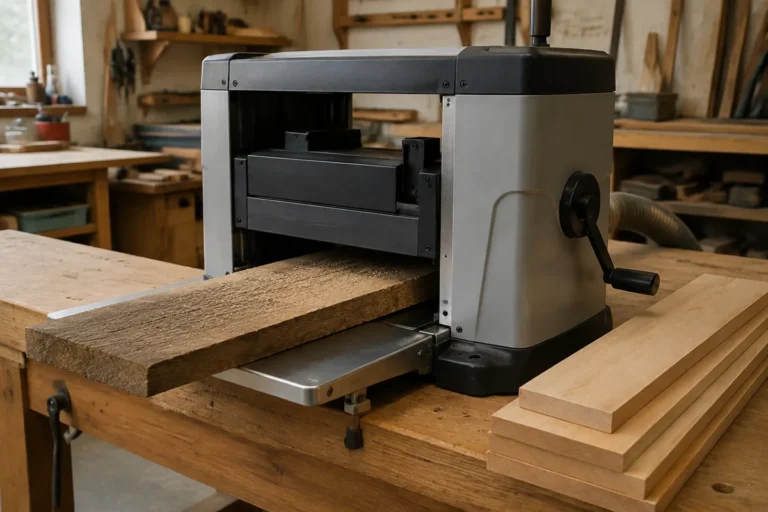
For occasional work with common softwoods and hardwoods, a portable two-knife planer is often the sensible, lower-cost choice. Its knives are inexpensive to replace or sharpen, but the high-speed straight knives can make a sharp, tiring sound. Expect more tear-out in reversing or figured grain, especially with a heavy cut.
A helical or segmented cutterhead uses many small inserts rather than two long knives. It often produces a less harsh sound and leaves a smoother surface on difficult grain. The inserts can be rotated when an edge dulls, but they cost more than resharpening straight knives. “Helical” does not mean silent: the motor and material feed still make substantial noise.
If the quieter cutting character and reduced tear-out matter enough to justify the premium, compare helical-head thickness planers. For a tighter budget or occasional surfacing, a two-knife benchtop planer can do the job; budget for hearing protection and careful scheduling.
Compare the main options
| Planer type | Noise and finish | Best fit | Main trade-off |
|---|---|---|---|
| Benchtop, straight knives | Often sharp-sounding; more prone to tear-out on figured grain | Small shops, occasional use, limited budget | Shorter capacity and more knife maintenance |
| Benchtop, segmented cutterhead | Often less harsh; generally handles difficult grain better | Frequent hobby use where sound quality matters | Higher purchase price and insert cost |
| Floor-standing planer | Can be quieter in use, but size alone does not ensure it | Regular work, wider stock, a dedicated shop | Cost, space, electrical needs, and dust collection |
Compare cutting width and maximum stock thickness as well as cutterhead type. A nominal 12- or 13-inch benchtop machine suits most furniture parts, while wider work may call for a floor-standing planer. Check the actual feed rate and motor requirements in the manual; do not assume a larger machine can run on an existing circuit.
Reduce noise reaching the house
Sound travels through both air and structure. A planer bolted to a lightweight bench can shake the bench, floor, and shared wall. Put the machine on a rigid, level stand; tighten fasteners; and use vibration-isolating feet only if they keep the stand stable under long boards. A wobbly machine is not a noise-control solution.
Seal gaps around doors and openings, and add a solid-core door with weatherstripping if the existing doorway leaks sound. Soft insulation inside a wall may reduce some airborne noise, but it will not stop vibration passing through joists or a shared floor. Avoid boxing in the planer without enough clearance and ventilation: enclosed motors can overheat, and dust still needs a safe route out.
A dust collector can be as loud as the planer. Place it as far from the shared wall as practical, use properly sized ducting, and avoid restrictive bends that hurt airflow. A remote switch or a suitable muffler can help, but check that any muffler does not reduce the collector’s performance. Never run a planer without dust collection; chips can clog the machine and create a cleanup and fire hazard.
Use the machine in a way that limits the racket
Take modest cuts. Removing around 1/16 inch per pass is a practical starting point for many benchtop planers; dense hardwood or a small machine may need less. Heavy cuts strain the motor, increase the chance of snipe or tear-out, and can make the machine sound rougher. Keep knives or inserts in good condition: dull edges demand more effort and often leave a poorer surface.
Support long boards at the planer’s infeed and outfeed height. A board that drops or lifts can chatter, mark the surface, or pull the operator off balance. Feed stock flat, remove loose hardware, and do not plane wood with nails, screws, or embedded grit. Use hearing protection even for short sessions; attached-room location does not make hazardous noise safer.
A practical buying decision
For a shared-wall shop used a few times a month, a well-supported benchtop planer with straight knives is usually adequate. Spend first on stable mounting, hearing protection, and effective dust collection rather than buying the largest machine. If you plane regularly, work with figured hardwood, or find the high-pitched cutter sound especially troublesome, a segmented-head planer is a reasonable upgrade—but arrange a real-world listening test before paying extra.
For frequent wide-stock work, a floor-standing machine may be worth the space and electrical work. Compare actual noise under load, cutterhead replacement costs, dust-port requirements, and whether the machine fits through the shop door. The best choice is the one that handles your stock cleanly while keeping vibration, dust, and operating noise manageable in the room next door.