How to Choose Planer Table Length for Long Boards
What's inside
As an Amazon Associate I earn from qualifying purchases. This post may contain affiliate links at no extra cost to you.
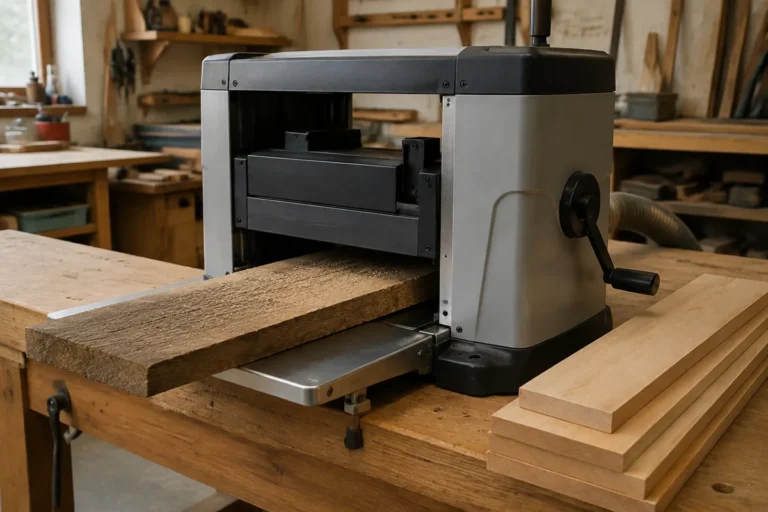
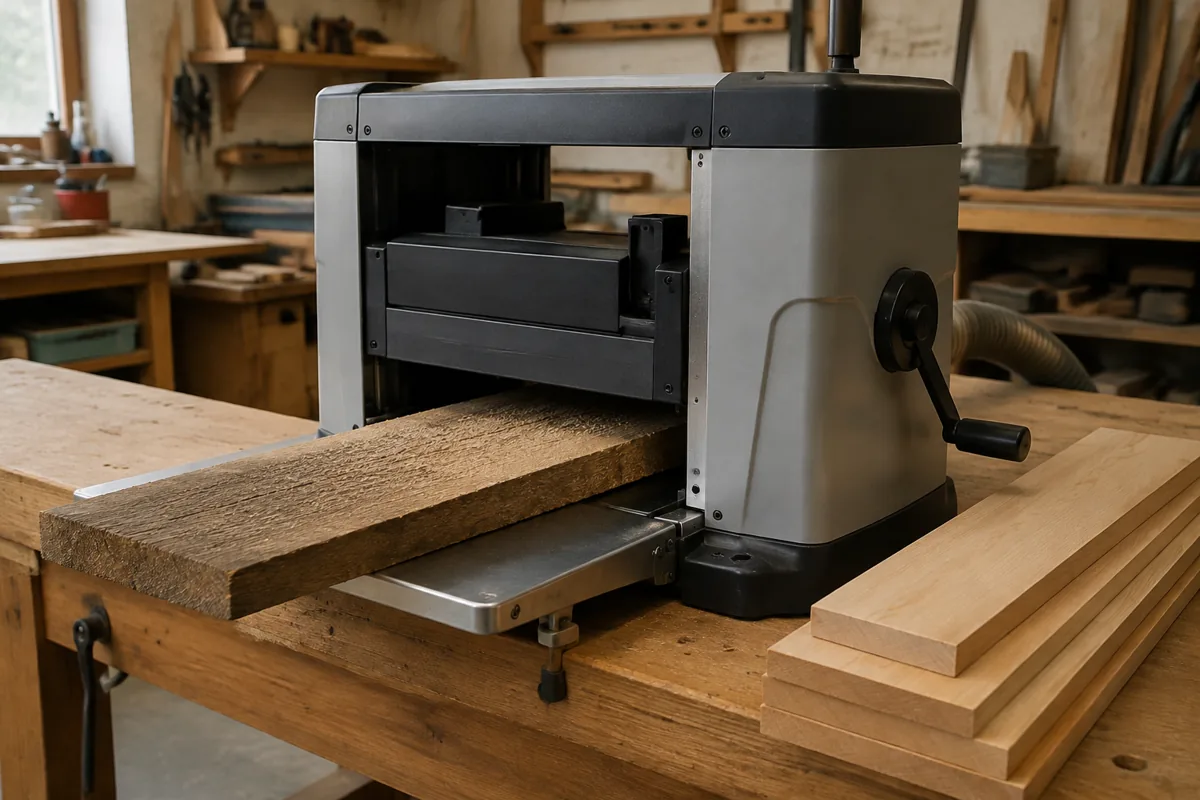
When a board is longer than your planer’s bed, the machine can still produce a straight, consistent thickness—but only if the board is supported correctly. The table length determines how much of the workpiece is controlled by the planer before and after the cutter head. Choose too little support and long boards will tip, lift, or dive as they enter and leave the machine.
Contents
Why Planer Table Length Matters
A thickness planer references the board against its bed and cutter head, but the board is not fully supported throughout the cut. As the leading end approaches the cutter, it may rise slightly. As the trailing end leaves the cutter, it may drop. These movements create two common defects:
- Snipe: A thinner section at the first or last few inches of the board.
- Uneven thickness: The board dips or climbs during the cut, producing a tapered or inconsistent result.
The longer the board, the more leverage it has against the planer. A 3-foot board may be manageable with modest extensions. An 8-foot board can act like a lever, especially when the operator is feeding it alone or the outfeed support is too low.
Table length is not the same as total support length. A planer with a 20-inch bed may work well with an additional 4 feet of properly aligned roller or folding support. Think of the machine table as the center of a support system, not the only surface carrying the board.
Measure Your Typical Stock
Start with the longest and heaviest boards you expect to plane regularly. Include rough lumber, not just finished project parts. A 6-foot board is easy to handle differently from a 10-foot board, and wet or dense hardwood can require more support than its length alone suggests.
For most workshop decisions, use these practical targets:
| Typical board length | Useful minimum planer bed | Recommended total support length | Best setup |
|---|---|---|---|
| Under 4 feet | 18–20 inches | About 4 feet | Built-in tables or one small support stand |
| 4–6 feet | 20–24 inches | 6–8 feet | Folding extensions or two stands |
| 6–8 feet | 24 inches or more | 8–10 feet | Stable infeed and outfeed tables |
| 8–12 feet | 24–30 inches | 10–14 feet | Long, rigid supports and a second operator when needed |
These are working guidelines, not guarantees. A rigid 1×8 pine board is easier to control than a flexible 2×12 hardwood board. A planer with a short bed can handle long stock, but it demands better support and more careful feeding.
Bed Length Versus Extension Tables
A longer built-in bed is convenient because it requires less setup and usually gives the board a smoother transition into the cutter head. It also reduces the chance that a folding extension is slightly out of alignment. If you regularly plane boards longer than 6 feet, a model with longer folding tables is worth considering. Compare thickness planers with long tables rather than looking only at maximum cutting width.
Short-bed benchtop planers are often the better value for occasional use. Their tables fold for storage, replacement parts are generally available, and the lower cost leaves room for proper support equipment. The trade-off is that you must set the extensions carefully every time they are used.
For most machines, the extensions should be level with the planer bed or just a fraction higher at the free end. If an extension slopes downward, the board can dive into the cutter. If it slopes upward too much, it can lift the board into the knives or make feeding difficult. Check the setup with a straightedge rather than trusting the stamped scale or a quick visual check.
How to Support Long Boards
Place support on both sides of the planer. Infeed support controls the board before it reaches the cutter; outfeed support prevents the trailing end from dropping. As a basic rule, support should reach at least half the board length beyond the planer when the board is centered on the machine.
For an 8-foot board, that does not mean you need an 8-foot table on each side. A planer centered between two 4-foot supports provides roughly the needed reach, provided the board remains straight and the stands do not move. Adjustable adjustable woodworking roller stands work for many shops, but their rollers can allow a board to drift sideways. Wide, flat support tables provide better control for rough or cupped stock.
Roller stands should be stable, locked at the correct height, and positioned close enough that the board cannot sag between supports. For heavy hardwood, use a pair of stands on each side or a continuous outfeed table. A single narrow stand may twist a wide board and create a diagonal feed.
Account for Snipe and Board Handling
Even with a long table, some planers produce snipe because the feed rollers release the board too early or engage it too late. Leave at least 6 inches of waste at each end when the part length allows. You can cut the finished part from the center section after planing.
Another option is to feed several boards end-to-end. The next board helps keep the feed rollers engaged as the previous one exits. This can reduce snipe, but only when the boards have square ends and are pushed together without forcing them. Do not use this method if boards can collide, shift sideways, or enter at different heights.
Before buying, check whether the planer has table extensions, extension-table length, and an available stand. A floor stand can put the machine at a comfortable height, while a low benchtop position may require improvised supports. Browse planer stands with infeed and outfeed support if floor space and setup time matter more than portability.
Choose the Right Size for Your Shop
Buy the longer-bed planer if you regularly process long, heavy boards and have room to leave support tables in place. The improved control is valuable when working alone. Choose a compact planer if most stock is under 6 feet, you store the machine between uses, or you are willing to leave extra material for trimming.
Do not solve a support problem by buying a wider cutter head alone. A 13-inch planer can accept wider boards, but width does not prevent the leading or trailing end from tipping. For long boards, a properly aligned support system matters at least as much as an extra inch of capacity.