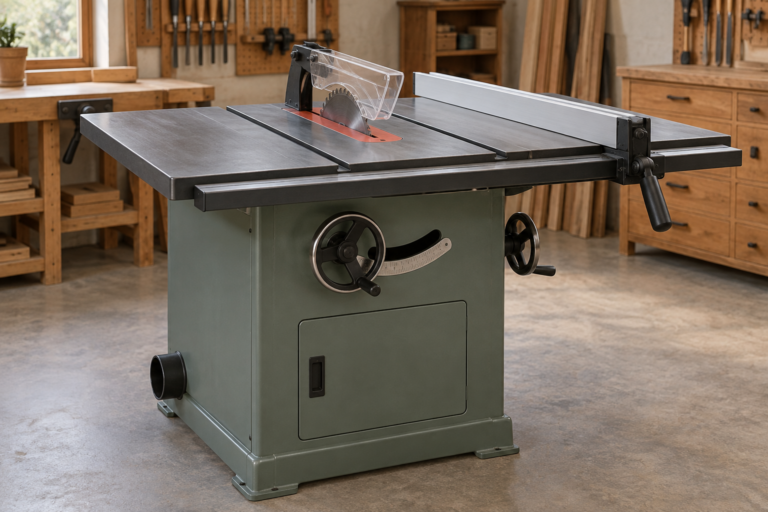
Best Table Saws with 3-HP Motors for Small Professional Shops
What's inside
As an Amazon Associate I earn from qualifying purchases. This post may contain affiliate links at no extra cost to you.
A 3-HP table saw is a practical step up for a small professional shop that regularly cuts thick hardwood, wide stock, or full sheets. It is not automatically the best choice: the saw usually needs 230-volt power, takes up more room than a jobsite machine, and costs more to install and maintain. The right buy depends on your work, available electrical service, and whether you need cabinet-saw mass or a more mobile setup.
As an Amazon Associate we earn from qualifying purchases at no extra cost to you.


Contents
What three horsepower means in practice
Compared with a typical 1¾-HP contractor or hybrid saw, a 3-HP motor is less likely to bog down in thick hardwood when the blade is sharp and the feed rate is sensible. That reserve is useful for repeated ripping, especially in dense species such as hard maple or white oak. It does not make a dull blade safe or turn a modest saw into a production line machine.
Most 3-HP saws run on 230 volts. Before shopping, check your panel, the planned outlet location, and the motor’s nameplate requirements. A licensed electrician may need to add a dedicated circuit; do not assume a standard 120-volt shop outlet will run the saw. Also check the manufacturer’s instructions for circuit and overcurrent requirements, since they vary.
Choose a saw type before comparing features
A cabinet saw is the usual fit for a permanent professional shop. Its heavy base helps resist vibration, the enclosed cabinet collects dust more effectively than an open stand, and the trunnion and table are designed for stationary use. The trade-off is weight: moving one may require machinery skates, a pallet jack, or help.
A 3-HP hybrid or contractor-style saw can cost less and may be easier to move. That can be a sensible compromise in a rented or space-limited shop, provided the fence, arbor, alignment, and dust collection meet the demands of your work. Do not buy by motor rating alone. A poorly aligned saw with a flexing fence is not an upgrade just because its motor says 3 HP.
For most small shops, start by comparing 3-HP cabinet table saws with lower-cost 3-HP hybrid table saws. Confirm each saw’s voltage, included fence, blade guard, riving knife, and dust port before treating it as a candidate.
Compare the main options
| Option | Best fit | Main advantage | Trade-off |
|---|---|---|---|
| 3-HP cabinet saw | Permanent professional shop; frequent hardwood ripping | Mass, stable table, enclosed dust collection | High purchase and installation cost; difficult to relocate |
| 3-HP hybrid saw | Smaller shop needing more power without a full cabinet footprint | Lower cost and often easier placement | May have less mass, storage, or dust control |
| 1¾-HP saw | Occasional cutting, thinner stock, limited 230-volt service | Lower price and simpler electrical setup | Less reserve for sustained heavy ripping |
Features worth paying attention to
The fence matters as much as the motor. Look for a locking mechanism that stays parallel to the blade and a rail system that supports the rip capacity you actually use. A long fence can help break down sheet goods, but only if you have room to store and operate the saw. Measure the distance from the blade to the wall and leave room for infeed and outfeed support.
Check the safety equipment and adjustment controls. A riving knife that stays in place for common cuts is more useful than one that is awkward to remove and reinstall. Make sure the guard fits your typical stock and that blade-height and tilt adjustments move smoothly. If the machine uses a belt drive, inspect the access and tensioning arrangement; routine belt work should not require a major teardown.
Dust collection is a system, not a port size. A cabinet saw connected to an appropriately sized collector generally contains dust better than an open-base machine, but poor duct layout or a weak collector can still leave debris around the blade. Confirm the port diameter and your collector’s airflow needs rather than assuming a shop vacuum is enough for sustained use.
When a cheaper saw is enough
A 1¾-HP saw can be the better buy if your work is mostly plywood, softwood, or hardwood under about 1½ inches thick, and you make cuts intermittently rather than running long ripping sessions. Use a sharp, suitable blade, avoid forcing the feed, and let the motor recover if it slows. A 3-HP saw will not compensate for an undersized circuit, bad alignment, or a blade that is loaded with pitch.
Consider a 3-HP upgrade when a smaller saw repeatedly slows under normal feed pressure, trips protection, or struggles with the thickness and species you cut every week. Those symptoms can also point to a dull blade, poor alignment, or electrical trouble, so diagnose those before replacing a machine.
Checks before buying
Ask whether delivery includes placement or only curbside drop-off; cabinet saws can weigh several hundred pounds. Measure doorways, stairs, and the final footprint, including fence rails. Budget for the electrical work, dust collection, blades, and mobile base or handling equipment if needed. For an existing machine, inspect the table for damage, test the fence lock, check arbor runout and blade alignment, and listen for bearing noise. A low price is not a bargain if correcting wear and alignment erases the savings.
Buy the 3-HP cabinet saw if the machine will stay put and heavy ripping is routine. Choose a hybrid when budget and footprint matter more than maximum mass. If those demanding cuts are occasional, keep the cheaper saw and spend first on a good blade, accurate setup, and safe stock support.