Best Belt Wood Sanders for Fast Stock Removal and Flattening
What's inside
- Best Belt Wood Sanders for Fast Stock Removal and Flattening
- Handheld or stationary: the decision in one minute
- What to look for in a belt wood sander
- Handheld belt sanders: best for boards and rapid removal
- Stationary belt sanders: best for repeatability and small parts
- Dust collection, tracking, and control matter more than they look
- A practical sanding setup that prevents wasted wood
- Ownership costs and common failure points
- Final buying recommendation
- Best Belt Wood Sanders for Fast Stock Removal and Flattening
- Handheld or stationary: the decision in one minute
- What to look for in a belt wood sander
- Handheld belt sanders: best for boards and rapid removal
- Stationary belt sanders: best for repeatability and small parts
- Dust collection, tracking, and control matter more than they look
- A practical sanding setup that prevents wasted wood
- Ownership costs and common failure points
- Final buying recommendation
As an Amazon Associate I earn from qualifying purchases. This post may contain affiliate links at no extra cost to you.
Contents
- Best Belt Wood Sanders for Fast Stock Removal and Flattening
- Handheld or stationary: the decision in one minute
- What to look for in a belt wood sander
- Handheld belt sanders: best for boards and rapid removal
- Stationary belt sanders: best for repeatability and small parts
- Dust collection, tracking, and control matter more than they look
- A practical sanding setup that prevents wasted wood
- Ownership costs and common failure points
- Final buying recommendation
Best Belt Wood Sanders for Fast Stock Removal and Flattening
The best belt wood sander depends on the job: choose a handheld model for boards, edges, and occasional flattening, or a stationary belt sander for repeatable shaping, small parts, and controlled stock removal at a bench.
Handheld or stationary: the decision in one minute
| Situation | Best choice | Why |
|---|---|---|
| Flattening a tabletop or wide board | Handheld 3 x 21-inch sander | Its long belt covers more surface and the tool can move across large workpieces. |
| Small shop with limited bench space | Handheld 3 x 18-inch sander | It stores easily and handles general-purpose sanding without a permanent setup. |
| Small parts, curves, and end-grain shaping | Stationary 1 x 30-inch belt sander | The exposed belt gives better visibility and leaves both hands available to guide the work. |
| Frequent joinery or cabinet work | Stationary 4 x 24-inch or combination belt-disc sander | A wider platform supports repeatable shaping and longer sanding sessions. |
| Occasional DIY use on a tight budget | Basic corded handheld model | It offers the most removal per dollar without requiring a dedicated stand. |
| Long sessions where mobility matters | Corded handheld model with a dust port | Battery runtime is rarely the limiting factor; continuous power and a lighter tool are usually more useful. |
What to look for in a belt wood sander
Belt size determines coverage and handling
Common handheld sizes include 3 x 18 inches and 3 x 21 inches. A 3 x 18-inch belt is easier to control and generally suits furniture parts, doors, and shorter boards. A 3 x 21-inch belt spans more area per pass and is the better handheld format for flattening long boards, but its extra length and weight can make it less comfortable overhead.
As an Amazon Associate we earn from qualifying purchases at no extra cost to you.


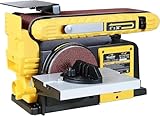
Stationary machines commonly use 1 x 30-inch, 2 x 42-inch, or 4 x 24-inch belts. Narrow belts reach tighter contours and are useful for model making, knife handles, and small joinery. Wider belts remove material faster and provide a flatter reference surface, but they need more bench area and cost more to equip.
Speed is useful only when it is controllable
Most corded handheld sanders run their belts at roughly 800 to 1,500 surface feet per minute (SFPM), while some stationary machines run from about 1,500 to 4,500 SFPM. Higher speed can improve removal on ordinary softwood, but it also creates heat, clogs abrasive faster, and makes mistakes more costly.
A variable-speed control is valuable when sanding resinous wood, thin stock, end grain, or heat-sensitive finishes. For rough flattening, high speed can save time. For final leveling or delicate edges, a slower setting gives you more reaction time and reduces the chance of digging a hollow into the workpiece.
Motor power affects sustained removal
Handheld corded models commonly fall between 6 and 12 amps. Amperage is not a complete measure of performance, but a stronger motor is less likely to bog down when you keep steady pressure on a coarse belt. For occasional household work, a 6- to 8-amp tool is usually sufficient. Frequent stock removal favors roughly 9 to 12 amps.
Stationary sanders are often rated from about 0.5 to 1.5 horsepower. A half-horsepower machine can shape small parts effectively; a one-horsepower or larger unit is better suited to wider pieces and repeated use. Avoid judging by motor size alone: a rigid platen, accurate tracking, and a stable table often matter more than a higher headline rating.
Handheld belt sanders: best for boards and rapid removal
A handheld belt sander is the practical choice when the workpiece is larger than the machine or when you need to move the tool rather than the stock. It excels at removing mill marks, leveling glued-up panels, shortening doors, and correcting a proud joint before finer sanding.
Prioritize a flat base, a front handle that can be repositioned, a long power cord, and a tracking adjustment that stays put. A flat top or clamping provision can also allow upside-down mounting for occasional stationary-style work, although an improvised setup should never defeat the tool’s guards or leave the belt exposed in an unsafe way.
The main limitation is control. A handheld sander can remove a surprising amount of wood in seconds. Tilting it at the beginning or end of a pass creates a shallow dip, and lingering near an edge can round it over. Models with a lower center of gravity and a clearly visible belt edge are easier to keep level.
Stationary belt sanders: best for repeatability and small parts
A stationary belt sander holds the abrasive in a fixed position, so you bring the work to the belt. This is faster and more precise for shaping tenon shoulders, flattening narrow pieces, smoothing curves, and refining end grain. A tilting table expands its usefulness, particularly for bevels and angled parts.
Look for a rigid work table, positive table locks, a replaceable platen, reliable belt tracking, and accessible dust extraction. Combination belt-and-disc models add a disc for end grain and small edges, but the disc can produce more localized burning if the work is held in one spot.
Stationary machines require a stable base. A lightweight unit that shifts under pressure is difficult to use accurately, even if its motor is adequate. If your bench is crowded, measure the machine’s footprint and the clearance needed to feed work safely—not just the published dimensions.
Dust collection, tracking, and control matter more than they look
- Dust collection: A 1 1/4-inch or 2 1/2-inch port can connect to different extraction systems, but port size alone does not guarantee effective capture. A tight hood, short hose, and strong airflow reduce airborne dust and keep abrasive from loading. Wear suitable eye and respiratory protection even when extraction is connected.
- Tracking: The belt should remain centered without constant correction. A tracking knob that responds gradually is easier to tune than one that moves the belt abruptly. Check tracking with the tool running free, then recheck after installing a different belt.
- Platen rigidity: On a stationary machine, a stiff platen keeps the belt flat. A flexible or worn platen can make supposedly straight edges slightly convex.
- Variable speed: It adds control for resinous wood, finishes, plastics, and fine abrasives. It is less important if the tool will only rough-sand ordinary construction lumber.
- Lock-on operation: Useful for a stationary setup, but the switch must be easy to reach and the tool must have a safe, stable mounting method approved by its manufacturer.
A practical sanding setup that prevents wasted wood
- Secure the workpiece. Clamp it so the belt cannot pull it forward. Support long boards close to the sanding area to prevent vibration.
- Mark the surface. Draw a light crosshatch with pencil. Sand until the marks disappear evenly; this reveals low spots better than relying on appearance alone.
- Start with a suitable grit. Use 40 or 60 grit for major removal, 80 grit for leveling and preparation, and 100 to 120 grit for a transition to random-orbit sanding. Starting too fine increases heat and slows the job.
- Let the abrasive cut. Use moderate pressure and a steady feed. Heavy pressure loads the belt, strains the motor, and can leave uneven tracks.
- Keep the tool moving. On a handheld unit, begin with the base flat, move at a consistent pace, and lift only after the belt clears the work. Do not pivot on one corner.
- Change direction between grits. Lightly sanding across the previous scratch direction makes remaining deep scratches easier to see.
- Finish with a finer tool. A belt sander is for removal and leveling, not usually for the final furniture-ready surface. Follow with a random-orbit sander or hand sanding as appropriate.
Ownership costs and common failure points
A belt sander’s purchase price is only part of its cost. Replacement belts commonly range from about $3 to $12 each, depending on size, backing, abrasive material, and premium ceramic or zirconia grain. A simple calculation helps: if a $10 belt lasts through four substantial projects, its abrasive cost is about $2.50 per project. For occasional use, that is often more significant than small differences in motor power.
The belt is usually the first consumable to wear. Expect reduced cutting, glazing, heat, or visible loading before the belt appears completely damaged. Belts used on painted or gummy wood wear faster. Never force a dull belt to compensate; the added pressure can overheat bearings and the workpiece.
Keep the sanding area clean, blow or vacuum dust from cooling vents, and inspect the drive rollers and tracking mechanism periodically. Unplug the tool before clearing a clogged port or changing a belt. On stationary models, check table alignment and fasteners after moving the machine.
Common mistakes include fitting the belt backward, using excessive pressure, sanding across loose knots, ignoring a wandering belt, and expecting a coarse belt to leave a finish-ready surface. Match the abrasive to the task, and replace a belt that has torn edges or exposed backing.
Final buying recommendation
Choose a 3 x 21-inch handheld belt wood sander if you need the fastest versatile option for boards and panels. Choose a smaller 3 x 18-inch model when weight, storage, and occasional use matter more than maximum coverage. Choose a stationary 1 x 30-inch machine for small-part shaping and curves, or a wider 2 x 42-inch or 4 x 24-inch machine when repeatability and sustained removal justify dedicated space.
Whichever format you select, prioritize stable tracking, a usable dust port, manageable weight, and a controllable sanding speed. Those features determine whether the tool removes stock quickly while preserving a flat, predictable surface.