Best Miniature Sanders for Small Woodworking Projects
What's inside
As an Amazon Associate I earn from qualifying purchases. This post may contain affiliate links at no extra cost to you.
Contents
Best Miniature Sanders for Small Woodworking Projects
The best miniature sander for most small woodworking projects is a low-vibration detail sander with a pad of about 90–140 cm²; choose a pen-style 12V sander for models and tight recesses, a compact cordless detail sander for portability, or a corded palm sander for longer sessions and lower running cost.
Small sanders are not simply full-size tools made smaller. Pad shape, sanding speed, grip diameter, and access around delicate parts matter more than maximum power. A large triangular detail sander may remove material quickly on a cabinet corner but remain awkward inside a model boat, while a narrow pen sander can reach a recess yet take much longer on a tabletop.
As an Amazon Associate we earn from qualifying purchases at no extra cost to you.


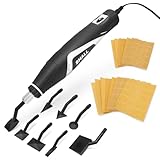

Quick comparison of miniature sanders
| Tool or type | Pad or sanding area | Power | Approx. weight | Best use | Main limitation |
|---|---|---|---|---|---|
| Proxxon PS 13 Pen Sander | Approx. 13 × 13 mm contact face | 12V corded | About 0.5 kg | Models, carved details, narrow slots | Slow on broad surfaces |
| Black+Decker Mouse BDEMS600 | About 140 cm² triangular pad | 120V corded | About 0.9 kg | Edges, corners, craft furniture | Dust collection is basic |
| Bosch PSM 100 A | About 104 cm² triangular pad | 220–240V corded, regional model | About 0.9 kg | General small-shop detail sanding | Requires a nearby outlet |
| Makita BO4565 | Approx. 112 × 102 mm base | 200W corded, regional model | About 1.1 kg | Frequent trim and small furniture work | Less suitable for delicate models |
| Compact 12V cordless detail sander | Usually 90–140 cm² | 10.8–12V battery | About 0.8–1.3 kg with battery | Portable repairs and occasional crafts | Battery and charger add cost |
Dimensions and weights can vary by market, battery, dust box, and included accessories. Treat the table as a buying comparison rather than a substitute for the specification sheet for the exact regional model.
Which miniature sander fits your project?
For scale models and fragile craft parts: choose a pen-style sander
The Proxxon PS 13 is closer to a powered sanding file than to a conventional palm sander. Its small rectangular sanding face can work around window openings, joints, figurines, thin plywood bulkheads, and other areas where a triangular pad would strike neighboring details. Its 12V corded design avoids the extra weight of a large battery.
A pen sander is particularly useful when control matters more than speed. Use fine abrasive sheets and light pressure; forcing the tool can round an edge or enlarge a narrow opening before you notice. It is not the right choice for preparing an entire board or smoothing a large glued panel.
For corners, edges, and small furniture: choose a triangular detail sander
The Black+Decker Mouse BDEMS600 and Bosch PSM 100 A represent the familiar compact detail-sander format. The pointed pad reaches inside corners, and hook-and-loop or paper-backed abrasives make grit changes quick. These tools suit picture frames, drawer fronts, small shelves, craft boxes, and paint-removal preparation.
The Bosch is a sensible choice when you prefer a compact, balanced body and can use the voltage version sold in your region. The Mouse is attractive when a narrow nose and very small overall body are more important than the most efficient dust extraction. Neither should be treated as a precision tool for sanding directly against delicate inlays without masking.
For repeated work on flat parts: choose a corded palm-style detail sander
The Makita BO4565 is larger and more powerful than a model-making sander, but its compact rectangular base makes it useful for repeated work on trim, cabinet components, and small furniture parts. A corded tool avoids the gradual drop in performance that can occur as a battery discharges and is usually cheaper to operate if you sand every week.
Its wider base also creates a risk: the tool can remove material faster than expected at an edge. Keep the pad flat, use the lowest practical pressure, and stop frequently to inspect the surface.
Head-to-head buying criteria
Pad size and shape
Pad area determines coverage and control. A 13 mm pen-style face can fit where no triangular pad will, but it may cover less than one-tenth of the area of a 100–140 cm² detail pad. For a 300 × 200 mm panel, a 100 cm² pad has a theoretical coverage ratio of 6:1; in practice, overlapping passes and edge work make the real time considerably longer.
Pointed triangular tips are useful in inside corners, while rectangular pads are often more predictable on narrow strips. Check whether replacement abrasives are readily available before choosing an unusual pad shape.
Corded versus battery power
Corded sanders are usually the better value for a permanent bench. They provide continuous runtime and do not require a second battery. A cordless model is more convenient for installing trim, working outdoors, or moving between rooms, but the battery can make a small tool top-heavy.
As a practical estimate, a compact 12V cordless detail sander may provide roughly 20–40 minutes of active sanding from a 2.0Ah battery, depending on load, speed, and battery condition. If you sand for 10 minutes per project and own one battery, that is approximately two to four short sessions before charging. For longer work, budget for a second battery rather than relying on the advertised no-load runtime.
Grip comfort and vibration
Look for a body that lets you guide the tool with fingertips rather than squeezing it tightly. A narrow pen grip is easier to steer around miniature parts, while a palm-style body spreads pressure across the hand. Vibration becomes tiring before weight does, especially when sanding end grain or hard finishes.
Do not press down to speed up sanding. Excess pressure can reduce the pad’s orbital movement, clog the abrasive, increase heat, and leave uneven scratch patterns. Let the abrasive do the cutting and move at a steady pace.
Dust collection
Small sanding pads produce fine dust that can hide scratches and clog hook-and-loop backing. A removable dust box is convenient for occasional work, but a vacuum connection is preferable for regular use. Check the port diameter and whether an adapter is included; a dust box that seals poorly can add bulk without collecting much dust.
Decision matrix for common buyers
| Your situation | Best choice | Why |
|---|---|---|
| Mostly scale models and tiny openings | 12V pen-style sander | Small contact face and precise control |
| Occasional craft boxes on a limited budget | Corded triangular detail sander | Low purchase complexity and inexpensive replacement sheets |
| Frequent small-furniture or trim work | Corded rectangular detail sander | Wider pad and continuous runtime |
| No outlet or work in several rooms | 12V cordless detail sander | Portable and quick to deploy |
| Very tight spaces and delicate edges | Pen sander or manual sanding block | Less risk of striking adjacent parts |
Ownership costs and maintenance
Consumables usually matter more than the initial price. General-purpose miniature sanders commonly cost about $25–$80, while cordless kits can cost about $80–$180 before buying additional batteries. Replacement sheets may cost roughly $5–$20 per assorted pack, depending on pad shape and abrasive quality.
A useful cost calculation is simple: if a $12 abrasive pack contains 20 usable sheets, each sheet costs $0.60. If one sheet lasts 30 minutes of effective sanding, the abrasive cost is about $1.20 per hour. Cheap paper that clogs after 10 minutes costs three times as much per working hour, even if the pack price is lower.
- Vacuum or brush dust from vents after every session; blocked vents increase heat.
- Peel worn hook-and-loop sheets off slowly so the backing does not separate from the pad.
- Replace paper when cutting slows, not only when the surface looks visibly worn.
- Keep the pad flat and avoid sanding across protruding nails, staples, or metal fasteners.
- Store cordless batteries partly charged according to the battery maker’s instructions, away from heat.
- Use hearing and eye protection, and control fine dust with extraction and suitable respiratory protection.
Final recommendation
Choose the Proxxon PS 13 or another pen-style miniature sander for models, carvings, and narrow recesses. Choose the Bosch PSM 100 A or Black+Decker Mouse BDEMS600 for general corner and craft work. Choose the Makita BO4565 when you regularly sand flat components and want corded endurance. A 12V cordless detail sander is the most convenient option when mobility matters, but its battery weight and runtime should be part of the decision—not an afterthought.