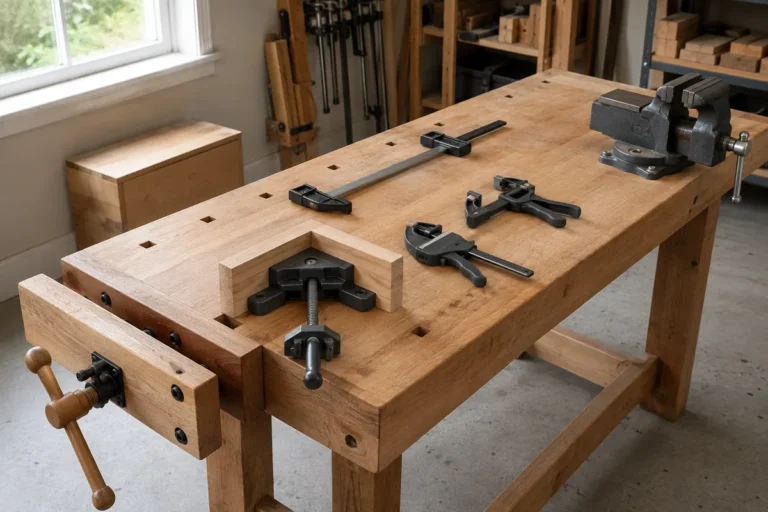
Best Stationary Sanders for Fast, Consistent Woodworking
What's inside
As an Amazon Associate I earn from qualifying purchases. This post may contain affiliate links at no extra cost to you.
The best stationary sander depends on your stock width, available floor space, dust-collection system, and how accurately you need to control thickness: choose a drum sander for wide panels and predictable finishing, an edge sander for joinery and curved parts, or a wide-belt sander when production speed matters more than price and footprint.
As an Amazon Associate we earn from qualifying purchases at no extra cost to you.

Contents
Quick picks by workshop situation
| Workshop situation | Best stationary sander type | Useful specification | Typical market range |
|---|---|---|---|
| Small garage or shared shop | Compact 16–19 inch drum sander | 120 V, folding or removable stand, 1–2 hp motor | $900–$1,800 |
| Furniture and cabinet panels | Open-ended drum sander | 18–22 inch capacity, expandable to roughly 36–44 inches | $1,300–$3,000 |
| Frequent solid-wood production | Wide-belt sander | 24–37 inch belt, 5–15 hp motor, powered conveyor | $6,000–$20,000 or more |
| Frames, doors, and end grain | Stationary edge sander | 6–12 inch abrasive belt, tilting table, 2–3 hp motor | $1,000–$3,500 |
| Curved components and small parts | Oscillating spindle sander | 1/2–4 inch spindle range, 1/2–1 hp motor | $250–$1,200 |
Choose the machine by the work, not by horsepower
Drum sanders for panels and controlled thickness
A drum sander is the most versatile stationary sander for many serious woodworking shops. Its abrasive wraps around a rotating drum while the conveyor carries the workpiece underneath. It removes saw marks, evens glued-up panels, and brings delicate stock to a controlled thickness without the aggressive cutting action of a planer.
Open-ended models sand boards wider than the drum by making a second pass with the workpiece repositioned. A 19-inch machine can therefore process pieces approaching 38 inches wide, although the second pass requires careful alignment. A 22-inch model can handle roughly 44 inches in the same way. Closed-end machines are more rigid across their full width, but they take more floor space and do not offer that extra capacity.
Look for a conveyor with variable speed, a height adjustment that is easy to read, and a mechanism that keeps the drum parallel to the bed. Variable speed is particularly valuable with figured maple, cherry, and other woods that can burn or show uneven scratch patterns. Slower feed rates improve removal; faster rates usually produce less heat and reduce the chance of burn marks when taking a light finishing cut.
Wide-belt sanders for speed and repeatability
A wide-belt sander is the right choice when the shop regularly processes large batches of doors, tabletops, flooring, or cabinet components. It works faster than a drum sander and normally produces a more uniform surface across a broad panel. Combination machines may use a sanding belt followed by a platen or brush head, allowing both stock removal and finishing.
The tradeoff is substantial cost, power, weight, and infrastructure. Many industrial machines need three-phase power, a large dust collector, and a permanent location. A wide-belt sander is excessive for a hobbyist who sands a few panels each month, but it can pay for itself in labor when the same dimensions are processed repeatedly.
Edge sanders for joinery and end grain
An edge sander uses a vertical abrasive belt against a table. It excels at straightening cabinet edges, smoothing door components, and removing saw marks from end grain. A tilting table expands its usefulness for bevels and compound work.
It should not be your only machine for flattening wide panels. The narrow contact area makes it easy to round an edge or create a hollow if pressure is inconsistent. Use a straightedge and light passes, especially with short parts that are difficult to hold safely.
Spindle sanders for curves and internal shapes
An oscillating spindle sander moves the abrasive sleeve up and down as it rotates. This prevents one small section of abrasive from overheating and makes the machine effective on chair parts, templates, coves, and inside curves. It removes material more slowly than a belt or drum sander, but it gives much better control on shaped components.
How much machine do you need?
Match the machine’s usable capacity to the largest parts you make, then add working margin. If your widest routine panel is 30 inches, a 16- or 19-inch open-ended drum sander can cover it in two passes. If you frequently make 36-inch doors, a 22-inch machine reduces alignment risk and may finish the piece in fewer passes.
Motor power matters because sanding resistance rises with abrasive width, cut depth, and feed rate. Compact drum sanders commonly use about 1 to 2 horsepower, while larger units may use 3 horsepower or more. A high horsepower rating cannot compensate for an undersized dust collector, dull abrasive, or a conveyor that slips under load.
As a practical example, assume a 19-inch drum sander is used on a 30-inch tabletop. The first pass covers 19 inches and the second pass covers the remaining 11 inches, with a small overlap. If the conveyor is set to 6 feet per minute and the table is 4 feet long, one pass takes about 40 seconds. Allowing 20 seconds for returning the stock and checking alignment, four passes take approximately four minutes. A slower feed, abrasive changes, and inspection can easily double that time, which is why variable speed and quick height adjustment become important during multi-panel work.
Dust collection is a performance specification
Sanding produces finer dust than many cutting operations, and a collector that seems adequate for a table saw may be disappointing on a stationary sander. Compact drum machines often need approximately 600–900 cubic feet per minute at the machine inlet; larger drum and wide-belt machines may require 1,000–2,000 CFM or more. Always use the manufacturer’s requirement rather than relying on the collector’s advertised maximum airflow.
- Use a short, smooth hose with the diameter specified for the sander.
- Seal unused ports and keep blast gates fully open for the active machine.
- Clean or replace filters when airflow drops; a clogged filter can cause burning and poor finish quality.
- Use appropriate respiratory protection and ventilation because dust collection does not capture every airborne particle.
Dust buildup also affects ownership. Abrasive dust can collect around bearings, height-adjustment threads, switches, and conveyor rollers. Vacuum the machine after each session and avoid directing compressed air into sealed bearings or electrical components.
Finish quality by wood and abrasive
For softwoods such as pine and cedar, use light passes because excessive pressure can compress fibers and make later finishing uneven. Hard maple and beech tolerate more sanding but show cross-grain scratches readily. Cherry and walnut benefit from a consistent final scratch direction, while figured woods are safer with shallow cuts and a slower feed to reduce tear-out and burning.
A practical abrasive progression is 80 or 100 grit for removing planer marks, 120 or 150 grit for general preparation, and 180 grit when the finish schedule calls for it. Do not assume a 220-grit pass always improves the result: on some finishes it can burnish the surface and reduce absorption. Sanding across the grain should be reserved for stock removal and followed by a lengthwise finishing pass.
Ownership costs and common failure points
The abrasive is usually the first consumable to affect performance. Abrasive strips, sleeves, and belts wear faster when sanding glue squeeze-out, painted material, or resinous woods. Keep separate abrasives for dirty reclaimed lumber and clean furniture stock. A $20–$60 abrasive replacement used over several projects is cheaper than forcing a dull belt and overheating the motor.
- Replace abrasive when the machine needs noticeably more pressure, not only when the grit looks visibly worn.
- Check conveyor tracking and belt tension periodically; a wandering conveyor creates inconsistent thickness.
- Wax or lubricate the table only according to the manufacturer’s instructions. Excess lubricant can contaminate finishing surfaces.
- Measure the workpiece at both ends and in the middle after setup. Do not trust the height scale alone.
- Never feed loose short pieces unless the machine is designed for them; use a carrier board or another safe method recommended by the manual.
For occasional use, a compact drum or spindle sander generally offers the best value. For weekly furniture production, spend more on conveyor adjustment, dust extraction, and abrasive access rather than buying horsepower alone. For daily batch work, a wide-belt machine can justify its footprint through speed and repeatability.
Bottom line
Choose a compact oscillating spindle sander for curves, an edge sander for joinery, a 16–22 inch drum sander for most panel and furniture work, and a wide-belt sander for continuous production. The best stationary sander is the one whose capacity matches your largest stock, whose motor and conveyor suit your feed rate, and whose dust system can maintain airflow while you produce the surface quality your wood and finish require.