Belt Sander Buying Guide: Best Options for Fast Material Removal
What's inside
- What to look for in a belt sander
- Head-to-head: which belt-sander format fits your work?
- Notable options by use case
- Dust collection, tracking, and handling details that matter
- A practical buying decision matrix
- Setup and use: three steps that prevent common mistakes
- Ownership costs and parts that wear first
- Related Guides
- What to look for in a belt sander
- Head-to-head: which belt-sander format fits your work?
- Notable options by use case
- Dust collection, tracking, and handling details that matter
- A practical buying decision matrix
- Setup and use: three steps that prevent common mistakes
- Ownership costs and parts that wear first
- Related Guides
As an Amazon Associate I earn from qualifying purchases. This post may contain affiliate links at no extra cost to you.
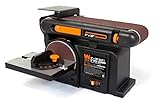
For most woodworkers, the best belt sander is a corded 3 x 21-inch model with a 7–10 amp motor, variable-speed control, dependable tracking, and a usable dust port; choose a smaller 3 x 18-inch tool for lighter work and a 4 x 24-inch sander only when rapid stock removal matters more than maneuverability.
As an Amazon Associate we earn from qualifying purchases at no extra cost to you.
Contents
- What to look for in a belt sander
- Head-to-head: which belt-sander format fits your work?
- Notable options by use case
- Dust collection, tracking, and handling details that matter
- A practical buying decision matrix
- Setup and use: three steps that prevent common mistakes
- Ownership costs and parts that wear first
- Related Guides
What to look for in a belt sander
A belt sander removes material much faster than a random-orbit sander, but that speed makes tool choice important. A powerful sander that is difficult to control can leave dips, rounded edges, and deep scratches. Compare the belt size, motor, speed control, tracking system, dust handling, weight, and grip rather than choosing by amperage alone.
Belt size: the most important starting point
A 3 x 21-inch belt is the best all-purpose size for furniture parts, doors, benchtops, and general flattening. Its long sanding surface bridges small high spots while remaining manageable. Belts are widely available in coarse grits such as 40, 60, and 80, as well as finer grits for smoothing.
- 3 x 18 inches: More compact and easier to control on narrow boards, edges, and occasional repairs. It usually has a smaller sanding footprint and may remove material more slowly.
- 3 x 21 inches: The best balance for most workshops. It offers good control, useful capacity, and the broadest selection of replacement belts.
- 4 x 24 inches: Covers more area and can flatten large surfaces quickly, but is heavier and more demanding to steer. It suits frequent stock removal on wide boards and large panels.
Do not assume that a wider belt automatically produces a flatter result. Technique, belt condition, and keeping the tool moving matter just as much. A wide, powerful sander can remove a surprising amount of material before you notice a hollow.
Motor power and sanding speed
For corded tools, approximately 6–8 amps is adequate for occasional 3 x 18-inch or 3 x 21-inch work. Around 8–11 amps provides more reserve for hardwood, glued-up panels, and prolonged use. A higher rating does not eliminate bogging if the belt is dull or you press too hard.
Fixed-speed models are often simpler and less expensive. Variable-speed control is more useful when working with veneers, softwoods, finishes, plastics, or heat-sensitive materials. A typical belt sander may run from roughly 850 to 1,500 feet per minute, depending on the model and control setting. Lower speeds reduce aggressive cutting and make it easier to avoid burning; higher speeds are useful for rapid removal from solid wood.
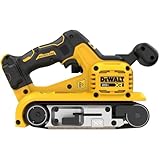
For battery-powered models, compare the platform voltage and battery capacity, not voltage alone. A 5.0 Ah pack generally lasts longer than a 2.0 Ah pack, but runtime varies substantially with pressure, belt grit, and material. Cordless sanders are convenient for installation work, while corded models usually offer better sustained power for large surfaces.
Head-to-head: which belt-sander format fits your work?
| Situation | Recommended format | Useful specification | Why it fits |
|---|---|---|---|
| Occasional repairs and small projects | Compact corded model | 3 x 18 in; 6–8 amps; about 6–9 lb | Easier to store and control; sufficient for edges and small panels |
| General furniture and renovation work | All-purpose corded model | 3 x 21 in; 7–10 amps; about 9–13 lb | Best balance of capacity, power, belt availability, and handling |
| Large panels and frequent stock removal | Heavy-duty corded model | 4 x 24 in; 10–12 amps; about 13–17 lb | Fast coverage and strong material-removal capacity, with greater fatigue |
| Remote installation or limited outlet access | Cordless belt sander | Typically 3 x 18 in; 18–20 V platform; 4–8 lb bare tool | No power cord, but battery cost and runtime affect ownership |
Notable options by use case
Best general-purpose design: 3 x 21-inch corded sander
A conventional 3 x 21-inch sander is the safest recommendation for a first belt sander. Look for a motor in the 7–10 amp range, a front handle that can be repositioned, and a dust port that accepts a workshop vacuum. The Makita 9403 is a well-known heavy-duty example of this format, while the Bosch 1274DVS adds variable-speed control in a more adjustable design. Availability and current pricing can vary, so compare the specifications and replacement-belt supply in your region.
This format is large enough for doors and tabletops but not so large that every pass becomes tiring. It is also easier to use for flattening a narrow glue-up because the long 21-inch belt provides a stable reference.
Best for lighter handling: 3 x 18-inch model
A 3 x 18-inch belt sander is preferable when you value lower weight, have limited storage, or work mostly on small furniture parts. The shorter belt area makes the tool more responsive, which can be helpful for beginners but also makes uneven pressure more noticeable. A model such as the Metabo HPT SB8V2 represents this compact class and includes variable speed.
Choose this size if your typical jobs involve cabinet sides, stair components, small doors, or localized removal. It is less convenient for flattening a large tabletop because you will make more passes and may find it harder to maintain a consistent path.
Best for maximum removal: 4 x 24-inch model
A 4 x 24-inch sander is appropriate when removing old finish, leveling broad stock, or processing large areas repeatedly. The added width improves coverage, but the extra weight increases fatigue and makes overhead work unpleasant. It is not the best first choice for delicate furniture or small parts.
Before buying this size, confirm that you have a stable workbench, adequate dust extraction, and enough room to move the tool without catching the cord. Large sanders are most useful when their capacity is used regularly.
Dust collection, tracking, and handling details that matter
Dust collection is not a minor convenience. A clogged port can reduce suction, scatter fine dust, and allow abrasive particles into the tool. Prefer a model with a standard-sized port or a supplied adapter that fits your vacuum hose securely. A cloth dust bag is useful for quick work, but a vacuum is generally more effective for indoor sanding. Use suitable respiratory and eye protection even when collection appears good.
Tracking adjustment keeps the belt centered between the rollers. A responsive adjustment knob is valuable because belts vary slightly and can drift as they warm. The belt should run near the middle without rubbing the housing. If it repeatedly walks sideways, inspect the belt installation, rollers, tension mechanism, and belt condition rather than continually turning the tracking knob.
Weight affects both stability and fatigue. A heavier tool can sit firmly on a flat surface, but it becomes difficult to control on vertical panels or edges. Check whether the front handle gives your wrist a neutral position and whether the trigger can be locked without shifting your grip. A long power cord also improves handling by reducing accidental tugging.
A practical buying decision matrix
| Your priority | Choose | Avoid prioritizing |
|---|---|---|
| Lowest sensible purchase cost | Fixed-speed 3 x 18-inch corded model with common belts | Large 4 x 24-inch capacity you will rarely use |
| Beginner-friendly control | 3 x 21-inch tool with variable speed and a comfortable front handle | Maximum amperage and excessive weight |
| Weekly furniture production | 8–11 amp 3 x 21-inch model with strong dust extraction | Unusual belt sizes with limited grit availability |
| Very limited workshop space | 3 x 18-inch tool with a compact case or vertical storage option | Large dust bags and permanently attached bulky accessories |
| Frequent large-panel work | 4 x 24-inch heavy-duty model, preferably with vacuum connection | Using a small tool for hours to save a modest amount initially |
Setup and use: three steps that prevent common mistakes
- Install and track the belt. Unplug the tool, fit the belt in the direction shown by the arrows, release the tension, and adjust tracking briefly while the tool runs. Keep fingers clear of the moving belt.
- Begin with a coarse but not unnecessarily aggressive grit. Use 60 or 80 grit for ordinary leveling, moving to 40 grit only when substantial material must be removed. A simple coverage estimate helps: a 3 x 21-inch tool has 63 square inches of belt footprint, while a 4 x 24-inch tool has 96 square inches—about 52% more nominal area. That does not mean 52% faster sanding, because motor load and operator movement also limit productivity.
- Keep the tool moving and finish with lighter passes. Set the front of the belt down first, keep the base level, and move at a steady pace. Do not rock the tool at the beginning or end of a pass. Reduce pressure as the surface approaches flatness, then switch to a random-orbit sander for a cleaner final finish.
Ownership costs and parts that wear first
Belts are the main consumable. Resin buildup, torn joints, and exposed backing are signs to replace one. Dull belts generate heat and encourage excessive pressure, which can overload the motor and create waves in the wood. Keep several grits available rather than forcing one belt to perform every task.
Tracking rollers, tension springs, carbon brushes on some corded designs, drive belts, and dust seals may eventually need attention. Clean vents and the roller area regularly with vacuum suction or low-pressure air, following the manufacturer’s instructions. Do not store the tool with a belt left tensioned for long periods if the manual advises releasing it; unnecessary tension can reduce spring and roller life.
For most buyers, a 3 x 21-inch variable-speed corded belt sander is the strongest all-round choice. Move down to 3 x 18 inches for portability and occasional work, or up to 4 x 24 inches when broad, repeated stock removal justifies the additional weight, belt cost, and storage requirements.