Stationary Planer vs Wide-Belt Sander for Thickness Accuracy
What's inside
As an Amazon Associate I earn from qualifying purchases. This post may contain affiliate links at no extra cost to you.
Contents
The short answer
A stationary planer and a wide-belt sander do different jobs when making stock to a target thickness. A planer is usually the practical choice for reducing solid lumber quickly and consistently. A wide-belt sander is better for bringing panels and glued-up parts to a controlled final thickness, smoothing them, and correcting modest variation without cutter marks. Neither machine guarantees accuracy by itself: setup, stock condition, feed consistency, and measurement matter.
If you mainly mill boards, start with a planer and a reliable way to flatten one face first, such as a jointer or a planer sled. If you build cabinets or furniture from panels and need repeatable final thickness across wide work, a wide-belt sander may earn its floor space and cost. For occasional small jobs, a drum sander or careful hand sanding can be the less expensive answer.
As an Amazon Associate we earn from qualifying purchases at no extra cost to you.


What thickness accuracy means
Thickness accuracy has two parts: how close the finished piece is to the target, and how uniform it is across its length and width. A board that measures 3/4 inch at one end and 23/32 inch at the other is not uniform, even if its average thickness is near 3/4 inch.
Use calipers or a thickness gauge to check several points, including both edges and the middle. For furniture parts, a spread of about 0.005 to 0.010 inch may be acceptable, depending on the assembly. Parts that must fit a fixed opening or match a batch deserve tighter checks. Wood can also move after machining as moisture equalizes, so a freshly milled reading is not always the final one.
How a stationary planer works
A planer feeds a board past rotating knives or cutterhead inserts while rollers hold it against the bed. It makes the upper face parallel to the lower face. That last point is important: a planer does not reliably flatten a board that is cupped, twisted, or bowed. It may reproduce the bend on the opposite face. Flatten one face first, or support the board on a stable sled.
For ordinary stock, a planer can remove roughly 1/32 inch per pass as a cautious starting point; hardwood, wide boards, and machines with limited power may need lighter cuts. Heavy cuts can cause snipe at the ends, tear-out, stalled feed, or a rough finish. Snipe is often reduced by supporting long stock level with the infeed and outfeed tables and keeping light upward pressure as the board enters and exits.
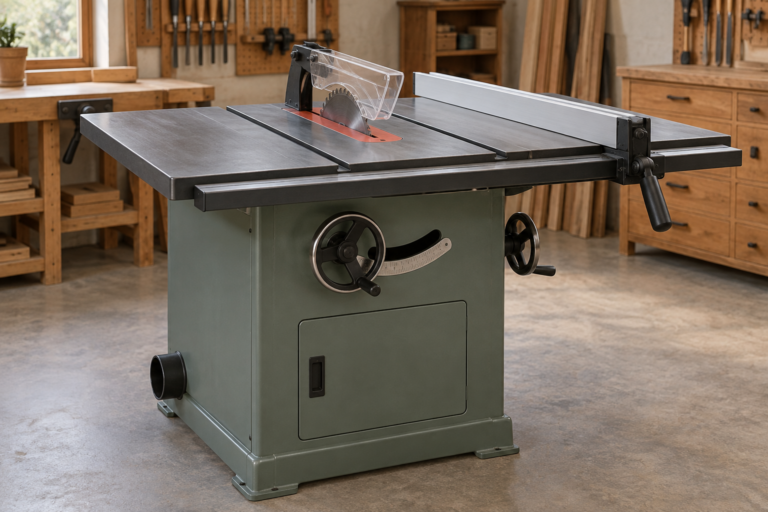
A stationary planer is generally faster and cheaper per board than a wide-belt machine. It is the sensible purchase for rough lumber and dimensioning solid wood, but it leaves knife marks and can struggle with figured grain.
How a wide-belt sander works
A wide-belt sander uses an abrasive belt and a feed system to remove material across a broad surface. Depending on its configuration, a platen or contact drum supports the belt. It is useful for panels, veneer work, glued-up tops, and final sizing where a planer’s cutter marks would create extra sanding work.
It removes material more slowly than a planer. That can be an advantage near a target thickness: a light pass can take off a few thousandths of an inch, where a planer’s minimum practical cut may be too aggressive. But a sander can still leave a tapered or uneven part if the feed, pressure, abrasive, or machine setup is wrong. A worn belt, clogged abrasive, or inconsistent hold-down can produce burnishing, scratches, or a thickness difference from one side to the other.
A wide-belt sander is a substantial investment in space, power, dust collection, and abrasive belts. It makes sense in production shops or for frequent panel work, not simply because sanding sounds more precise than planing.
Planer vs. wide-belt sander
| Factor | Stationary planer | Wide-belt sander |
|---|---|---|
| Best use | Dimensioning solid lumber | Finishing and sizing panels or glued-up parts |
| Material removal | Fast; suited to larger reductions | Slower; suited to light, controlled passes |
| Surface left behind | Cutter marks; possible tear-out | Abrasive scratches; can be ready for finer sanding |
| Thickness control | Good when the reference face is flat and the machine is set up well | Good for fine adjustment, but depends on calibration and feed consistency |
| Common problems | Snipe, tear-out, chip buildup, uneven results from a warped reference face | Loading, belt wear, burning, scratches, uneven removal |
| Cost and footprint | Lower for comparable shop capacity | Higher; requires room, power, and dust collection |
Choose for the work you actually do
For a small shop processing boards a few at a time, a planer is usually the better first machine. A benchtop or floor-standing unit can bring stock close to finished thickness efficiently. Check its stated maximum width and thickness, but also consider the infeed and outfeed support needed for longer boards. A portable planer may be enough if your stock is narrow and your accuracy requirements are moderate.
If your work is mostly cabinet doors, tabletops, or other wide assemblies, a planer’s width limit can be a deal-breaker. A wide-belt sander can handle broad panels and refine their faces, but confirm the machine’s maximum width, minimum thickness, and whether it has the head and platen configuration your work needs. A smaller drum sander can be a reasonable compromise for narrower parts and occasional work, though it is slower and will not match a production wide-belt machine’s capacity.
Neither machine is a substitute for straight stock preparation. A board with twist should be flattened before planing; feeding it unsupported can produce a board that is evenly thick but still twisted. Likewise, sanding a warped panel down until it is flat may waste a lot of material and create heat. Start with stock close to flat, then use the machine that matches the width and amount of removal.
A reliable workflow for accurate results
First, let the wood acclimate in the shop and check its moisture content. For indoor furniture, many shops aim for roughly 6–8% moisture content, though climate and use affect the target. Flatten one face, then plane the opposite face parallel. Leave a small amount of extra thickness—often 1/32 inch or less—if the piece will need final sanding.
On a planer, take light finishing cuts, use sharp knives or inserts, and feed boards in the same direction when working with figured grain if that reduces tear-out. On a wide-belt sander, use a fresh, appropriate grit and make small adjustments; an initial 80-grit pass and a finer follow-up may suit rough work, but do not jump straight to a fine belt to remove substantial stock. Check thickness in multiple locations after each adjustment. If readings drift, verify the machine’s parallelism and feed supports before compensating by changing the setting.
The buying decision
Buy a planer if your main problem is turning rough lumber into consistent boards. Buy a wide-belt sander if you regularly process wide panels and need fine, repeatable surface correction at production speed. If you only need occasional final sizing, a planer followed by a separate sanding step is usually cheaper and entirely adequate. Pay for the wide-belt machine only when its width, finish, and throughput solve a recurring problem that the planer cannot.