Best Stationary Planers for Wide Boards in a Professional Shop
What's inside
As an Amazon Associate I earn from qualifying purchases. This post may contain affiliate links at no extra cost to you.
Contents
Choosing a planer for wide stock
For wide boards, the first question is the machine’s actual planing capacity—not its motor size or the width printed on a brochure. A 15-inch planer can handle boards up to 15 inches wide in ideal conditions, but knots, cupping, and the need to leave a little room for handling make that a poor everyday target. If your work regularly includes 13- to 15-inch boards, a 20-inch machine gives useful breathing room. If you routinely surface panels wider than 20 inches, look at a 24-inch planer or a wide-belt sander instead.
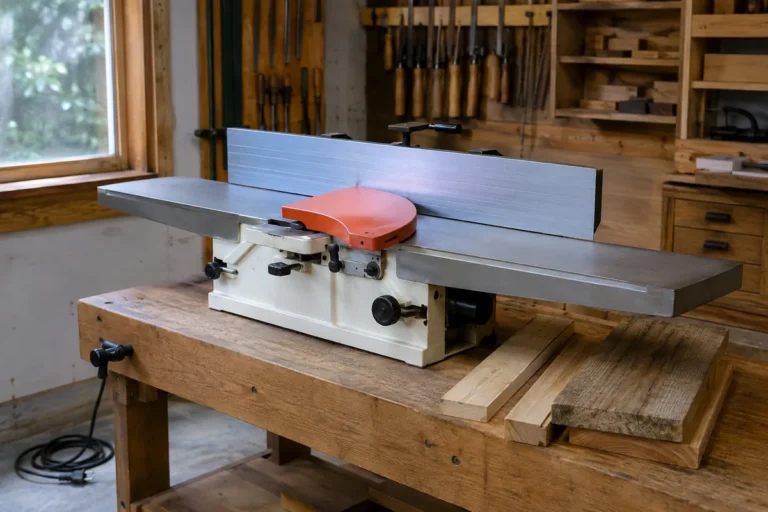
Also distinguish a planer from a jointer. A planer makes the two faces parallel; it does not reliably flatten a badly bowed or twisted board by itself. Flatten one face on a jointer or with a sled, then plane the opposite face. Feeding a twisted board straight into a planer can leave it twisted, or make the machine rock and produce an uneven cut.
As an Amazon Associate we earn from qualifying purchases at no extra cost to you.


Capacity and cutting head
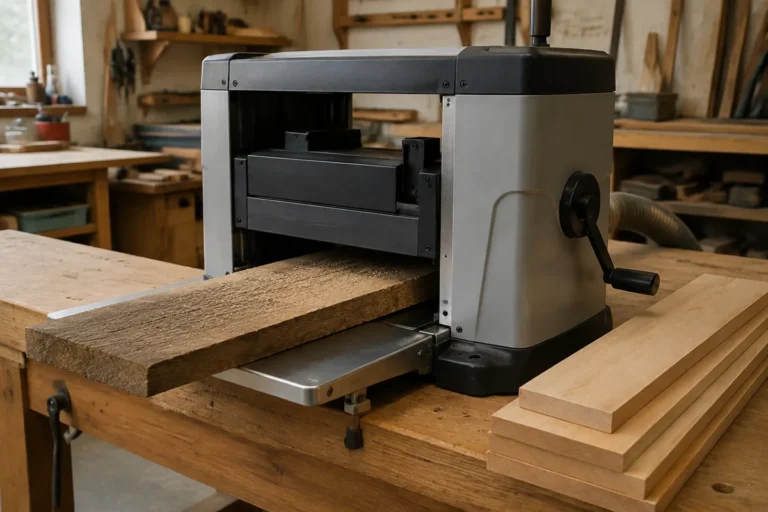
For a professional shop, a floor-standing 20-inch planer is a practical middle ground: wide enough for many tabletops and cabinet parts, but less expensive and space-hungry than a 24-inch machine. A 20-inch stationary planer is the sensible starting category when that width covers most of your work. Choose 24 inches when wide boards are a routine part of the business, not an occasional exception.
Cutting-head style affects finish, noise, and maintenance. Straight-knife heads are often cheaper to buy and straightforward to service, but knives need careful setting and can leave visible scallops or tear-out in figured grain. Helical or segmented heads use replaceable inserts. They usually cost more up front, but a chipped insert can be rotated or replaced individually, and the cut tends to be quieter with less noticeable tear-out. Check insert availability and cost before buying; a head that is easy to service matters more than the word “helical” on a listing.
How the main options compare
| Planer category | Useful capacity | Best fit | Main trade-off |
|---|---|---|---|
| 15-inch floor-standing | Boards up to about 15 inches wide | Small shops and occasional wide work | Limited margin on wide stock; not a substitute for a 20-inch machine |
| 20-inch floor-standing | Boards up to about 20 inches wide | General professional furniture and cabinet work | Higher purchase, power, and space requirements than a 15-inch planer |
| 24-inch floor-standing | Boards up to about 24 inches wide | Frequent wide-panel and slab work | More costly, heavy, and demanding to move and install |
These widths describe nominal maximum capacity, not a promise that every board can be fed safely or cleanly at that size. Confirm the throat opening, table length, and feed arrangement in the machine’s specifications.
Feed system, snipe, and finish
Roller feed is standard on many planers, but roller count and adjustment matter. Infeed and outfeed rollers must grip consistently, and the pressure bar must control the board as the cutter head works. Poor adjustment can cause slipping, chatter, or uneven thickness. Snipe—deeper cuts at the leading or trailing end—is common when a board is not supported level through the cut. Long tables, aligned extension rollers, and a short sacrificial lead-in and tail-out can reduce it, though they do not replace correct setup.
Feed speed is another trade-off. Slower feed generally produces a smoother finish because the knives or inserts make more cuts per inch, but it takes longer. A two-speed planer is useful when you switch between rough dimensioning and finish passes. For a shop that mostly removes modest amounts of material, a fixed-speed machine may be entirely adequate.
Do not size a planer by horsepower alone. A wide cutter head removing a heavy cut from dense hardwood can bog down even a powerful machine if the feed rate is too high. Start with shallow passes—around 1/32 inch is a reasonable finishing cut—and reduce the depth when the motor strains, the board chatters, or the grain tears. Keep boards of similar thickness together when possible; changing the table height for every piece slows production.
Power, space, and dust collection
Many 20- and 24-inch planers need 230-volt service. Verify the machine’s voltage, amperage, and circuit requirements before ordering; an electrical upgrade can change the real cost of the purchase. These machines are heavy enough that delivery, shop access, and lifting equipment deserve attention too. Measure doorways, turns, and ceiling clearance, not just the floor space where the planer will sit.
Plan for chip collection from the outset. Planers produce a large volume of chips quickly, and a small shop vacuum is not an adequate collector for sustained work. Use a correctly sized dust collector and ducting, and keep the hood and impeller clear. A clogged hood can back chips into the cutter area, mark the board, and create a fire and housekeeping hazard.
A 24-inch planer with a helical head makes sense when wide stock and frequent figured-grain work justify the extra expense. If wide boards appear only a few times a year, a 20-inch planer—or having the occasional oversized piece surfaced by a nearby shop—can be the better financial choice.
What to check before buying
Compare the usable width, minimum and maximum thickness, feed speeds, table length, head type, motor requirements, and available replacement parts. Ask how the knives or inserts are set and whether the manufacturer sells them individually. Check that the machine has a reliable thickness scale, but verify it with calipers: scales can drift, and a planer’s job is to make faces parallel, not to guarantee an exact finished dimension without measurement.
Finally, consider the work you actually do. For mostly narrow cabinet parts, a 15-inch planer is cheaper and occupies less space; it is fine if its capacity covers nearly all your stock. For mixed furniture work, a 20-inch shop planer offers a useful balance. Buy 24 inches when the extra width will save regular handling, glue-up, or outsourcing—not simply because the largest machine is available.