How to Choose a Stationary Planer for Wide Hardwood Boards
What's inside
As an Amazon Associate I earn from qualifying purchases. This post may contain affiliate links at no extra cost to you.
Choosing a planer for wide hardwood boards means balancing capacity, cut quality, power, and the way you handle heavy stock. A board that is wider than the machine’s opening will not fit, but maximum width alone is a poor buying guide: a long, figured maple slab can challenge a planer much more than a short, straight-grained board of the same width.
Contents
Start with board size and capacity
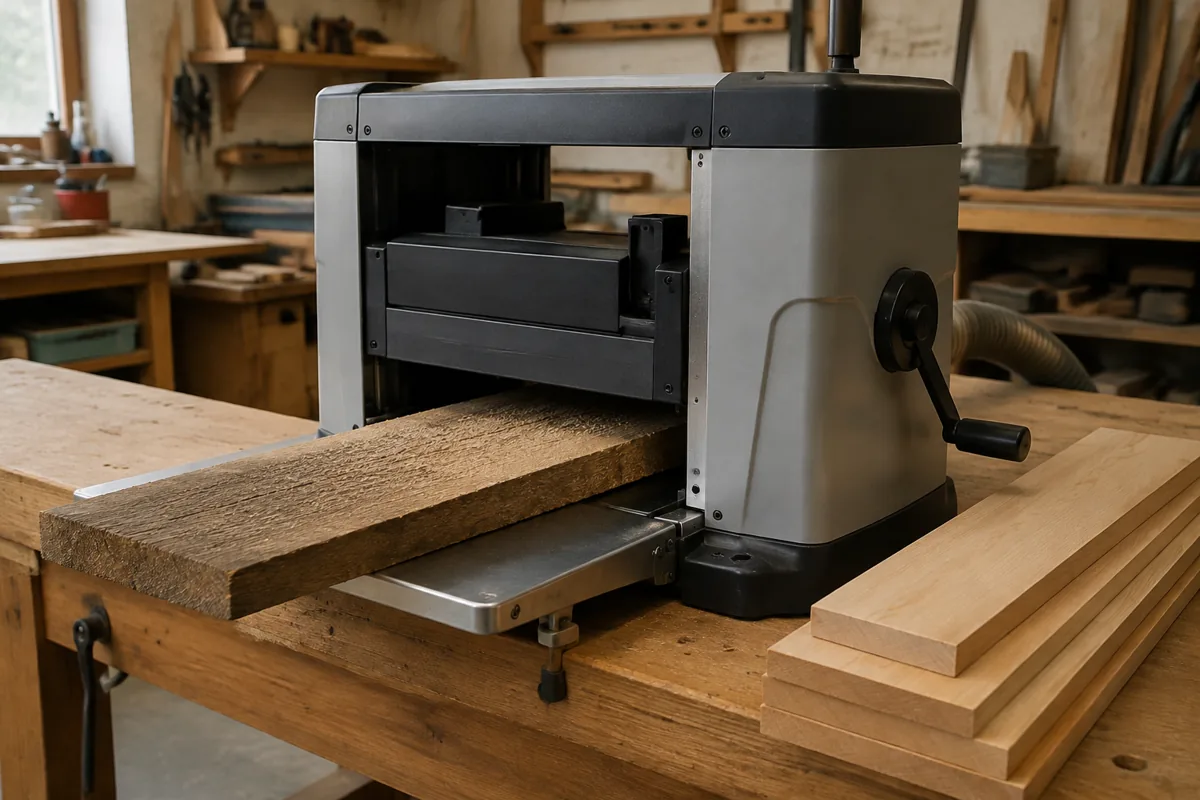
Measure the widest boards you expect to plane, then leave some room for future projects. Benchtop planers commonly accept stock around 12 to 13 inches wide; larger stationary machines may handle 15 inches or more. Check the maximum thickness as well. Many planers accept stock up to about 6 inches thick, but the exact limit varies.
Capacity is not the same as practical handling. A 12-inch-wide, 8-foot hardwood board can weigh enough to make solo feeding awkward, even if it fits the planer. Infeed and outfeed support, shop space, and a helper matter. A board that dips as it enters or exits can cause snipe—deeper cuts near one or both ends.
If your work routinely exceeds the planer’s width, consider whether resawing, ripping and rejoining, or using a wide-belt service is realistic. Do not assume you can turn a board sideways and plane it safely; the planer’s stated opening is its limit.
Choose the cutterhead for the work
Planers use straight knives or segmented cutterheads with small inserts. Straight knives can leave a good finish on clear, straight-grained lumber and are often less expensive to buy. They need sharpening or replacement, and a nick can leave a continuous ridge down the board. Changing and aligning knives also takes care.
Helical or spiral-style heads use many small inserts arranged at an angle. They generally reduce tear-out on figured grain and make a damaged insert easier to rotate or replace. They cost more upfront, and inserts still need attention when dull or chipped. “Helical” and “spiral” are not always used consistently in product listings, so inspect the head design and replacement-insert availability rather than relying on the label.
Neither head makes difficult grain foolproof. Take light finishing cuts—about 1/32 inch is a sensible starting point on figured hardwood—and feed the board in the direction that gives the cleanest result. If the board has reversing grain, test on scrap or an offcut first.
Compare feed rate, power, and cut depth
A faster feed rate can save time on rough stock, but often leaves a rougher surface because each knife or insert takes a larger bite. Slower feed generally improves finish, though it does not eliminate tear-out. Look for a genuine two-speed setting or a clearly specified variable feed if finish control matters. A machine with one fixed speed can still work well; it just gives you fewer options.
Do not judge power by horsepower alone. Compare the motor rating, cutterhead speed, feed rate, and maximum cut depth, and remember that manufacturers may report electrical input rather than useful cutting power. Deep cuts in dense hardwood strain the motor, increase tear-out, and can stall the feed. For roughing, make several moderate passes rather than forcing a full-width, deep cut. A 1/16-inch cut may be reasonable on some machines and stock; on wide, hard, or figured boards, start shallower.
Match the machine to your workload
| Planer type | Best fit | Main trade-off |
|---|---|---|
| Benchtop, straight knives | Occasional work on boards up to its stated width | Lower cost and easier storage; more knife noise and setup work |
| Benchtop, segmented head | Smaller shops handling figured hardwood regularly | Cleaner results on difficult grain; higher purchase and insert cost |
| Floor-standing planer | Frequent use, heavier stock, or a wider capacity requirement | More stable and often more capable; costs more and needs floor space and suitable power |
For occasional furniture repairs or a few boards a month, a well-supported benchtop planer may be enough. A higher-priced stationary machine is easier to justify when you routinely plane wide, dense stock or need longer uninterrupted sessions. Before buying, confirm whether the machine requires a dedicated circuit. A planer that overloads the circuit or trips the breaker is not a bargain, however wide its capacity.
Compare 13-inch benchtop planers if your boards fit that width. If you want to compare insert-head machines, browse 15-inch helical-head planers, checking the actual opening, motor requirements, and replacement insert cost in each listing.
Account for snipe, dust, and support
Snipe is usually a handling and roller-pressure problem, not a reason to reject every planer. Support long boards level with the machine bed and let the board enter and exit without sagging. Feed boards with the same end leading and trailing when processing a batch; this can keep snipe on sacrificial ends. Some machines let you adjust roller pressure or bed rollers, but do not count on adjustments to replace good support.
Planers make large volumes of chips. A shop vacuum may not keep up; many machines work better with a dust collector, and the outlet diameter must match your hose or adapter. Poor extraction can clog the hood, scatter chips, and affect cut quality. Confirm the dust port size and collector requirements before purchase.
Also check the weight, stand options, and noise level. A heavy machine is steadier but harder to move. Planer noise can be severe, especially with straight knives, so hearing protection is essential even for short runs.
Check service and operating costs
Before ordering, verify the true maximum width, minimum and maximum stock thickness, feed speeds, cutterhead type, electrical requirements, dust-port diameter, and availability of knives or inserts. Look for replacement parts from a source you can actually use; an inexpensive planer with hard-to-find knives can become costly downtime.
For wide hardwood, the best choice is the machine that fits the stock you process most often and can feed it steadily. Spend extra for width, feed control, or an insert head only when those features solve a real problem in your shop. Whatever you buy, joint one face flat before planing for thickness: a thickness planer makes opposite faces parallel, but it will not flatten a bowed or twisted board on its own.