Best Transmission Fluid Exchangers
What's inside
- Top 3 Picks
- Quick Comparison
- How We Chose
- 1. VEVOR 12V Flush Machine – Best for Mixed-Fleet Shops
- 2. QPKING ATF702 – Best for Operator-Controlled Exchanges
- 3. PreAsion Dual 5.3-Gallon Exchanger – Best for High-Volume Shops
- 4. Valvoline MaxLife Multi-Vehicle ATF – Best for Broad Coverage With One Fluid
- 5. ACDelco Dexron VI – Best for GM Automatics
- 6. Castrol Transmax ATF/CVT Universal – Best for Shops Covering Both ATF and CVT
As an Amazon Associate I earn from qualifying purchases. This post may contain affiliate links at no extra cost to you.
The best transmission fluid exchanger for most independent shops is the VEVOR Flush Machine DC12V 0-60PSI: a 12-volt, pressure-regulated automatic unit with a 0-60 PSI gauge that runs from a battery, needs no dedicated 110 V bay, and covers a genuinely mixed domestic, Asian and European vehicle mix. If you want more operator control over flow rate and cycle timing, the QPKING ATF702 12 V semi-auto machine is the better fit. If your mix leans toward trucks, vans and large-capacity units, the PreAsion dual 5.3-gallon machine is the capacity play. And because the machine is only half the job, the fluid side of this guide matters just as much: Valvoline MaxLife Multi-Vehicle ATF for broad conventional-automatic coverage, ACDelco Dexron VI and Mopar 8 & 9 Speed ATF for specific transmission families, and Honda HCF-2 and Nissan NS-3 for the CVTs that will not tolerate a universal fluid.
If you are not ready to buy a machine at all, the FOUR UNCLES 3L Pump Kit covers manual gearboxes, transfer cases and low-volume drain-and-fill work for mid-range money, and it is the honest starting point for a shop doing a handful of transmission services a month.
Contents
- Top 3 Picks
- Quick Comparison
- How We Chose
- 1. VEVOR 12V Flush Machine – Best for Mixed-Fleet Shops
- 2. QPKING ATF702 – Best for Operator-Controlled Exchanges
- 3. PreAsion Dual 5.3-Gallon Exchanger – Best for High-Volume Shops
- 4. Valvoline MaxLife Multi-Vehicle ATF – Best for Broad Coverage With One Fluid
- 5. ACDelco Dexron VI – Best for GM Automatics
- 6. Castrol Transmax ATF/CVT Universal – Best for Shops Covering Both ATF and CVT
Our Top Picks
 Valvoline MaxLife Multi-Vehicle ATF Full Synthetic Automatic Transmission4 QT8.2 x 4.48 x 10.9 inches0 PoundsCheck on Amazon
 ACDelco GM Original Equipment 10-9395 Dexron VI Automatic1 gallon11.5 x 5.5 x 5.5 inches4 poundsCheck on Amazon
 Castrol Transmax ATF/CVT Universal Automatic Transmission Fluid128 Fl Oz (Pack of 1)8.31 x 4.56 x 11.04 InchesCheck on Amazon


Top 3 Picks
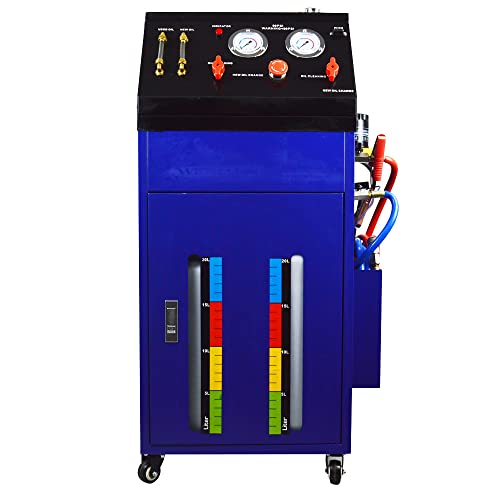
Best overall: VEVOR Flush Machine DC12V 0-60PSI. 12 V DC operation, a 0-60 PSI gauge and an automatic exchange cycle in a heavy-duty frame. It suits the shop that services whatever rolls in, and it does not need a wall outlet or a second operator to run a clean exchange.
Best budget: Valvoline MaxLife Multi-Vehicle ATF, 1 gallon. Not a machine, but the single line item that decides whether a transmission service is profitable. One full-synthetic multi-vehicle fluid in gallon jugs covers a large share of Asian and domestic conventional automatics, and buying it by the gallon rather than the quart is where the margin lives.
Best for high-volume work: PreAsion Dual 5.3-Gallon Exchanger. Two roughly 20-liter tanks mean fewer refills, fewer pauses mid-job and less downtime between vehicles. For a shop running back-to-back exchanges on trucks and vans, the capacity is the feature that pays.
Quick Comparison
| Product | Best for | Key specs | Price tier |
|---|---|---|---|
| VEVOR Flush Machine DC12V 0-60PSI | Mixed-fleet shops wanting one do-everything machine | 12 V DC power; 0-60 PSI gauge; automatic exchange; heavy-duty build; separate new/waste tanks | Premium |
| QPKING ATF702 | Shops that want operator-controlled flow and cycle timing | 12 V DC; semi-automatic exchange; dedicated ATF flush machine; gauge-monitored operation | Premium |
| PreAsion Dual 5.3-Gallon Exchanger | High-volume shops, trucks, vans, large-capacity units | Dual 5.3 gal (≈20 L each) tanks; ≈40 L total on board; auto transmission and gearbox oil change | Premium |
| Valvoline MaxLife Multi-Vehicle ATF | One fluid covering most conventional automatics | Full synthetic multi-vehicle ATF; 1 gal (128 fl oz / 3.78 L) | Budget |
| ACDelco 10-9395 Dexron VI | GM vehicles specifying Dexron VI | GM Original Equipment Dexron VI ATF; 1 gal (3.78 L) | Mid-range |
| Castrol Transmax ATF/CVT Universal | Shops wanting one SKU for ATF and CVT shelves | Universal fluid covering conventional ATF and CVT specs; 1 gal | Budget |
| Honda 08200-9008 ATF | Older Honda and Acura automatic transaxles | Honda Genuine automatic transmission fluid; 4 × 1 US qt (946 mL) | Mid-range |
| Valvoline Multi-Vehicle ATF, 1 Quart | Top-offs, single-vehicle jobs, shelf stock | Full synthetic multi-vehicle ATF; 1 qt (946 mL) | Budget |
| Nissan Genuine CVT Fluid 999MP-NS300P | Nissan continuously variable transmissions | NS-3 / CVT-3 class CVT fluid; 5 qt pack | Mid-range |
| Mopar 8 & 9 Speed ATF | Chrysler, Dodge, Jeep and Ram 8- and 9-speed units | OEM fluid for 8- and 9-speed automatic transmissions; OEM packaging | Budget |
| Honda HCF-2 | Recent Honda and Acura CVTs | HCF-2 CVT fluid; 5 × 1 qt | Premium |
| FOUR UNCLES 3L Pump Kit | Manual gearboxes, transfer cases, no-machine shops | 3 L manual pump; 12 adapters | Mid-range |
How We Chose
This guide is assembled from manufacturer specification sheets, published fluid-approval lists, the service-information requirements for the transmissions these products are aimed at, and the connection, capacity and power specs stated in each listing. Nothing here is based on shop testing or ownership experience, and no product is included because of a rating or a review count.
The selection criteria were deliberately narrow. First, category fit: a machine, a fluid and a manual pump do different jobs, so each product is judged against the job it is actually built for rather than against the others. Second, spec transparency: products that state power source, pressure range, tank volume, container size or adapter count in concrete terms rank above products that only describe themselves in adjectives. Third, vehicle-mix coverage: an exchanger is only as useful as the connections it can make and the fluid it can carry, so cooler-line compatibility and fluid-family matching carry real weight. Fourth, upgrade path: a shop buying its first machine should be able to add adapters, a second tank set or OEM fluids without replacing the whole setup. Fifth, cost tier, expressed as budget, mid-range or premium rather than a fixed price, because listing prices move constantly and a tier travels better than a number.
1. VEVOR 12V Flush Machine – Best for Mixed-Fleet Shops
As an Amazon Associate we earn from qualifying purchases at no extra cost to you.

The VEVOR DC12V flush machine is the closest thing to a default choice in this list. It suits the independent shop that sees a genuinely mixed vehicle mix — a mid-2010s Asian sedan in the morning, a late-model domestic truck at noon, a crossover with a CVT in the afternoon — and needs one machine that can handle all three without a dedicated bay, a wall outlet or a second operator. It also suits the serious home mechanic with a lift or a set of ramps who services two or three family vehicles and wants machine-grade fluid movement rather than a stack of drain pans and a funnel.
The case for it rests on three things: 12-volt operation, a 0-60 PSI gauge, and an automatic exchange cycle.
Key specs
- Power: 12 V DC — clamps to a shop battery, a jump box or the vehicle battery. No 110 V circuit required at the bay, which matters in shops where the nearest outlet is behind a toolbox.
- Pressure gauge range: 0-60 PSI. Cooler-line exchanges normally run in a much narrower band than that, so a 60 PSI face gives usable resolution across the whole working range instead of pinning the needle against a stop.
- Operating method: automatic exchange. The pump moves new fluid in while displaced fluid returns to the waste side, so the operator monitors rather than hand-pumps.
- Duty class: heavy-duty / shop-grade construction, per the listing.
- Tanks: separate new-fluid and waste-fluid reservoirs — the standard layout for this class of machine, and the reason a single job does not require decanting between steps.
- Connections: cooler-line hose and clamp setup. OEM quick-connect adapters are a separate purchase, which is normal for the category and worth budgeting for up front.
Where it earns its place
The 12 V power source is the quiet advantage. A machine that runs from a battery can be rolled to the vehicle instead of the vehicle being brought to the machine, and it can be used in a bay with no power drop, in a driveway, or in a mobile setup. That flexibility is worth more in a small shop than any single specification on the box.
The 0-60 PSI gauge is the second advantage. A pressure gauge is the operator’s only real feedback during an exchange — it tells you the fluid is moving, that the line is not blocked, and that the cooler circuit is holding. On a gauge with too narrow a range you lose the top end; on one with too wide a range you cannot read small changes. Sixty PSI is a sensible middle for this work.
Automatic operation is the third. Manual pumping is fine for a handful of jobs a month, but once you are doing several exchanges a week, the operator’s time becomes the constraint. An automatic cycle keeps one technician free to work on something else while the fluid moves, and it produces a more consistent exchange volume job to job because the machine is not dependent on how hard someone squeezed a handle.
Pros
- 12 V DC power makes it portable and independent of shop wiring.
- 0-60 PSI gauge gives readable resolution across the working pressure band.
- Automatic exchange cycle frees the operator during the job.
- Heavy-duty build suits daily shop use rather than occasional hobby work.
- Separate new and waste tanks keep the process clean and reduce spill risk.
- Covers a wide vehicle mix, which is exactly what a general repair shop needs.
Cons
- Premium tier pricing puts it out of reach for a shop doing only a few services a month.
- OEM quick-connect adapters are not included, so the true entry cost is higher than the machine alone.
- Automatic operation gives less fine control over flow rate than a semi-auto unit when you are working on a fragile or partially blocked cooler circuit.
- Tank capacity is not stated as a headline figure in the listing, so high-volume shops should confirm it against the largest system they expect to service before buying.
How it compares
Against the QPKING ATF702, the VEVOR trades a degree of operator control for a degree of automation. The QPKING is a semi-auto machine, which means the technician watches the gauge and manages the cycle; that is an advantage on unusual vehicles and a disadvantage when you are trying to run three jobs at once. Against the PreAsion dual 5.3-gallon machine, the VEVOR is the more flexible everyday tool and the PreAsion is the higher-throughput one. If your bays are full and your jobs are large, capacity wins; if your jobs are varied and your shop is small, the VEVOR is the more sensible purchase.
2. QPKING ATF702 – Best for Operator-Controlled Exchanges

The QPKING ATF702 is the pick for the technician who does not want a machine making decisions. It is a 12 V semi-automatic flush machine, which means the exchange is powered but the operator stays in the loop — watching the gauge, controlling the cycle and deciding when the fluid running through the return line has gone from dark to clean. That suits an experienced transmission tech working on a mixed but manageable workload, and it suits a shop where one person owns the transmission work and wants a tool that behaves the same way every time.
Key specs
- Model: ATF702 transmission fluid exchanger.
- Power: 12 V DC — same battery-clamp portability as the other machines here.
- Operating method: semi-automatic. The pump does the work; the operator controls the cycle rather than letting the machine run a fixed program.
- Application: built as a dedicated ATF flush machine, aimed at conventional automatic transmissions.
- Feedback: gauge-monitored operation, so the technician reads flow and pressure directly.
Where it earns its place
Semi-automatic is not a compromise — it is a different philosophy, and for some shops it is the correct one. An automatic machine decides when the exchange is finished based on its own cycle. A semi-auto machine lets the person holding the return line decide. On a healthy transmission that difference barely matters. On a unit with 150,000 miles and an unknown service history, it matters a great deal, because the operator can slow down, watch what comes out, and stop if the fluid carries debris or the pressure starts behaving oddly.
The 12 V power source keeps the same practical advantages as the VEVOR: no outlet needed, roll it to the vehicle, use it anywhere in the shop. For a one-bay operation or a mobile mechanic, that is a meaningful constraint removed.
The dedicated ATF framing is also worth noting. This is not a universal fluid handler; it is aimed at automatic transmission fluid service. That focus keeps the machine simple, and simple machines have fewer seals, fewer valves and fewer places to leak.
Pros
- Semi-automatic operation gives the technician direct control over the exchange cycle.
- 12 V DC power means no dependence on shop wiring.
- Dedicated ATF design keeps the fluid path simple and easy to clean.
- Gauge feedback lets the operator catch a slow return line or a pressure anomaly early.
- Well suited to a shop where one technician owns all transmission work.
Cons
- Premium tier pricing, and the extra operator attention means it does not free a technician the way an automatic unit does.
- Semi-auto control is a liability in the hands of an inexperienced operator who does not know what a normal return line looks like.
- Dedicated ATF focus means CVT work needs a different fluid path and a careful cleaning routine between fluid families.
- Slower throughput than a large-tank automatic machine on back-to-back jobs.
How it compares
Against the VEVOR, the QPKING is the more hands-on tool and the more diagnostic one. If you want to see exactly what is coming out of a transmission and adjust mid-job, the QPKING gives you that; if you want to set the machine and walk away, the VEVOR is the better match. Against the PreAsion, the difference is capacity and speed rather than control — the PreAsion’s dual 5.3-gallon tanks exist to keep a busy shop moving, and it is the right answer only if throughput is your actual bottleneck.
3. PreAsion Dual 5.3-Gallon Exchanger – Best for High-Volume Shops

The PreAsion machine is the capacity answer. Its headline feature is a pair of 5.3-gallon tanks — roughly 20 liters each, about 40 liters total on board — for automatic transmission fluid exchange and gearbox oil changes. That makes it the right machine for a shop whose problem is not vehicle variety but vehicle volume: fleet accounts, truck and van work, and days where three or four exchanges land on the same bay.
Key specs
- Tank capacity: dual 5.3 gal tanks. In metric, 5.3 US gallons is approximately 20 liters per tank, so roughly 40 liters of total on-board capacity.
- Application: automatic transmission fluid exchange and gearbox oil change work.
- Configuration: separate new-fluid and waste-fluid sides, sized for multiple jobs between refills and drains.
- Operating method: powered exchange with a dual-tank layout designed for continuous service.
Why capacity is the spec that matters here
Run the arithmetic and the point becomes obvious. A typical passenger-car transmission holds somewhere in the region of 8 to 12 quarts of fluid in total, and a full exchange pushes somewhere between 12 and 16 quarts through the unit to reach a high replacement percentage. That is roughly 3 to 4 gallons per job.
A 5.3-gallon new-fluid tank therefore holds enough for one large exchange with headroom, or several smaller drain-and-fill services. On a day with four exchanges, a small-tank machine means four refills, four pauses and four chances to spill. The PreAsion’s tank means one fill in the morning and a top-up later, and the waste side holds the displaced fluid rather than forcing a drain between vehicles.
For a shop doing large-capacity work — full-size trucks, vans and heavy-duty units with deeper pans and bigger coolers — that headroom is not a luxury. A single exchange on a large unit can consume more fluid than a small machine’s entire new-fluid tank holds.
Pros
- Dual 5.3-gallon tanks (≈20 L each) reduce refills and mid-job interruptions.
- Handles back-to-back exchanges without draining the waste side between vehicles.
- Suited to trucks, vans and large-capacity transmissions that drink fluid.
- Gearbox oil change capability broadens the machine’s usefulness beyond automatic transmissions.
- Fewer fill and drain cycles means less spill risk across a working day.
Cons
- Premium tier pricing, and it is the most expensive way into the category if your volume does not justify it.
- Large tanks full of fluid are heavy, which works against the portability that 12 V machines usually offer.
- Overkill for a shop doing two or three exchanges a month, where the fluid in the tank sits longer than it should.
- Storage and cleaning are bigger jobs with more fluid volume to manage.
How it compares
Against the VEVOR and the QPKING, the PreAsion is not competing on control or portability — it is competing on throughput and on how much fluid it can hold at once. If your shop’s bottleneck is the number of exchanges per day, the PreAsion is the direct answer. If your bottleneck is vehicle variety, cooler-line compatibility or bay space, the VEVOR is the better-balanced machine and the PreAsion’s capacity becomes dead weight you still have to move around.
4. Valvoline MaxLife Multi-Vehicle ATF – Best for Broad Coverage With One Fluid

Valvoline MaxLife Multi-Vehicle ATF is the fluid most independent shops should keep on the shelf in gallon jugs. It is a full-synthetic multi-vehicle automatic transmission fluid, sold in a 1-gallon container, and its purpose is to cover a long list of conventional automatic transmission specifications with a single SKU. It suits the general repair shop that services a wide mix of Asian and domestic automatics and does not want to stock twelve different OEM fluids behind the counter.
Key specs
- Type: full-synthetic multi-vehicle automatic transmission fluid.
- Container: 1 US gallon — 128 fluid ounces, approximately 3.78 liters.
- Coverage: formulated against a broad list of conventional automatic transmission specifications rather than a single OEM approval.
- Intended use: conventional (planetary-gear) automatic transmissions. This is not a CVT fluid.
Where it earns its place
The economics of fluid are the economics of the whole service. A full exchange on a 12-quart system needs roughly 3 gallons of fluid, and the difference between a universal fluid and an OEM-specific one can swing the parts cost of that job by a hundred dollars or more. On a high-mileage vehicle out of warranty, that swing is often the difference between a customer approving the service and declining it.
Buying by the gallon instead of the quart is the second half of that math. Quart bottles exist for top-offs and single-vehicle work; gallon jugs exist for exchanges. A machine-based exchange that empties four quart bottles per job is paying a packaging premium on every service.
Multi-vehicle coverage also simplifies the shelf. Instead of stocking a fluid for each manufacturer, a shop keeps one drum or a stack of gallons and consults the specification list before the job. That reduces both inventory cost and the chance of grabbing the wrong bottle in a hurry.
Pros
- One fluid covers a wide range of conventional automatic specifications.
- Full synthetic formulation suited to the heat cycles a transmission sees in normal service.
- Gallon packaging matches how fluid is actually consumed during an exchange.
- Budget tier pricing keeps the parts cost of a service competitive.
- Reduces the number of SKUs a small shop has to stock and track.
Cons
- Not a CVT fluid — using it in a continuously variable transmission is a serious and expensive mistake.
- Not a substitute for an OEM-specific fluid on a vehicle still under warranty or on a transmission with a narrow approval list.
- Multi-vehicle coverage is a broad claim; the specification list still has to be checked per vehicle rather than assumed.
- Gallon jugs are heavier and clumsier to pour into a small fill port than quart bottles.
How it compares
Against Castrol Transmax ATF/CVT Universal, the Valvoline is the more conservative choice: it stays on the conventional-automatic side of the line, while the Castrol claims coverage of both conventional ATF and CVT specifications. That broader claim is convenient for shelf space but it means the fluid is a compromise across two very different friction regimes. Against the Valvoline Multi-Vehicle ATF quart, the fluid is essentially the same family in a different package — the gallon is the exchange size, the quart is the top-off size, and the gallon wins on cost per quart every time.
5. ACDelco Dexron VI – Best for GM Automatics

ACDelco 10-9395 Dexron VI is GM Original Equipment automatic transmission fluid in a 1-gallon container, and it is the straightforward answer for any GM vehicle whose service information calls for Dexron VI. It suits the shop with a GM-heavy customer base, and it suits the owner of a GM truck or SUV who wants the fluid the factory specified rather than a universal substitute.
Key specs
- Specification: Dexron VI — a widely used GM automatic transmission fluid specification.
- Brand positioning: ACDelco GM Original Equipment.
- Container: 1 US gallon (approximately 3.78 liters).
- Intended use: automatic transmissions specifying Dexron VI, and the older Dexron specifications that Dexron VI supersedes where the manufacturer permits backward compatibility.
Where it earns its place
Dexron VI is one of the few fluid specifications that reached genuine ubiquity. It is specified by GM, it is commonly approved by other manufacturers for their own units, and it is the reference point against which a lot of universal fluids market themselves. That means stocking it is rarely wasted shelf space.
The OEM-branded advantage is the approval trail. When a transmission fails under warranty and the fluid comes into question, having used the fluid named in the service information is a defensible position. Universal fluids are usually fine, but “usually fine” and “documented as specified” are different levels of comfort when a customer is asking who pays for a replacement.
The gallon size matches exchange volumes. A 12-quart system serviced by machine takes roughly 3 gallons, so buying by the gallon is the natural unit for this work and avoids the per-quart premium that quart bottles carry.
Pros
- Meets a widely specified GM fluid standard, so it applies to a large share of domestic vehicles.
- Original Equipment branding gives a clean approval story for warranty-sensitive work.
- Gallon packaging suits machine exchanges and reduces packaging cost per job.
- Mid-range tier pricing sits between a universal fluid and a niche OEM fluid.
- Common enough that most parts channels stock it, which matters when a job runs long.
Cons
- Mid-range pricing is higher than a budget universal fluid, and for an out-of-warranty high-mileage vehicle the premium may not be justified.
- It is one specification, not a coverage list — it does not replace a multi-vehicle fluid for a mixed fleet.
- Not applicable to CVTs, and not applicable to transmissions requiring a manufacturer-specific fluid outside the Dexron family.
- Buying a single-spec fluid means stocking a second SKU alongside your universal fluid.
How it compares
Against Valvoline MaxLife Multi-Vehicle ATF, the ACDelco is narrower and more defensible. The Valvoline covers more vehicles; the ACDelco covers GM vehicles exactly as specified. Against the Mopar 8 & 9 Speed ATF, the split is simply by transmission family — Dexron VI for the GM units, Mopar’s fluid for the Stellantis eight- and nine-speed units — and a shop that sees both should stock both rather than trying to make one fluid do two jobs.
6. Castrol Transmax ATF/CVT Universal – Best for Shops Covering Both ATF and CVT

Castrol Transmax ATF/CVT Universal is a 1-gallon universal fluid that claims coverage across both conventional automatic transmission fluid specifications and continuously variable transmission specifications. It suits the shop that wants one SKU