Best Bottom Bearing Router Bits for Flush Trimming and Pattern Work
What's inside
- What a bottom bearing router bit does
- Key specifications compared
- How the bearing diameter changes the result
- Cutting length: choose capacity, not maximum reach
- Carbide quality and bit construction
- Shank size: 1/4 inch versus 1/2 inch
- Best choice by situation
- Bit profiles beyond straight flush trimming
- What about compression router bits with bearings?
- Setup and maintenance that extend bit life
- Bottom line
- Related Guides
- What a bottom bearing router bit does
- Key specifications compared
- How the bearing diameter changes the result
- Cutting length: choose capacity, not maximum reach
- Carbide quality and bit construction
- Shank size: 1/4 inch versus 1/2 inch
- Best choice by situation
- Bit profiles beyond straight flush trimming
- What about compression router bits with bearings?
- Setup and maintenance that extend bit life
- Bottom line
- Related Guides
As an Amazon Associate I earn from qualifying purchases. This post may contain affiliate links at no extra cost to you.
The best bottom bearing router bit for most template work is a 1/2-inch-shank, carbide-tipped flush-trim bit with a 1/2-inch-diameter bearing and a cutting length matched closely to your stock thickness.
That configuration offers the best balance of stability, bearing support, cutting capacity, and replacement cost. For thin laminates, a 1/4-inch-shank bit is adequate; for thick hardwood, repeated production work, or large templates, choose a larger-diameter cutter with a 1/2-inch shank.
As an Amazon Associate we earn from qualifying purchases at no extra cost to you.


Contents
- What a bottom bearing router bit does
- Key specifications compared
- How the bearing diameter changes the result
- Cutting length: choose capacity, not maximum reach
- Carbide quality and bit construction
- Shank size: 1/4 inch versus 1/2 inch
- Best choice by situation
- Bit profiles beyond straight flush trimming
- What about compression router bits with bearings?
- Setup and maintenance that extend bit life
- Bottom line
- Related Guides
What a bottom bearing router bit does
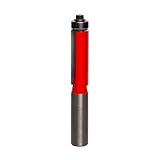
A bottom bearing router bit has its guide bearing below the cutting edges, so the bearing follows a template or finished surface while the cutters remove the overhanging material. It is the usual choice when the template sits on top of the workpiece. The arrangement is different from a top-bearing pattern bit, which follows a template positioned beneath the work.
This makes a router bit with bearing on bottom useful for duplicating shapes, trimming laminate, routing curved parts, copying sign blanks, and flush-trimming a workpiece against a shop-made pattern. The bearing does not determine the cut by itself: the cutting diameter and bearing diameter must be considered together.
Key specifications compared
| Bit configuration | Typical cutting diameter | Cutting length | Shank | Best use |
|---|---|---|---|---|
| Compact flush-trim | 1/4 to 3/8 in. | 1/2 to 3/4 in. | 1/4 in. | Thin laminate, small templates, light trimming |
| Standard pattern bit | 1/2 in. | 3/4 to 1 in. | 1/4 or 1/2 in. | General template routing and flush trimming |
| Long-reach pattern bit | 1/2 to 5/8 in. | 1-1/4 to 2 in. | 1/2 in. preferred | Thick stock and two-layer templates |
| Large-diameter production bit | 3/4 to 1 in. | 1 to 1-1/2 in. | 1/2 in. | Stable cuts in hardwood and repeated work |
| Spiral bearing-guided bit | 1/4 to 1/2 in. | 1/2 to 1-1/2 in. | 1/4 or 1/2 in. | Cleaner evacuation and reduced splintering |
How the bearing diameter changes the result
The bearing should normally match the cutter diameter. If both are 1/2 inch, the bit follows the template and cuts flush with its edge. A smaller bearing can create an intentional offset, while a larger bearing can make the cutter remove less material than the template edge suggests.
The offset is calculated as:
Offset = (cutter diameter − bearing diameter) ÷ 2
For example, a 5/8-inch cutter paired with a 1/2-inch bearing produces a 1/16-inch outward offset from the template. That can be useful for leaving a small finishing allowance, but it is a poor choice if you expect the part to be flush after one pass. Check the bearing and cutter dimensions rather than assuming a bit described as “pattern” will be exact.
A 1/2-inch bearing is the most versatile size because replacement bearings are common and it provides a broad, stable contact surface. Smaller bearings fit tighter curves, but they have less surface area and can be more sensitive to dust, wear, and a slightly tilted router.
Cutting length: choose capacity, not maximum reach
Cutting length should exceed the material thickness by only enough to let the bearing contact the template securely. A bit that is much longer than necessary increases leverage, vibration, and the chance of damaging an exposed edge.
For 3/4-inch plywood with a 1/4-inch template, a 1-inch cutting length is usually sufficient. For a 1-1/2-inch hardwood blank with a template on top, a 1-1/2-inch or longer cutter may be required, although two controlled passes are often safer than one deep pass.
Do not bury the entire cutting length simply because it is available. Make the first pass remove most of the waste, then let the bearing guide the final pass. This reduces heat and puts less load on the carbide.
Carbide quality and bit construction
Carbide-tipped bits are the sensible choice for ordinary wood, plywood, MDF, and laminate. Look for carbide that is thick enough to permit several sharpenings and brazed or machined cleanly onto the body. Industrial-grade carbide generally holds an edge longer in abrasive sheet goods than inexpensive thin-tip construction.
Solid-carbide spiral bits can produce a cleaner shearing action and evacuate chips more effectively than straight cutters, especially in plywood and MDF. However, they cost more, are less forgiving of nails or screws, and may have a shorter practical life if used against dirty reclaimed wood.
A spiral router bit with bearing is a good choice when edge quality matters or when a straight bit repeatedly chips veneer. An upcut spiral lifts chips away but can pull fibers from a veneered top surface. A downcut spiral presses fibers down and often improves the top edge, though chip removal can be less efficient. Select the spiral direction according to which surface must look best.
Shank size: 1/4 inch versus 1/2 inch
A 1/4-inch shank is convenient for compact routers and adequate for short cutters, light passes, and small templates. It is also easier to use in confined spaces. Keep the bit projection as short as the job allows, because a long exposed 1/4-inch shank amplifies vibration.
A 1/2-inch shank is preferable for cutting diameters above 1/2 inch, cutting lengths over about 1 inch, hardwood, and extended production runs. It offers greater stiffness and typically reduces chatter. A 1/2-inch shank will not fit a 1/4-inch collet, so verify the router’s collet system before buying.
Best choice by situation
| Your situation | Recommended specification | Why |
|---|---|---|
| Occasional DIY template work | 1/4-inch shank, 1/2-inch cutter, 3/4-inch cutting length | Low cost and sufficient capacity for common plywood |
| Frequent cabinet or sign work | 1/2-inch shank, 1/2-inch bearing, 1-inch cutting length | Versatile and stable across many materials |
| Thick hardwood components | 1/2-inch shank, 5/8- to 3/4-inch cutter, 1-1/2-inch capacity | More rigidity and fewer overloaded passes |
| Veneered plywood or MDF | Spiral bearing-guided bit, matched bearing and cutter | Improves shearing and chip evacuation |
| Tight inside curves | 1/4- to 3/8-inch cutter with a small bearing | Smaller radius and less template interference |
| Repeated production trimming | Large-diameter carbide bit, 1/2-inch shank, replaceable bearing | Better heat management and longer service life |
Bit profiles beyond straight flush trimming
A straight bottom-bearing flush-trim bit makes a vertical edge. A bearing-guided router bit can also use a round-over, chamfer, rabbeting, or ogee profile when the bearing establishes the edge location. These profiles are useful when the template must control both the shape and the position of the decorative cut.
For a first template-routing set, buy a straight bit before specialty profiles. Decorative profiles are less tolerant of changing depth, and a bearing that is not fully supported can produce an uneven transition. A bearing guided router bit should always have enough template or workpiece surface under the bearing to prevent it from dropping into a gap.
What about compression router bits with bearings?
A compression router bit with bearing combines a compression-flute cutting pattern with a guide bearing, usually for laminated plywood or veneered panels. It can reduce tear-out on both the upper and lower faces when the cutting depth and feed direction are correct. These bits are specialized and are not automatically better than a straight flush-trim bit.
Use one when both faces of a panel need clean edges and you are prepared to follow the manufacturer’s recommended plunge depth. For ordinary solid wood templates, the added cost and setup sensitivity usually offer little benefit.
Setup and maintenance that extend bit life
- Secure the template with clamps or screws placed outside the cutting path. Adhesive alone can let a template shift during a climb-cut section.
- Install the shank at least to the manufacturer’s insertion mark, but do not bottom it out in the collet. Tighten the collet firmly with the correct wrench.
- Set the bearing height so it contacts the template continuously. A partial contact patch allows the bit to wander.
- Remove waste in stages when more than about 1/2 inch is overhanging. The final pass should be light and consistent.
- Inspect the bearing after each long session. Clean resin and dust from its shield, and replace it if it feels rough, loose, or fails to spin freely.
- Clean carbide with a resin remover intended for router bits. Do not scrape the edges with steel, and do not run a dull bit harder to compensate.
The bearing usually wears before the carbide when the template is abrasive or dusty. A replacement bearing is often inexpensive, whereas a damaged carbide edge may require professional sharpening or replacement. Avoid routing through fasteners: even a single hidden screw can chip carbide and distort the bearing.
Bottom line
Choose a matched 1/2-inch cutter and bearing with a 1/2-inch shank for the best all-purpose bottom bearing router bit. Move to a 1/4-inch shank and shorter cutting length for compact, occasional work; choose a spiral version for difficult plywood or veneer; and reserve long-reach or compression-bearing designs for jobs that specifically require their extra capacity. Matching the bearing diameter, cutting length, and material thickness matters more than selecting the most elaborate profile.