Best Flush Trim Router Bits for Clean Pattern Routing
What's inside
- Quick comparison: which flush trim bit fits your job?
- Top-bearing versus bottom-bearing flush trim bits
- 1/4-inch shank or 1/2-inch shank?
- Cutting length and maximum material thickness
- Carbide quality matters more than an extra inch of reach
- Best choice by material
- Decision matrix for buying in 2026
- Setup and maintenance that prevent poor results
- Bottom line
- Related Guides
- Quick comparison: which flush trim bit fits your job?
- Top-bearing versus bottom-bearing flush trim bits
- 1/4-inch shank or 1/2-inch shank?
- Cutting length and maximum material thickness
- Carbide quality matters more than an extra inch of reach
- Best choice by material
- Decision matrix for buying in 2026
- Setup and maintenance that prevent poor results
- Bottom line
- Related Guides
As an Amazon Associate I earn from qualifying purchases. This post may contain affiliate links at no extra cost to you.
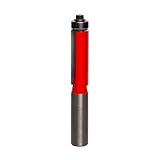
The best flush trim router bit for most woodworking is a carbide-tipped, 1/2-inch-shank bit with a top bearing and a 1-inch cutting length; choose a bottom-bearing version instead when the template must sit above the workpiece or when routing with a handheld router.
A flush trim bit copies the edge of a template, previously cut part, or laminate overhang. Its bearing follows the reference edge while the cutters remove the excess material. The right choice depends less on brand name than on bearing position, cutting length, carbide quality, shank size, and the material you need to trim.
As an Amazon Associate we earn from qualifying purchases at no extra cost to you.


Contents
- Quick comparison: which flush trim bit fits your job?
- Top-bearing versus bottom-bearing flush trim bits
- 1/4-inch shank or 1/2-inch shank?
- Cutting length and maximum material thickness
- Carbide quality matters more than an extra inch of reach
- Best choice by material
- Decision matrix for buying in 2026
- Setup and maintenance that prevent poor results
- Bottom line
- Related Guides
Quick comparison: which flush trim bit fits your job?
| Bit type | Bearing position | Typical cutting length | Practical maximum material thickness | Best use | Typical market range |
|---|---|---|---|---|---|
| Compact 1/4-inch shank | Top or bottom | 1/2–3/4 in | About 1/2 in per pass | Laminate, thin plywood, light template work | $12–$30 |
| Standard 1/2-inch shank | Top or bottom | 3/4–1 in | About 3/4 in per pass | General hardwood and plywood routing | $20–$50 |
| Long-reach pattern bit | Usually top | 1-1/4–2 in | About 1-1/4 in per pass | Thick templates and deep pattern work | $30–$75 |
| Compression or shear-style laminate bit | Usually bottom | 1/2–1 in | About 1/2–3/4 in per pass | Chipping-sensitive laminate and veneered panels | $25–$70 |
These are useful working ranges rather than universal manufacturer limits. The router, cutter diameter, feed rate, grain direction, template stability, and the bit maker’s instructions can reduce the safe depth. A long cutting length does not mean a router should remove the full thickness in one pass.
Top-bearing versus bottom-bearing flush trim bits
Top-bearing bits
On a top-bearing bit, the bearing is above the cutters when the bit is installed in a conventional table or handheld-router setup. This arrangement is convenient when the template is on top of the workpiece and the router is guided from above. It is also useful for copying a top-mounted pattern through a thicker blank.
A top-bearing flush trim router bit is often the most versatile choice for template routing. However, the template must be securely attached because the bearing can pull the assembly toward the guide. Double-sided woodworking tape, clamps outside the cutting path, or screws in waste areas are safer than relying on hand pressure.
Bottom-bearing bits
A bottom-bearing bit places the bearing at the end nearest the router base. It works well when the pattern is below the workpiece, when trimming laminate with the router base resting on the panel, or when a previously shaped edge is used as the guide.
Bottom-bearing flush trim router bits are especially practical for countertop and cabinet laminate. Keep the router base flat and move against the cutter’s rotation when working freehand. A bearing that is dirty, seized, or loose can stop following the reference edge and ruin the profile.
1/4-inch shank or 1/2-inch shank?
Searches for a “1/4 flush trim router bit” can mean two different things: a bit with a 1/4-inch shank or a bit intended to trim 1/4-inch-thick material. Check the specification carefully. “1/4 flush trim router bit” is not a complete size description unless it states which measurement is 1/4 inch.
A 1/4-inch-shank bit fits compact routers and is adequate for thin plywood, edge banding, plastic laminate, and occasional pattern work. Its smaller shank has less stiffness, so use conservative cutting depths and avoid forcing a large-diameter cutter through hardwood.
A 1/2-inch-shank bit is the better choice for frequent use, large cutters, thick hardwood, and deep templates. It reduces deflection and generally gives a cleaner, more predictable cut, provided the router accepts a 1/2-inch collet. Never use a reducer sleeve as a substitute for the correct collet.
Cutting length and maximum material thickness
Match cutting length to the thickness that must be trimmed, not to the total thickness of the assembled jig. A bit with a 1-inch cutting length can reach approximately 1 inch of material, but leaving no clearance invites overheating and bearing contact with the wrong surface.
For a practical sizing calculation, suppose a plywood blank is 18 mm thick and the template is 6 mm thick. The bit needs to cover the 18 mm workpiece thickness, while the template controls the bearing. A 1-inch, or 25.4 mm, cutter provides about 7.4 mm of nominal length beyond the workpiece. That margin accommodates minor setup differences without requiring the cutter to run at the end of its flutes.
When the stack is thicker than the bit’s cutting length, remove most of the waste with a bandsaw, jigsaw, or straight bit first. Leave roughly 1/16 inch to 1/8 inch for the flush trim pass. This lowers heat, noise, and bearing load while improving edge quality.
Carbide quality matters more than an extra inch of reach
Look for brazed carbide tips with a clean, uniform grind and sufficient carbide thickness for repeated sharpening. Carbide lasts considerably longer than high-speed steel against plywood glue, MDF resin, laminate, and abrasive hardwood. A polished or low-friction body can also reduce resin buildup, but it does not compensate for dull cutting edges.
Freud, Whiteside, Amana Tool, Bosch, and CMT all offer established router-bit ranges, but individual models differ. Compare the actual cutter diameter, cutting length, bearing size, shank, and replacement-bearing availability rather than choosing by brand alone.
For plywood, two-flute carbide cutters are a dependable general-purpose option. In hardwood, a sharp bit with a substantial 1/2-inch shank is preferable, especially for long cuts. On laminate, a bit marketed for laminate or with a geometry intended to reduce chipping can leave a cleaner surface than a general-purpose straight cutter.
Best choice by material
- Plywood: Choose a sharp carbide bit with a 1/2-inch shank for repeated work. Make shallow passes when the plywood has voids or exposed cross-grain layers, since a flush trim bit can pull fibers from the edge.
- Hardwood: Use the largest practical shank and a cutting length close to the job’s thickness. Remove excess stock first and take climb-cutting only as a brief, controlled cleanup technique at corners—not as the normal feed direction.
- Laminate: A compact bottom-bearing bit is convenient for trimming overhangs. Support the panel fully, keep the router base flat, and use a sharp cutter; dull carbide tends to chip the decorative layer and burn adhesive.
- MDF: Wear suitable respiratory protection and use dust extraction. MDF dulls edges quickly, so a replaceable or economically priced bit may make more sense for high-volume work.
Decision matrix for buying in 2026
| Your situation | Recommended specification | Why |
|---|---|---|
| Occasional DIY laminate trimming | 1/4-inch shank, 1/2–3/4-inch cutting length, bottom bearing | Compact and sufficient for thin material |
| Template work every few months | 1/2-inch shank, 1-inch cutting length, interchangeable bearing if available | More stable and adaptable |
| Frequent hardwood pattern routing | 1/2-inch shank, premium carbide, 3/4–1-inch cutting length | Better stiffness and wear resistance |
| Thick workpieces or tall templates | Long-reach bit, used in multiple passes | Reaches the guide without burying the cutter |
| Limited workspace or compact router | Small-diameter 1/4-inch-shank bit | Lower mass and easier handling, with reduced capacity |
Setup and maintenance that prevent poor results
- Inspect the bit. Check that the carbide is intact, the bearing spins freely, and the shank is clean.
- Insert the shank correctly. Seat it deeply in the collet, then withdraw it slightly—often around 1/16 inch—to prevent bottoming. Follow the router manufacturer’s collet instructions.
- Secure the template. Any movement becomes a matching defect on every workpiece.
- Remove excess waste first. Keep the flush trim cutter engaged with a small amount of material whenever possible.
- Feed consistently. Move against the cutter’s rotation with both hands controlling the router. Do not pause in one spot.
- Clean after use. Remove resin and adhesive with a router-bit cleaner approved for carbide. Do not scrape carbide with steel, and do not lubricate a sealed bearing with penetrating oil unless its maker permits it.
The bearing is usually the first component to show trouble: it may become noisy, rough, or intermittently sticky. Replace a damaged bearing rather than continuing to route. Dull carbide, chipped corners, excessive heat, and a loose template are the other common causes of poor flush-trim results.
Bottom line
For a single versatile purchase, choose a 1/2-inch-shank, carbide-tipped flush trim bit with a top bearing and approximately 1 inch of cutting length. Add a bottom-bearing 1/4-inch-shank bit if laminate and thin panels are your main work. If you routinely route hardwood or thick patterns, spend more on carbide quality and stiffness, then remove the bulk of the waste before the router bit flush trim pass.