Best Table Edge Router Bits for Clean Decorative Profiles
What's inside
As an Amazon Associate I earn from qualifying purchases. This post may contain affiliate links at no extra cost to you.
The best table edge router bit for most furniture work is a 1/2-inch-shank carbide roundover or ogee bit sized so its cutting depth is no more than one-third of the stock thickness; choose a chamfer for a crisp modern edge, a cove for a softer traditional profile, and a bearing-guided bit whenever consistent edge tracking matters.
As an Amazon Associate we earn from qualifying purchases at no extra cost to you.



Contents
Quick picks by woodworking situation
| Situation | Best profile | Useful size | Safely suitable stock | Why choose it |
|---|---|---|---|---|
| First decorative table | Roundover | 1/4-inch radius, 1/2-inch shank | 3/4 inch and thicker | Forgiving setup and easy sanding |
| Small, contemporary edge | 45-degree chamfer | 1/4-inch cutting depth | 1/2 inch and thicker | Sharp visual line without a large profile |
| Traditional tabletop or shelf | Ogee | 5/8- to 3/4-inch profile | 1 inch and thicker | Combines a cove and bead-like transition |
| Softening a large furniture edge | Roundover | 3/8- to 1/2-inch radius | 1 inch and thicker | Comfortable hand contact and fewer sharp corners |
| Decorative apron or narrow trim | Cove | 1/4- to 3/8-inch radius | 3/4 inch and thicker | Creates a concave shadow line |
How the main table edge profiles compare
Roundover bits: the safest all-purpose choice
A roundover bit removes the sharp corner and leaves a quarter-circle transition. It is the most useful edge rounding router bit for dining tables, desks, benches, and children’s furniture because the profile is symmetrical and easy to blend at corners. A 1/4-inch radius is subtle; a 3/8-inch radius is more noticeable; and a 1/2-inch radius creates a substantial furniture edge.
For a balanced appearance, the radius should generally be smaller than half the board thickness. On 3/4-inch stock, a 1/4-inch roundover is a sensible maximum for a full profile. A 1/2-inch roundover requires at least 1 inch of thickness if you want material remaining above and below the profile.
Chamfer bits: clean lines and easy control
A chamfer bit cuts a straight angled face, commonly at 22.5 or 45 degrees. It is less likely than a roundover to look oversized on thin stock, and its cutting depth is simple to judge from the fence or bearing position. A 1/4-inch chamfer works well on 1/2- to 3/4-inch boards, while a 3/8-inch chamfer is better reserved for stock around 1 inch thick or more.
Chamfers also expose less end-grain tear-out than some complex profiles because the cut is relatively direct. They suit modern tables, cabinet shelves, and plywood edges that need a deliberate visual break.
Ogee bits: attractive, but demanding
An ogee combines convex and concave curves. It gives a traditional table edge a more elaborate appearance than a roundover, but it needs adequate thickness and careful height adjustment. Large ogee cutters can remove a substantial amount of wood in one pass, so they are better used in two or more shallow passes.
Use a small ogee on stock at least 3/4 inch thick and reserve large 5/8- or 3/4-inch profiles for boards approximately 1 inch to 1-1/4 inches thick. Do not allow the decorative portion to consume nearly the entire edge: a thin remaining lip can chip or look weak.
Cove and beading bits: useful accents
A cove bit cuts a concave groove into the edge. It is often paired with a bead or roundover elsewhere in a design, but it can also form a restrained shadow line on its own. Because the cutter removes material inward rather than merely softening the corner, check the remaining edge thickness before routing.
Beading bits create a rounded convex detail. They are effective on thicker aprons and trim, but a bead placed too close to the top surface can leave a fragile ridge. For narrow or thin material, a small roundover is usually more forgiving than a full bead.
Bearing diameter, shank size, and cutting depth
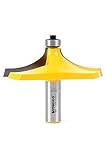
Most bearing-guided table edge router bits use a bearing around 1/2, 5/8, or 3/4 inch in diameter. The bearing follows the existing edge; it does not automatically determine the profile radius. A larger bearing can provide a broader contact surface on a wide edge, while a smaller bearing may fit into a tighter layout or allow a more compact cutter design.
For a bearing-guided bit, verify that the bearing turns freely and that its diameter matches the intended guide surface. A bearing that is dirty, seized, or loose can burn the edge and make the cut vary in depth. Replace a damaged bearing rather than lubricating it with a heavy oil that can attract dust.
A 1/2-inch shank is preferable for a router table because it provides better rigidity for large-diameter cutters and deep profiles. A 1/4-inch shank is acceptable for small roundovers and chamfers, especially in a handheld trim router, but it is a less desirable choice for large edge-forming router bits. Never install a 1/2-inch bit in a 1/4-inch collet or use a reducer sleeve unless the router manufacturer specifically approves that system.
Cutting depth means how far the profile enters the edge, not simply the total diameter of the cutter. Set the bit so the bearing contacts the edge and the decorative shape leaves a substantial flat or structural section. As a practical starting point, keep the maximum cut depth at or below one-third of the board thickness for thin stock and avoid removing more than about half the edge thickness even on large, stable hardwood.
Worked sizing example
Suppose a tabletop is 1 inch thick and you want a comfortable rounded edge. A 3/8-inch roundover removes a 3/8-inch quarter-circle from the upper or lower corner. If you round only the top edge, about 5/8 inch of lower material remains, giving the board a strong flat underside. If you use the same bit on both faces, the two profiles meet at the center and leave almost no straight section; that may look attractive, but it provides less protection against dents.
For a 3/4-inch tabletop, choose a 1/4-inch roundover or a chamfer with approximately 3/16- to 1/4-inch depth. Make a test cut in scrap from the same material before touching the finished edge.
Carbide durability and ownership costs
Carbide-tipped cutters from established manufacturers such as Freud, Whiteside, Bosch, Amana Tool, and CMT are widely available in common edge profiles. The brand matters less than carbide thickness, accurate brazing, a true-running bearing, and a clean grind. Thick carbide generally tolerates more sharpening cycles, while inexpensive cutters may show a dull edge sooner in abrasive woods or veneered sheet goods.
The cutting edges usually wear before the shank. Dull carbide produces a fuzzy surface, increased burning, and greater feed resistance. Pitch and resin buildup can mimic dullness, so clean the cutter with a router-bit resin cleaner or an approved mild cleaning method before deciding it needs sharpening. Do not scrape carbide with hardened steel or soak the bearing.
As a rough ownership calculation, a $35 bit used for 70 furniture projects costs about 50 cents per project before sharpening. A cheaper $18 bit that lasts only 20 projects costs 90 cents per project. The more durable option also reduces sanding and the risk of ruining expensive stock. Prices vary by profile and size, but common carbide edge bits generally occupy a broad mid-range market band of roughly $15 to $80, with large specialty profiles costing more.
Safe setup for router bits for table edges
- Inspect the bit. Check that the carbide is intact, the bearing spins smoothly, and the shank is clean.
- Choose a stable height. Start with a partial profile and leave a small flat section rather than trying to achieve maximum depth immediately.
- Secure the fence and guard. Keep the fence aligned with the bearing or use the bearing as the guide only when the bit and setup are designed for it.
- Test on matching scrap. Confirm the profile, bearing contact, grain direction, and corner treatment.
- Take multiple passes. Remove roughly 1/8 inch or less per pass on a large profile, reducing the cut further in hard wood or end grain.
- Feed against rotation. On a standard router table, feed the work from right to left. Keep hands clear and use push blocks where the workpiece allows.
- Finish the corners separately. A bearing-guided bit cannot prevent end-grain breakout at a corner. Rout end grain first, then long grain, or use climb-cutting only as a controlled, shallow cleanup operation with proper experience.
Before routing, remove loose knots, confirm the board is flat against the table, and use dust extraction. Large edge forming router bits can generate considerable torque, so use the router manufacturer’s maximum cutter diameter and speed limits. Stop if the bit vibrates, the bearing stops turning, or the workpiece becomes difficult to control.
Bottom line
Choose a 1/4-inch roundover for a dependable first table edge router bit, a 45-degree chamfer for thin modern work, a 3/8- or 1/2-inch roundover for thick tabletops, and an ogee or cove only when the stock is thick enough to support the deeper profile. For frequent table work, prioritize a 1/2-inch shank, thick carbide, a replaceable bearing, and a size that leaves plenty of wood after the cut.