Best Table Saws with Mobile Bases for Compact Workshops
What's inside
- Best Table Saws with Mobile Bases for Compact Workshops
- Quick comparison
- Best for most compact shops: a contractor saw on a full mobile base
- Best when space is extremely tight: a jobsite saw with a rolling stand
- Best for heavier use: a hybrid saw with a low-profile mobile base
- What to check before buying
- When the cheaper option is fine
- Best Table Saws with Mobile Bases for Compact Workshops
- Quick comparison
- Best for most compact shops: a contractor saw on a full mobile base
- Best when space is extremely tight: a jobsite saw with a rolling stand
- Best for heavier use: a hybrid saw with a low-profile mobile base
- What to check before buying
- When the cheaper option is fine
As an Amazon Associate I earn from qualifying purchases. This post may contain affiliate links at no extra cost to you.
Contents
- Best Table Saws with Mobile Bases for Compact Workshops
- Quick comparison
- Best for most compact shops: a contractor saw on a full mobile base
- Best when space is extremely tight: a jobsite saw with a rolling stand
- Best for heavier use: a hybrid saw with a low-profile mobile base
- What to check before buying
- When the cheaper option is fine
Best Table Saws with Mobile Bases for Compact Workshops
A table saw with a good mobile base can be more useful in a small workshop than a larger saw that never moves. The right setup needs to roll easily, lock solidly, and return to a stable position without shifting during a cut. A poor base does the opposite: it makes alignment tedious, raises the saw’s working height, and can let the machine creep when ripping a heavy board.
For most compact shops, there are three sensible choices: a jobsite saw with an integrated stand, a compact contractor saw with a folding or wheeled stand, or a heavier contractor or hybrid saw fitted to a separate mobile base. The best option depends on how often you move the saw and how much sheet goods or hardwood you expect to cut.
As an Amazon Associate we earn from qualifying purchases at no extra cost to you.


Quick comparison
| Saw type | Typical weight | Best use | Main compromise |
|---|---|---|---|
| Jobsite saw with rolling stand | 45–75 lb | Frequent setup and storage | Smaller table and more vibration |
| Compact contractor saw | 80–130 lb | Better accuracy in a small shop | Usually needs a separate base or stand |
| Hybrid saw on mobile base | 250–350 lb | Regular furniture and cabinet work | Needs more floor space and careful positioning |
Best for most compact shops: a contractor saw on a full mobile base
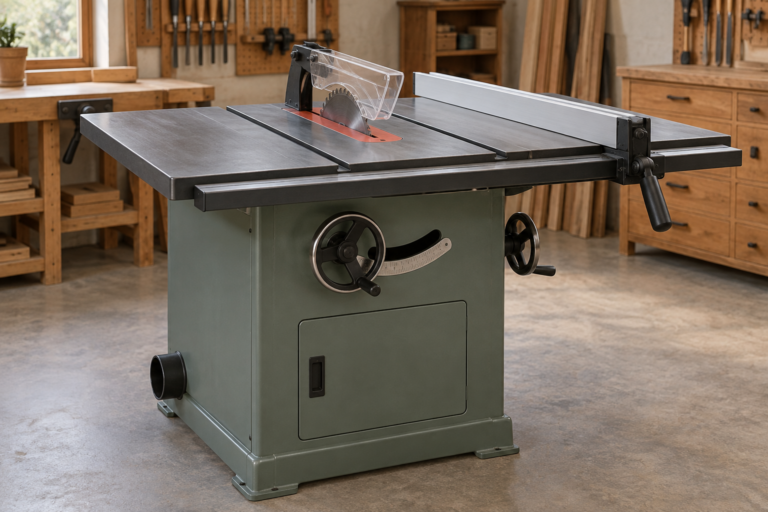
A compact contractor saw is the best middle ground when you have room to roll a machine against a wall but do not want a permanent cabinet saw. It generally offers a heavier cast-iron or steel table, a more rigid fence, and less vibration than a lightweight jobsite saw. A 10-inch blade and roughly 24 to 30 inches of rip capacity cover most small-shop work.
Look for a base rated at least 50 pounds above the saw’s actual operating weight. That margin accounts for the fence, dust hose, outfeed support, and any jig left on the table. A base rated for 300 pounds is a safer choice for a 220-pound saw than one rated for exactly 220 pounds.
For this setup, compare contractor table saws with mobile bases rather than buying a bare saw and assuming any caster set will fit. Check the leg spacing, bolt pattern, and minimum and maximum footprint before ordering.
Best when space is extremely tight: a jobsite saw with a rolling stand
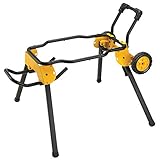
If the saw must be stored under a bench or moved through a narrow doorway, a jobsite saw is usually the practical choice. Integrated stands fold quickly, and many have two fixed wheels plus a handle that lets you tilt and roll the machine like a hand truck. This is much more convenient than lifting a 100-pound saw every weekend.
The trade-off is stability. Narrow stands can twist when you push a full sheet into the blade, especially if one leg sits on an uneven floor. Before cutting, lock every caster or stand wheel and test the saw by pushing sideways on the table. If it rocks, the problem is not solved by tightening the blade; the stand or floor needs attention.
A jobsite model is fine for shelving, trim, flooring, and occasional plywood. It is less pleasant for repeated hardwood ripping or large cabinet panels. The smaller table also makes a separate outfeed table almost essential. Search jobsite table saws with rolling stands if storage space matters more than maximum cutting comfort.
Best for heavier use: a hybrid saw with a low-profile mobile base
A hybrid saw on a quality mobile base is the most stable option short of a full cabinet saw. The enclosed or semi-enclosed base reduces vibration, and the larger table makes it easier to keep a board against the fence. This matters when cutting 8-foot boards, thick hardwood, or multiple identical parts.
The disadvantage is not just weight. A hybrid saw can occupy a footprint around 30 by 40 inches before adding infeed and outfeed space. You need at least 3 feet of working clearance on the infeed side and enough room to stand safely beside the cut. A mobile base helps storage, but it does not make the saw small while it is in use.
Choose a base with four independently adjustable feet or a mechanism that lifts the casters completely off the floor. Bases that leave one wheel carrying partial weight can cause a saw to shift during a cut. For this class of machine, consider heavy-duty table saw mobile bases with a stated capacity of at least 500 pounds.
What to check before buying
Wheel design: Two swiveling casters and two fixed wheels roll predictably, but four swiveling casters are easier to steer in a tight corner. The latter must have positive locks; inexpensive friction brakes often loosen with dust and vibration.
Working height: A mobile base can raise a saw by 1 to 3 inches. That may put the table above a comfortable 34- to 36-inch work height or leave an outfeed table too low. Measure from the floor to the existing tabletop, then add the base height before buying.
Dust collection: A raised saw can pull on a dust hose and make the base harder to move. Use a flexible hose with enough slack for the full travel, but keep it away from the blade, belts, and caster hardware. A blocked port or poorly sealed cabinet can reduce collection enough to leave chips on the floor and in the motor.
Leveling: Do not rely on caster locks to level the machine. Engage leveling feet, lower the saw firmly, and check for rocking at all four corners. Recheck the fence parallel to the miter slot after moving the saw. A shift of even 1/32 inch at the rear can cause burning, binding, or a cut that is not square.
When the cheaper option is fine
A basic jobsite saw and rolling stand are enough if you make occasional crosscuts, rip narrow boards, or break down plywood with a guide. Spending several hundred dollars more on a heavier saw will not automatically improve results if the fence is poorly adjusted or the stock is unsupported.
Pay for the heavier contractor or hybrid setup when you routinely cut hardwood, need repeatable rip widths, or are tired of realigning a light saw after every move. In a compact workshop, stability, accurate setup, and easy storage usually matter more than maximum horsepower.