Best Table Saws for Repetitive Production Joinery
What's inside
As an Amazon Associate I earn from qualifying purchases. This post may contain affiliate links at no extra cost to you.
Repetitive joinery changes what matters in a table saw. Maximum horsepower is useful, but repeatability, fence stability, fast setup, dust collection, and operator safety usually matter more. When cutting hundreds of parts, a fence that moves 1/32 inch or a stop that slowly creeps can create more waste than a slightly underpowered motor.
For most small shops, the best starting point is a 3-hp cabinet saw with a 30- or 52-inch fence. A contractor-style saw can handle production work, but it gives up mass, dust control, and often the rigid fence support needed for reliable batches. If the work includes narrow strips, repeated tenons, or box joints, plan the saw around an accurate stop system and dedicated jigs rather than relying on a tape measure for every cut.
Contents
Which table saw type fits production joinery?
| Saw type | Best use | Main strengths | Main limitations |
|---|---|---|---|
| Cabinet saw | Daily production and furniture joinery | Rigid, powerful, quiet, excellent dust collection | Heavy, expensive, usually stationary |
| Contractor saw | Small batches and mixed shop work | Lower price, mobile, adequate capacity | More vibration, weaker dust collection, less rigid stands |
| Hybrid saw | Serious hobby work and light production | Cabinet-style base at a moderate price | Usually limited to about 1-1/2 to 2 hp |
| Sliding table saw | Crosscutting panels and accurate repeated parts | Excellent support and repeatable crosscuts | Costs more and takes substantial floor space |
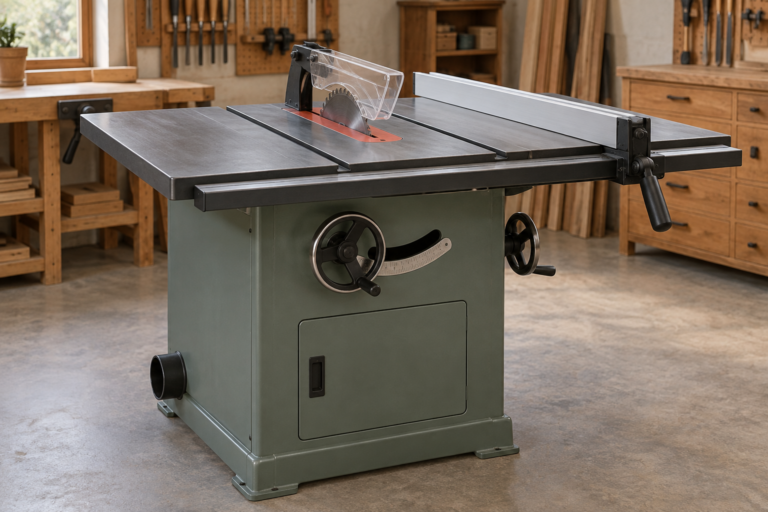
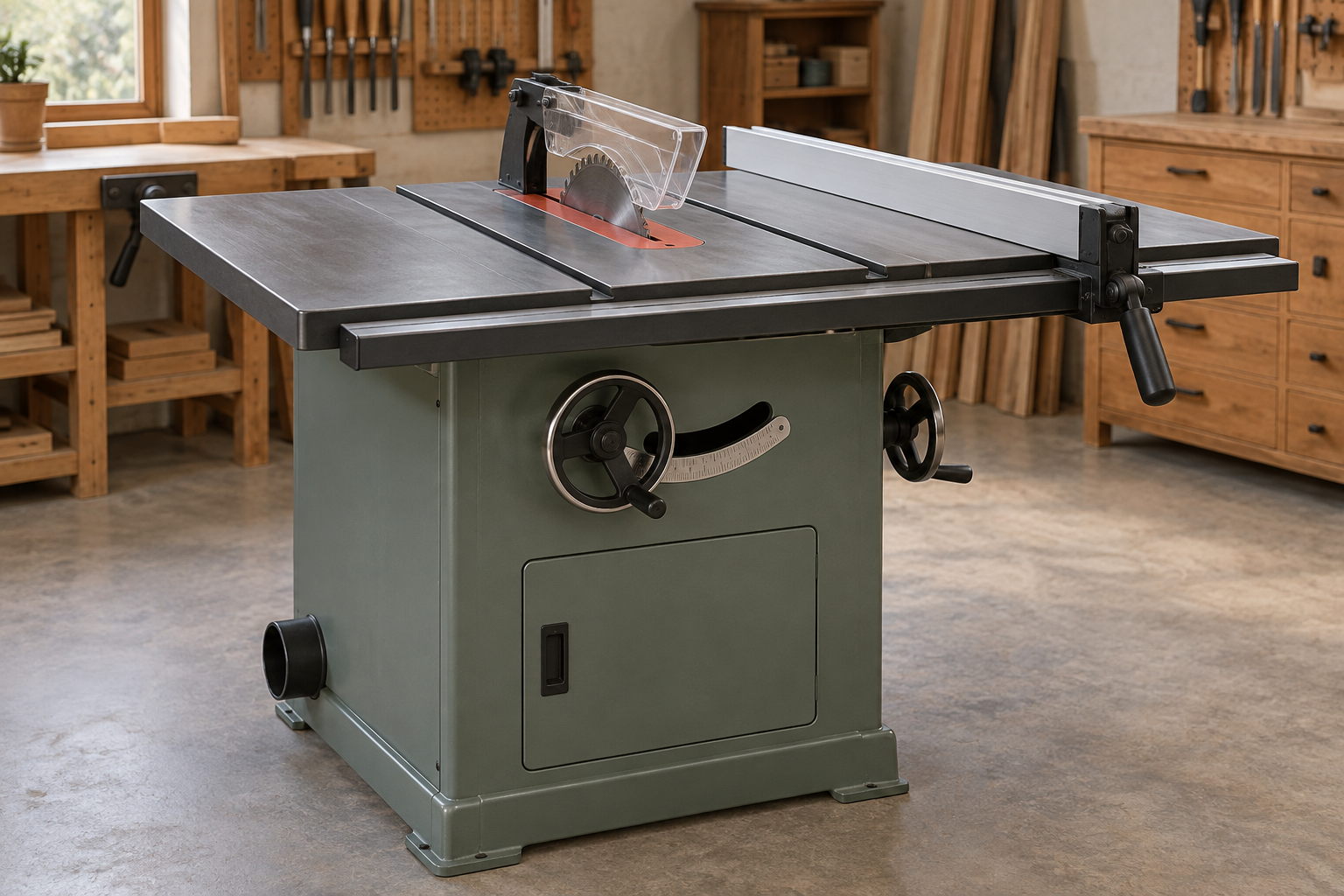
A cabinet saw is the safest general recommendation when the machine will run several hours a week. Its cast-iron top and enclosed base resist movement, and a 3-hp motor keeps the blade from slowing in hardwood. A properly wired 240-volt circuit is normally required. Verify the machine’s electrical requirements before buying; some “3-hp” saws are marketing claims that do not compare directly across brands.
A hybrid saw is fine when the batch size is measured in dozens rather than hundreds. It can make accurate cuts, especially after tuning, but the lighter trunnions and smaller motor leave less margin when ripping 8/4 maple or cutting a dado stack. For occasional cabinet parts, the cheaper option is often sensible.
Fence and stop systems are the production advantage
For ripping repeated widths, choose a fence that locks at both ends and stays parallel without hand pressure. A useful test is to lock it, measure the distance from the miter slot at the front and rear, and repeat after unlocking and relocking. Differences should be small enough that they do not show in the joint—roughly 0.005 inch is a good target for a tuned setup.
Long fences are not automatically better. A 52-inch rail is valuable for breaking down sheet goods, but it takes wall space and can make a small shop awkward. For solid-wood joinery, a 30-inch rip capacity is usually enough. Add a rigid auxiliary fence when using a dado blade, tenoning jig, or sacrificial face.
For repetitive crosscuts, use a miter gauge with a positive stop or build a crosscut sled with a replaceable stop block. A stop mounted directly to the sled is faster and safer than clamping a loose block to the fence. Leave enough clearance for the offcut so it cannot become trapped between the blade and stop. A trapped offcut can kick back or push the workpiece out of square.
If crosscutting is a major part of the job, consider a sliding table saw. Its table supports the work throughout the cut and makes repeated cabinet components easier to register. It is not automatically better for narrow ripping, though, and the added carriage requires more floor space and maintenance.
Blades, dadoes, and joinery fixtures
Use a high-quality combination or general-purpose blade for mixed work, but switch to a dedicated ripping blade for long runs in solid wood. A 10-inch blade with 24 to 30 teeth removes waste quickly; a 40- to 50-tooth blade gives cleaner crosscuts and plywood edges. Burning, excessive feed force, and a blade that wanders are signs that the blade is dull, dirty, incorrectly tensioned, or poorly suited to the cut.
For dadoes, confirm that the saw accepts the intended stack and that the throat plate leaves minimal exposed space around the cutters. Never assume a dado blade is approved just because the arbor fits. Check the manufacturer’s instructions, maximum dado width, and guard requirements. A tenoning jig should register against the fence without rocking, and its workpiece clamp must keep the part firmly down and against the reference face.
Repeatable joinery also depends on consistent stock. If boards vary by 1/32 inch in thickness, a precisely set tenon jig will still produce inconsistent shoulders. Joint one reference face, plane the opposite face, and mark the reference edge before bringing parts to the table saw.
Safety and dust collection for batch work
A riving knife aligned with the blade is essential. It keeps the kerf open and reduces the chance that a board will pinch the rear teeth. Use the guard for ordinary ripping and crosscutting; remove it only when a specific operation requires a different approved setup. Keep hands at least 6 inches from the blade, and use a push stick or push block well before the work becomes uncomfortable to control.
Dust collection affects both health and cut quality. An enclosed cabinet saw with a 4-inch port and a real dust collector will capture far more debris than an open contractor stand connected to a small shop vacuum. Fine dust buildup around the motor, trunnions, and elevation screws can also make adjustments stiff. Clean the cabinet and blade area regularly, especially when cutting MDF.
Practical buying recommendations
For daily furniture or cabinet production, shop for a 3-hp cabinet table saw with a 30-inch fence. This is the best balance for most joinery shops: enough power for hardwood, a manageable footprint, and a fence suited to repeatable ripping.
Choose a hybrid table saw with a 30-inch fence when the budget is tighter and batches are modest. Spend the savings on a better blade, crosscut sled, and dust collector. Those upgrades often improve real-world results more than moving from one midrange saw to another.
For production work, avoid choosing solely by rip capacity or horsepower. Confirm that replacement parts are available, the fence locks consistently, the table is flat, the riving knife can stay installed for normal cuts, and the machine fits your electrical service. A well-tuned 2-hp saw with reliable stops will outperform a larger saw that is difficult to set up accurately.