Best Table Saws with Enclosed Bases for Efficient Dust Extraction
What's inside
As an Amazon Associate I earn from qualifying purchases. This post may contain affiliate links at no extra cost to you.
Dust collection is one of the main reasons to choose a table saw with an enclosed base. A cabinet-style enclosure captures dust below the blade instead of allowing it to spill through an open stand, but the saw still needs a properly sized collector, sealed access panels, and a blade guard that does not leak badly. The best setup moves dust away before it reaches your lungs or coats the shop.
As an Amazon Associate we earn from qualifying purchases at no extra cost to you.


Contents
What an enclosed base actually does
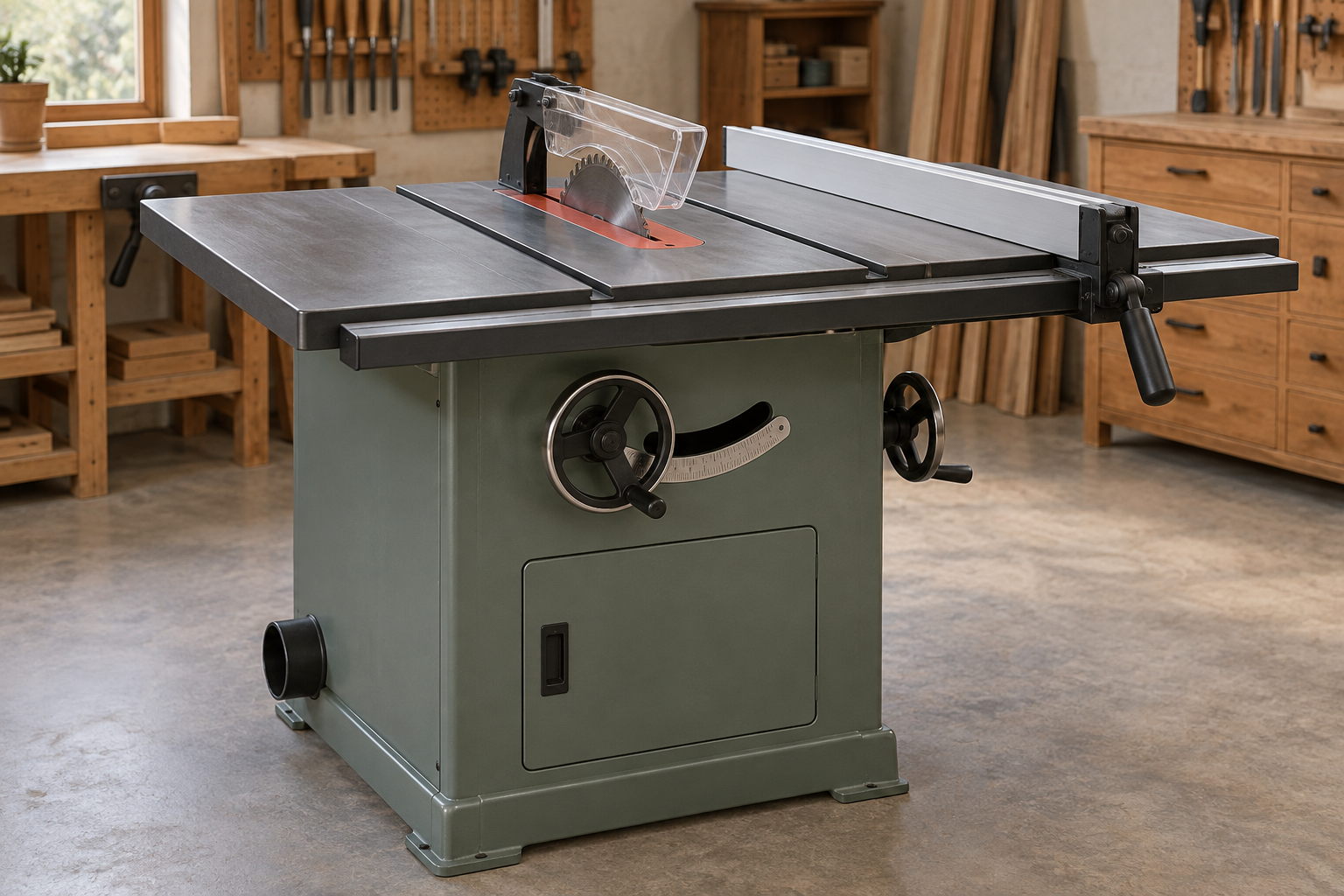
An enclosed-base table saw surrounds the motor, arbor, and lower blade area with sheet metal or a cabinet. Most have a 4-inch dust port, sometimes supplemented by a smaller port near the blade guard. This is different from a contractor saw on an open folding stand, where dust can fall directly onto the floor and escape around the motor.
The enclosure improves collection, but it does not make the saw dustproof. The blade throws chips forward and upward, while the teeth carry fine dust above the table. A decent overarm guard or dust-collecting blade guard can make a larger difference during ripping than a sealed cabinet alone. If you routinely cut plywood, MDF, or melamine, treat overhead collection as a major feature rather than an accessory.
Which enclosed-base saw type fits your shop?
For most permanent shops, a cabinet table saw is the strongest choice. Its rigid cabinet, induction motor, cast-iron table, and enclosed lower compartment provide good dust control and stable cutting. Typical motors are in the 1-3 horsepower range, and these saws commonly accept a 4-inch collector hose.
A hybrid table saw is the value option. It usually has an enclosed or partly enclosed base, a smaller motor, and lighter trunnions than a full cabinet saw. For a home shop cutting solid wood and sheet goods occasionally, a hybrid can be enough. The cheaper option is fine when you have a 1.5- to 2-hp motor, a rigid fence, and a real 4-inch port—not a tiny adapter that chokes airflow.
Look at hybrid table saws with enclosed bases if you need better extraction than a contractor saw but cannot justify the size, weight, or price of a full cabinet machine.
| Saw type | Dust control | Best use | Main compromise |
|---|---|---|---|
| Cabinet saw | Best, especially with overhead guard | Frequent furniture and sheet-good work | Heavy, expensive, usually stationary |
| Hybrid saw | Good with a sealed cabinet and collector | Home shops and moderate workloads | Less power and lighter construction |
| Contractor saw with enclosed aftermarket base | Variable; leaks are common | Existing saw owners on a budget | Motor and trunnion area may still shed dust |
Match the saw to the dust collector
A 4-inch port does not tell you how much air the saw needs. A typical cabinet saw works well with a collector delivering roughly 800 to 1,200 cubic feet per minute at the machine, not just the free-air rating printed on the collector. Long hoses, sharp bends, blast gates, and a clogged filter can cut that figure substantially.
For a single saw, a 1.5- to 2-hp dust collector with a 4-inch hose is a practical starting point. A 2- to 3-hp unit gives more margin, particularly with a 10-inch blade, overhead guard, or a hose run longer than about 15 feet. A shop vacuum can pull strongly through a small port, but it usually has insufficient volume for the open lower cabinet of a table saw. It is better suited to the guard port than the main cabinet outlet.
Use smooth-walled hose where possible. Flexible hose creates much more resistance, especially when stretched over a long distance. Keep the run short, open only the blast gate serving the saw, and check the collector filter before blaming the saw for poor capture.
Features worth paying for
Start with the cabinet itself. Doors should close against reasonably continuous seams, and removable panels should fit without large gaps. A badly fitting motor cover can leak more dust than the blade opening. Some saws include a bottom panel or dust funnel that directs debris toward the port; this is useful because flat cabinet floors allow chips to collect in corners.
Check the port diameter and location. A port facing straight backward may work well in a permanent installation but become awkward against a wall. A port low on the cabinet is often easier to connect, though it can clog if chips pile up inside. If the saw offers a second port for a blade guard, confirm that the guard hose does not interfere with the fence or stock.
The blade guard should lift easily and stay aligned. Operators frequently remove guards that are awkward, which eliminates the best collection point for above-table dust. A riving knife that accepts a separate guard is preferable to a guard requiring complicated tools or a full hardware change.
Common dust-collection failures
The most common failure is assuming that an enclosed base compensates for an undersized collector. Fine dust will still escape through the throat plate, blade slot, and cabinet seams. The second is using a zero-clearance insert with no relief for dust; chips can pack below the insert and restrict the blade.
Another problem is running a hose without a proper grounding strategy in a dry shop. Static buildup is not usually the main hazard with wood dust, but grounded hose systems can reduce annoying shocks. More important is preventing combustible dust accumulation: never let layers build on motors, heaters, or electrical boxes, and use a filter rated for fine woodworking dust.
Inspect the cabinet after a few cuts. A light coating is normal; piles of chips under the motor indicate poor internal airflow or a blocked port. If dust appears mostly on top of the table, improve the blade guard and workpiece support before replacing the saw.
A practical buying checklist
Choose a 2-hp cabinet table saw with a 4-inch dust port when you want a permanent, general-purpose machine and have room for a real dust collector. Choose a hybrid if your cuts are occasional and budget matters more than maximum rigidity. If you already own a contractor saw, an enclosed stand and better blade guard may be worthwhile, but calculate the upgrade cost against buying a better-sealed machine.
Before buying, measure the cabinet footprint, table height, fence travel, collector location, and electrical supply. A saw that captures dust well but leaves no room to open its motor door is not an efficient setup. For the cleanest results, pair the enclosed base with a sharp blade, a short 4-inch hose, a functioning overhead guard, and a collector whose airflow is measured at the hose—not merely advertised on the box.