One Hand Clamps Review
Key takeaways
- An editorial one hand clamps review that grades quick-release trigger clamps on jaw parallelism, pad grip, spine flex and long-term serviceability.
What's inside
As an Amazon Associate I earn from qualifying purchases. This post may contain affiliate links at no extra cost to you.
Every shop reaches the same moment: you are holding a panel against a fence with your left hand, a router in your right, and there is no third hand available. That is the problem one-handed trigger clamps exist to solve, and it is why this one hand clamps review focuses on mechanical behavior rather than marketing claims. A quick clamp is not a substitute for a parallel-jaw cabinet clamp. It is a fast, single-handed way to hold a stop block, tack a jig to a bench, or keep a workpiece from creeping while glue grabs.
The trouble is that the category has drifted. Bargain trigger clamps now look nearly identical to the ones that have held up in professional shops for two decades, and the differences that matter are all internal: how the pressure plate bites the bar, how much the spine flexes under load, whether the jaws stay parallel or rack into a wedge, and whether the pads stay attached after a year of glue. We graded on those criteria, and on serviceability, because a clamp you can rebuild is a clamp you keep.
As an Amazon Associate we earn from qualifying purchases at no extra cost to you. Product prices and availability are accurate as of the date shown and are subject to change.



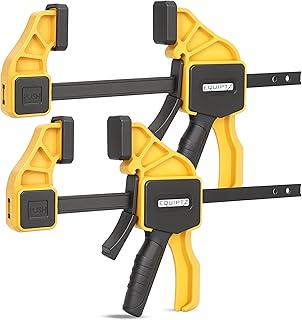

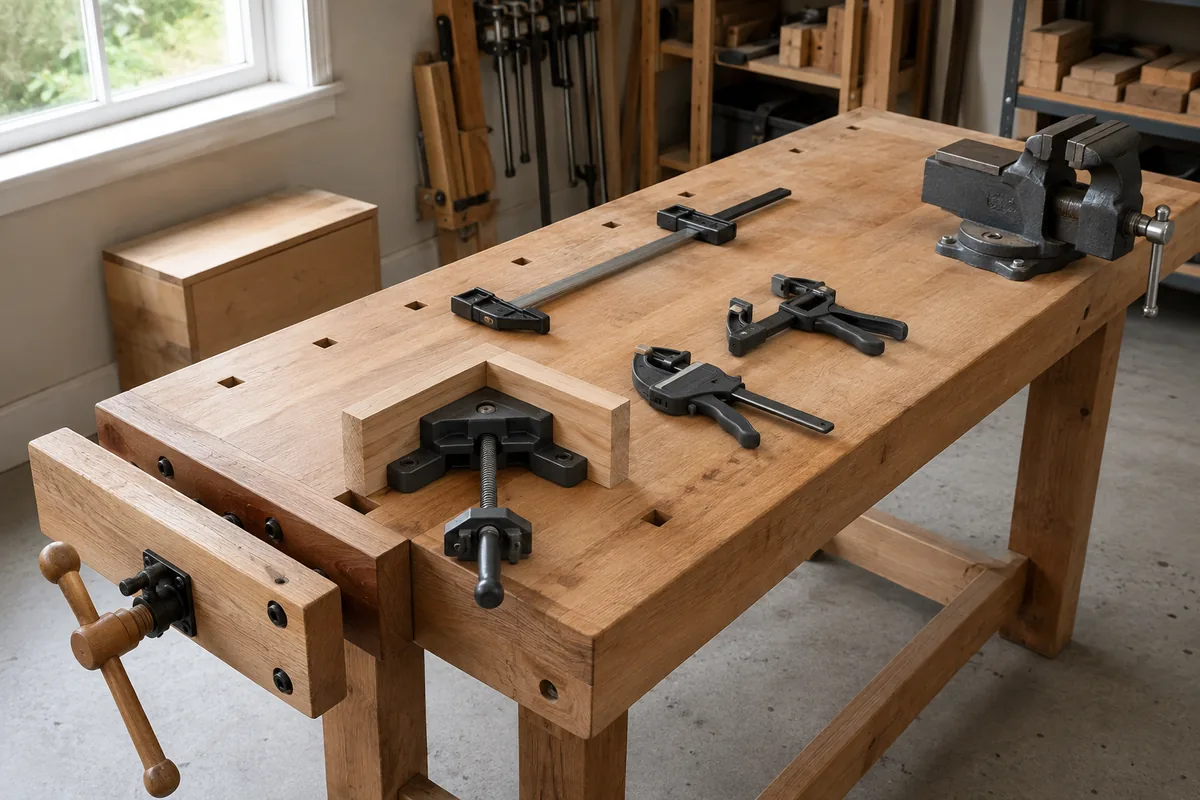
How We Judge One-Handed Clamps
We evaluate quick clamps the same way we evaluate a benchtop tool: by the parts that move. Five criteria carry the most weight.
Jaw parallelism under load. Squeeze a light clamp hard and watch the fixed jaw. If the bar is thin or the jaw casting is shallow, the faces tip outward and contact drops to the outer edges of the pads. That concentrates pressure where you do not want it and lets thin stock skate. Deeper jaw castings and taller bar sections hold face contact far better.
Bar section and spine flex. Bar height and wall thickness determine deflection over reach. A 6-inch clamp on a thin bar feels solid; the same bar at 36 inches becomes a bow. Longer clamps need a taller, boxier profile, and the better long models say so in their spec sheet by listing a lower clamping force at extended reach.
Trigger geometry and ratchet increment.A good trigger has a long lever arm, a smooth first stroke, and a fine enough ratchet step that you can creep up on final pressure. Coarse increments mean you overshoot, back off, and repeat. Pistol-grip designs generally give better mechanical advantage than compact squeeze-bar designs, at the cost of bulk.
Pad design and retention. Pads should be non-marring, replaceable, and removable so you can use the bare jaw for edge clamping or spreading. Glued-on rubber that peels is a permanent downgrade. Swiveling or slightly compliant pads help on out-of-parallel work; rigid flat pads are better on square stock.
Release behavior. The release lever should let go cleanly without a jolt. Some designs dump pressure instantly, which is fine on a stop block and unwelcome on a delicate glue-up.
The Categories, Compared
Rather than pretend all trigger clamps compete with each other, it helps to sort them by intended job. The table below compares the four families you will actually choose between.
| Clamp type | Typical clamping force | Best use | Main weakness |
|---|---|---|---|
| Light-duty trigger clamp (compact) | Low, roughly enough for stop blocks and jigs | Fast one-handed holding, template work | Jaws rack under real pressure |
| Heavy-duty trigger clamp (pistol grip) | Moderate to high for the category | Panel holding, fixturing, light glue-ups | Bulky head limits access in tight spots |
| Ratcheting bar clamp with removable pads | Moderate, plus spreading function | Cabinet assembly help, edge clamping | Pads wander if not seated squarely |
| One-handed F-style with quick trigger | Highest of the one-handed group | Sustained pressure, heavier assemblies | Slower to set than a pure trigger clamp |
Most shops end up owning two of these families, not one. A pack of light clamps in the 6 to 12 inch range handles daily fixturing, and a smaller number of heavy-duty units in the 18 to 36 inch range handles anything that needs to stay put while a tool passes over it.
Heavy-Duty One-Handed Trigger Clamps (12 to 24 in.)
If you are buying one set, buy this class. The taller bar section resists bowing, the pistol grip gives you leverage without a second hand, and the pads are usually replaceable. Look for a listed clamping force figure and a stated bar height in the specs; sellers who omit both are usually hiding a thin bar. Expect to pay noticeably more per clamp than for bargain multipacks, and expect them to outlast several rounds of those multipacks.
Where Cheap Multipacks Go Wrong
Budget trigger clamps fail in predictable places, and knowing them lets you inspect a set in the first ten minutes rather than the first year.
The pressure plate is the usual culprit. Inside the moving head, a small steel plate cams against the bar to lock position. On inexpensive clamps that plate is thin, softly hardened, or riding on a weak spring. The symptom is a clamp that holds at light pressure and then slips a fraction of an inch when you lean on the trigger, which is exactly when slipping does the most damage. If a new clamp creeps under moderate load, it will only get worse as the plate polishes the bar.
The second failure is bar finish. A painted or thinly plated bar sheds coating where the plate bites, and once bare steel is exposed in a humid shop, you get rust freckles that make the head drag. Better bars have a harder, more even finish and a machined, chamfered end that does not chew up the head when you slide it off.
Third, the plastic. The head and handle on nearly every one-handed clamp are glass-filled nylon or a similar engineering plastic, and the difference between good and bad is invisible until it cracks. Signs of a cheap molding include visible sink marks, thin unribbed sections around the trigger pivot, and mold flash left along the seams. A hairline crack at the trigger pivot is terminal, because that is where all the load concentrates.
Finally, glue. Trigger clamps live in squeeze-out. Any design where hardened glue can lock the ratchet or where pads are bonded rather than snapped on will degrade fast. We rate replaceable pads and an accessible release mechanism as durability features, not conveniences.
- ✔ One-handed operation frees your other hand for the tool or the workpiece
- ✔ Fast to set and release, which encourages actually clamping instead of hoping
- ✔ Removable pads let many models spread as well as clamp
- ✔ Non-marring faces are safe on finished or softwood surfaces
- ✔ Light enough to hang on a rail within arm’s reach of the bench
- ✘ Clamping force is well below a parallel-jaw or pipe clamp, so they are poor primary glue-up clamps
- ✘ Jaws tend to rack out of parallel as pressure rises, especially on thin bars
- ✘ Plastic heads are a wear item and rarely repairable once cracked
- ✘ Long models flex noticeably at full reach
- ✘ Ratchet mechanisms clog with dried glue and dust if never cleaned
Sizing, Quantity, and What Actually Lives on the Rack
Buy by reach, not by set count. The 6-inch and 12-inch sizes do the bulk of shop work: holding stop blocks to a miter fence, pinning a straightedge for a track saw cut, securing a router template, keeping a featherboard from sliding. These are the clamps you will reach for ten times a day, so quantity matters more than force. Six to eight is a realistic working number for a one-person shop.
The 18-inch to 24-inch range is where you want the heavier pistol-grip bodies. This is the size that holds a cabinet side to a bench while you drill shelf pins, or clamps a fence to a plywood panel for a circular saw cut. Two to four is usually enough.
Anything past 36 inches deserves scrutiny. Long one-handed clamps exist, and they are genuinely useful for holding a face frame in position, but bar flex means they apply pressure at the ends of their stroke far less evenly than a parallel-jaw clamp would. Treat them as positioners, not as glue-up clamps.
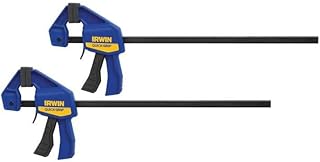
Light-Duty Trigger Clamp Multipack (6 in.)
For stop blocks, jigs, and template work you want many clamps, not strong ones. Buy a multipack of short trigger clamps and accept that they are consumables. The honest advice: do not use these for glue-ups and do not be surprised when one cracks. Judge a set by whether the head slides smoothly on the bare bar and whether the pads snap on rather than being bonded in place.
Care That Actually Extends Their Life
Two habits make a real difference. First, wipe the bar. A rag pass after a glue-up keeps squeeze-out from hardening on the surface the pressure plate needs to grip. Dried glue on a bar is the single most common reason a working clamp starts slipping. Second, keep them off the floor and out of the way of dust collection. Fine dust packed into the ratchet housing is abrasive, and it accelerates wear on the same plate and spring that determine whether the clamp holds.
Store them hanging by the jaw on a rail or a length of ripped plywood with slots cut in it. Clamps in a drawer get ignored, and an ignored clamp is functionally the same as one you do not own.
One-Handed F-Style Clamps with Trigger Release
When you need real pressure but still only have one free hand, an F-style body with a quick-release trigger splits the difference. The heavier casting and deeper jaw hold parallel far better than a light trigger clamp, and the sliding arm gives you a wider capacity range. They are slower and heavier, so buy a small number of these alongside your light clamps rather than replacing them.
One Hand Clamps Review: Frequently Asked Questions
Can I use one-handed trigger clamps for a panel glue-up? Not as your primary clamps. Even the heavier trigger designs deliver considerably less force than a parallel-jaw or pipe clamp, and the jaws tend to rack, which puts pressure on the outer edges of the pads rather than across the joint. Use them to align and hold boards while you set your real clamps, or on small assemblies where light, even pressure is sufficient.
Why does my clamp slip when I squeeze harder? Almost always the pressure plate or the bar surface. Clean dried glue and dust off the bar, then check whether the head holds on a clean section. If it still creeps, the plate is likely worn or its spring has weakened, and on most inexpensive clamps that is not economically repairable. This is the main argument for buying models with a service-friendly head.
Are the expensive one-handed clamps worth the difference? For the 12-inch and larger sizes, yes, because bar section, pressure-plate quality, and molding quality all scale with price and all determine whether the clamp holds under load. For 6-inch clamps used on stop blocks and jigs, the premium buys much less, and a mid-priced multipack is the sensible choice.
The Verdict
One-handed clamps earn their place by being fast, not strong. Judged on the criteria that matter, jaw parallelism, bar stiffness, trigger increment, pad retention, and cleanability, the category splits cleanly into two purchases. Buy short light-duty clamps in quantity and treat them as consumables for stop blocks, templates, and fixturing. Buy a smaller number of heavy-duty pistol-grip or one-handed F-style clamps in the 18 to 24 inch range for anything that has to resist a tool passing over it. Skip the temptation to make either type do a parallel-jaw clamp’s job, and skip any clamp whose listing will not tell you its bar dimensions or clamping force.
If you inspect one thing before buying, slide the head along a bare bar and squeeze the trigger to full pressure. Smooth travel, a fine ratchet step, no creep, and pads that snap off in your fingers tell you most of what you need to know.
Check prices on Amazon →