Best Table Saws for Repeated Crosscuts on Cabinet Parts
What's inside
As an Amazon Associate I earn from qualifying purchases. This post may contain affiliate links at no extra cost to you.
Repeated crosscuts on cabinet parts are a production problem, not simply a question of buying the biggest table saw. The right saw needs a stable table, a dependable fence, easy-to-repeat stops, and enough power to cut hardwood without slowing or burning. Accuracy also depends on the crosscut setup. Even an excellent saw will produce inconsistent parts if the operator measures each piece against the blade by hand.
Contents
What matters most for repeated crosscuts
Look first for a rigid cast-iron or heavily braced steel table. Cabinet sides, stretchers, rails, and dividers are often too large to support comfortably on a small benchtop saw. A full-size saw with a 27- to 30-inch rip capacity gives you room to cut panels, while a solid outfeed table prevents long parts from tipping as they leave the blade.
Power is less important than rigidity for most cabinet work, but it still matters in hardwood. A 1-3/4 to 2 horsepower induction motor is adequate for typical 3/4-inch material and narrow hardwood components. A 3 horsepower saw is a better choice if you routinely cut thick maple, multiple layers, or wide panels. More power does not correct a poor fence or a loose miter gauge.
The fence should lock parallel to the blade without needing to be persuaded into position. A front-locking, T-square-style fence is usually the best fit for cabinet work. Check that the fence face is straight and tall enough to support narrow parts. A fence that shifts by 1/32 inch during locking can create visibly mismatched doors and drawers.
Which table saw type fits the job?
| Saw type | Best use | Strengths | Limitations |
|---|---|---|---|
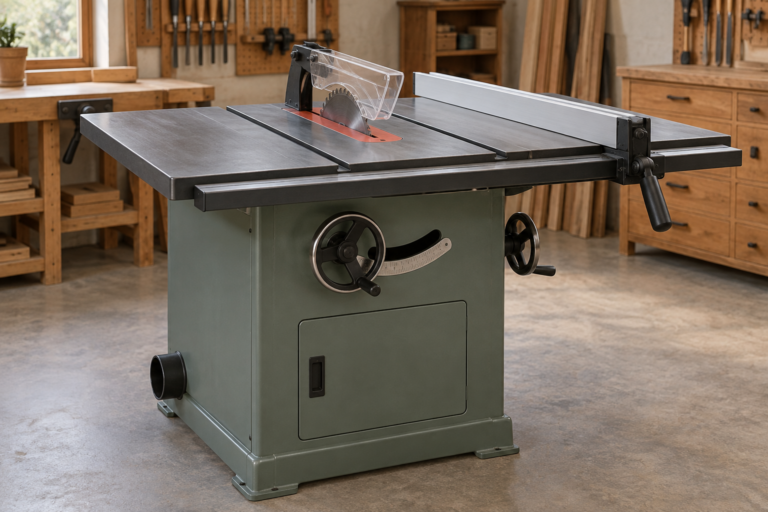
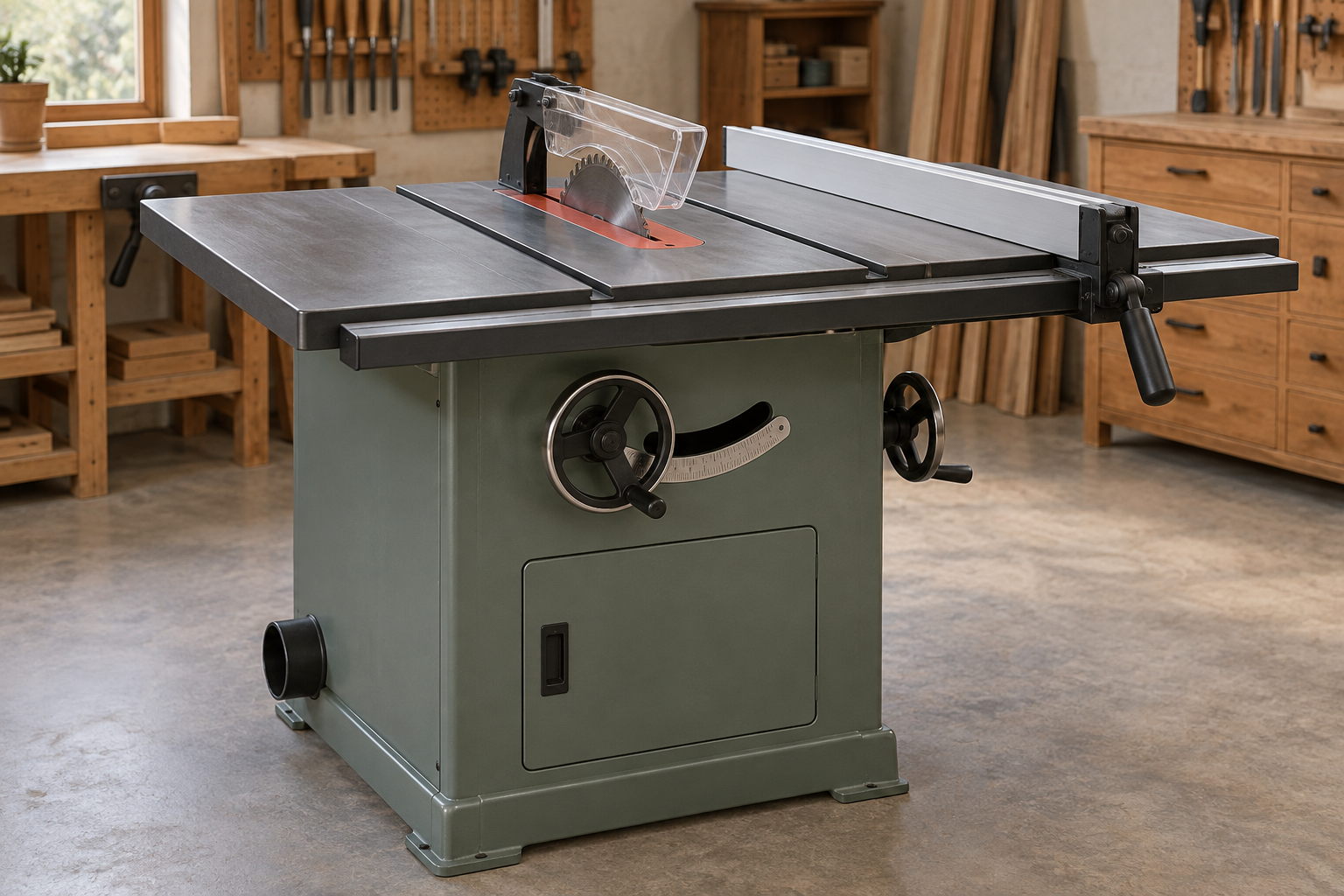
| Cabinet table saw | Dedicated shop and repeated cabinet production | Rigid, quiet, powerful, excellent dust collection | Expensive, heavy, needs permanent floor space |
| Contractor-style table saw | Serious hobby shops and smaller production runs | Lower cost, mobile options, capable of accurate work | Less mass, more vibration, often weaker dust control |
| Portable jobsite saw | Occasional cabinet work or shared spaces | Affordable, compact, easy to store | Small table, shorter fence, less repeatability and support |
A cabinet table saw is the strongest choice when the saw will stay in one shop and cut parts every week. Its weight reduces vibration, and the enclosed base usually connects to dust collection more effectively. This matters when cutting MDF or plywood, where airborne dust quickly becomes a cleanup and visibility problem.
A contractor-style saw is often the sensible middle ground. With a good stand, a properly aligned blade, and a dedicated crosscut sled, it can produce cabinet-quality parts. The cheaper option is fine when you build one kitchen or a few furniture projects each year. It is less appealing when the saw will run for several hours at a time or when every part must match without repeated sorting.
Build the crosscut system, not just the saw
Do not use the rip fence as the only guide for crosscutting narrow cabinet parts. A cutoff piece can become trapped between the blade and fence, causing kickback or a cut that wanders. Use a crosscut sled, miter gauge with an auxiliary fence, or a shop-built cutoff sled designed for the part length.
For repeated parts, install a stop block on the sled fence. A stop positioned 18 inches from the blade will let you produce a batch of 18-inch rails without measuring each piece. Keep the stop clear of the blade path. If the offcut can contact the stop after it separates, use a stop system with a relief cut or swing-away stop. Otherwise, the offcut may bind between the blade and stop.
A sled should run without side play but not require force. Set its runners so the sled does not lift or rock, then check the fence with the five-cut method. A 1/32-inch error spread across the test can indicate a fence alignment error of only a few thousandths, enough to affect drawer parts. Mark one reference edge on every board and keep that edge against the sled fence for the entire batch.
Features worth paying for
Spend money on a reliable fence, a flat table, and a useful miter slot before paying extra for electronic controls or elaborate accessories. A standard 3/4-inch by 3/8-inch miter slot makes it easier to build sleds and buy replacement runners. A riving knife that stays aligned through blade changes is also valuable, especially for narrow crosscuts and plywood.
Soft-start motors reduce the startup jerk, while a magnetic or paddle-style switch is easier to reach in an emergency. A brake system can add protection, but it does not replace safe handling, a riving knife, and push devices. If you buy a 3 horsepower cabinet table saw, confirm that your electrical circuit can support it before delivery.
Dust collection is especially important for repeated cabinet cutting. Look for an enclosed blade housing and a shroud that captures dust from below the table. A shop vacuum may work for occasional plywood cuts, but a 1-1/2 to 2 horsepower dust collector is more appropriate for sustained MDF or hardwood use. Poor collection can clog the blade guard and leave dust on the table, where it can affect smooth feeding.
A practical buying choice
Choose a cabinet saw if you have permanent space, plan to make cabinets regularly, and value repeatability over portability. Choose a contractor-style saw if your volume is moderate and you are willing to build a solid outfeed table and accurate sled. A contractor table saw with a cast-iron table is often the best value for a serious home shop.
Buy a jobsite saw only when storage, transport, or budget rules out larger machines. Pair it with a stable stand, auxiliary support, and a carefully checked sled. A table saw crosscut sled can improve repeatability more than upgrading from one portable saw to another.
Before cutting a batch, verify blade alignment, fence lock, sled squareness, and stop-block position. Make three test cuts, measure them with a reliable rule or calipers, and only then cut the production parts. That short check prevents an entire stack of cabinet components from being consistently wrong.