Best Cabinet Door Router Bits for Shaker, Raised-Panel, and Flat-Panel Doors
What's inside
- Match the Bit to the Door Style First
- Spec Comparison: Popular Cabinet Door Router Bit Options
- Decision Matrix: Which Setup Fits Your Shop
- Stock Thickness and Groove Fit: Where Mismatches Happen
- Router Power, RPM, and Shank Size
- Bearing Quality and Ownership Realities
- Cost Per Door: A Quick Calculation
- FAQ
- Related Guides
- Match the Bit to the Door Style First
- Spec Comparison: Popular Cabinet Door Router Bit Options
- Decision Matrix: Which Setup Fits Your Shop
- Stock Thickness and Groove Fit: Where Mismatches Happen
- Router Power, RPM, and Shank Size
- Bearing Quality and Ownership Realities
- Cost Per Door: A Quick Calculation
- FAQ
- Related Guides
As an Amazon Associate I earn from qualifying purchases. This post may contain affiliate links at no extra cost to you.
The best cabinet door router bits for most woodworkers are 1/2-inch-shank rail-and-stile sets from brands like Freud, Whiteside, or CMT for Shaker doors, and a matched raised-panel bit (with optional back cutter) for traditional raised-panel work — but the right pick depends on your router’s horsepower, your stock thickness, and whether you need horizontal or vertical panel orientation.
As an Amazon Associate we earn from qualifying purchases at no extra cost to you.


Contents
- Match the Bit to the Door Style First
- Spec Comparison: Popular Cabinet Door Router Bit Options
- Decision Matrix: Which Setup Fits Your Shop
- Stock Thickness and Groove Fit: Where Mismatches Happen
- Router Power, RPM, and Shank Size
- Bearing Quality and Ownership Realities
- Cost Per Door: A Quick Calculation
- FAQ
- Related Guides
Match the Bit to the Door Style First
Cabinet door router bits fall into three functional groups, and buying the wrong group is the most common beginner mistake:
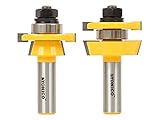
- Rail-and-stile sets (Shaker and flat-panel doors): Two matched bits — one cuts the cope (end grain) profile on rail ends, the other cuts the sticking profile and panel groove along all inside edges. Sold as pairs, typically $40–$90 for a quality set. A rail-and-stile router bit for cabinet doors must be run in a router table; these are not handheld bits.
- Raised-panel bits: A single large-diameter bit (2-1/2″ to 3-1/2″) that cuts the beveled edge profile so the panel fits the groove. Profiles include ogee, cove, and bevel. Add a matching back cutter if your panels are thicker than the groove depth allows.
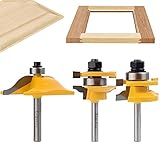
- Combination/matched sets: Three-piece or four-piece kits (rail cutter, stile cutter, panel bit, sometimes a drawer-front bit) from brands like Freud, CMT, Yonico, and MLCS — good value if you’ll build complete kitchens.
Spec Comparison: Popular Cabinet Door Router Bit Options
| Product / Type | Style | Shank | Max Bit Diameter | Stock Thickness | Min. Router Power | Typical Price Range |
|---|---|---|---|---|---|---|
| Freud 99-260 rail & stile set (2 pc) | Shaker / flat panel | 1/2″ | 1-5/8″ | 3/4″ standard | 1-3/4 HP | $60–$80 |
| Whiteside 6001 rail & stile set | Shaker / flat panel | 1/2″ | 1-5/8″ | 3/4″ standard | 1-3/4 HP | $70–$90 |
| CMT 891.501.11 rail & stile set | Shaker / flat panel | 1/2″ | 1-5/8″ | 3/4″ standard | 1-3/4 HP | $55–$75 |
| Freud 99-510 raised panel bit (ogee) | Raised panel | 1/2″ | 3-1/2″ | 3/4″–7/8″ panels | 2-1/4 HP + speed control | $45–$65 |
| Vertical raised panel bit (generic type) | Raised panel | 1/2″ | 1-1/8″ | 3/4″–7/8″ panels | 1-3/4 HP | $30–$50 |
| Yonico / MLCS 3-pc door kit | Shaker + raised panel | 1/2″ | 3-1/4″ (panel bit) | 3/4″ standard | 2-1/4 HP | $50–$80 (kit) |
| Budget 1/4″-shank rail & stile sets | Shaker | 1/4″ | 1-3/8″ | Up to 3/4″ | 1 HP trim router | $25–$40 |
Decision Matrix: Which Setup Fits Your Shop
| Your Situation | Recommended Choice | Why |
|---|---|---|
| 1 HP–1.5 HP router, occasional doors | Vertical raised panel bit + budget rail/stile set | Small diameter keeps RPM safe; vertical bits don’t demand 3+ HP |
| 2.25 HP+ router in a table, full kitchen build | Freud or Whiteside rail & stile set + horizontal panel bit | Best carbide and bearing quality; survives 30+ doors cleanly |
| Flat-panel doors only (groove holds plywood/MDF) | Rail & stile set alone | No panel bit needed — groove fits 1/4″ or 1/2″ panel directly |
| Tight budget, learning curve acceptable | Yonico or MLCS matched kit | All profiles coordinated; softer carbide but fine for softwood/poplar |
| Plywood or MDF panels only, no handheld router | Any 1/2″-shank set — avoid 1/4″ shanks | Thin shanks chatter on 1-5/8″ cutters and ruin cope cuts |
Stock Thickness and Groove Fit: Where Mismatches Happen
Most cabinet making router bits are engineered for 3/4-inch stock, producing a 1/4-inch-wide by 3/8-inch-deep panel groove. Three mismatch traps to check before buying:
- 5/8″ or 7/8″ stock: Standard sets leave the groove off-center or too shallow. Look for sets labeled for thick stock, or plan a shim-jig setup with adjustable cutters (Amana and some Freud sets offer stacked/slot-cutter designs).
- Panel thickness: A 1/4″ groove accepts standard plywood panels directly. Solid raised panels typically end at 1/4″ tongues cut by the panel bit — verify the bit’s tongue spec matches your set’s groove width, especially mixing brands.
- Plywood undersizing: “1/4-inch” plywood often measures 5.9mm. A standard 1/4″ groove leaves a rattle. Undersized-plywood groove cutters or space balls (rubber balls in the groove) solve this.
Router Power, RPM, and Shank Size
Large panel raisers are the most demanding router bits for cabinet doors. A 3-1/2″ bit needs a variable-speed router of at least 2-1/4 HP run at 10,000–12,000 RPM — never full speed (22,000+ RPM), which burns edges and risks carbide failure. Rail-and-stile bits run safely at 16,000–18,000 RPM on a 1.75 HP router.
On shank size: choose 1/2-inch for every cabinet door router bit. The mass of a 3-1/2″ panel bit on a 1/4″ shank is a genuine safety issue, and even 1-5/8″ stile cutters chatter enough on thin shanks to leave tear-out at cope joints — the most visible flaw on a finished door.
Bearing Quality and Ownership Realities
What actually wears out over a door set’s life:
- Guide bearings first. Cheap sets use unsealed bearings that gum up with pitch and freeze mid-cut, burning a stripe into your profile. Quality bits (Freud, Whiteside, CMT, Amana) use sealed or shielded bearings; replacements cost $5–$10. Clean bearings with mineral spirits after every session.
- Carbide edges. Poplar and pine are gentle; MDF and plywood glue lines dull edges fast — expect resharpening after 20–40 MDF doors versus 100+ in solid wood. A $15–$20 resharpening restores the edge two or three times before retirement.
- Common mistakes: running cope cuts without a backer block (blowout on the trailing edge), feeding rails face-up instead of face-down, and taking full-depth panel passes instead of two or three stepped passes.
Cost Per Door: A Quick Calculation
A $75 Freud rail-and-stile set plus a $55 panel bit = $130. On a 20-door kitchen, that’s $6.50 per door in tooling — versus $15–$35 per door for pre-made doors. Even factoring one resharpening, a hobbyist building two kitchens breaks even well before the bits wear out. Budget kits halve the upfront cost but typically need replacement around 15–20 hardwood doors, narrowing the long-term gap.
FAQ
Can I use cabinet door router bits in a handheld router?
No. Rail, stile, and panel bits all require a router table with a fence — the cuts need consistent bearing contact and both hands controlling the workpiece.
Do I need a panel bit for Shaker doors?
No. Shaker and flat-panel doors use flat panels seated in the groove — only the two-piece rail-and-stile set is required.
One bit or a matched set?
Rail and stile profiles must mirror each other exactly, so always buy them as a matched pair. The panel bit can be bought separately in whatever profile you prefer, as long as the tongue thickness matches the groove.