Best Benchtop Sanders for Small Shops and Precise Finishing
What's inside
As an Amazon Associate I earn from qualifying purchases. This post may contain affiliate links at no extra cost to you.
e best benchtop sander for most small shops is a 4×36-inch belt and 6-inch disc combo — models like the WEN 6502T or Rikon 50-112 give you the widest project coverage for under roughly $200 — while woodworkers who mostly flatten and thickness small parts should look instead at a benchtop oscillating spindle sander or a compact disc/belt with a cast-iron table and a proper dust port.
As an Amazon Associate we earn from qualifying purchases at no extra cost to you.

Contents
What Actually Matters When Comparing Benchtop Sanders
Spec sheets on benchtop sanders for wood look similar until you map them to real work. These are the criteria that change the outcome:
- Footprint vs. belt/disc size. A 4×36 belt plus 6-inch disc fits a 20-inch-deep bench; moving to a 6×48 belt usually means a dedicated stand. Measure your bench first — the motor housing often sticks out 3–4 inches beyond the listed width.
- Sanding width. Belt width caps how wide a board edge or glue-up you can flatten in one pass. A 4-inch belt handles most box, tray, and small furniture parts; only buy wider if you regularly sand frame panels or long edges.
- Thickness control. Combo belt/disc sanders are not thicknessers. If you need repeatable, uniform thickness on thin stock (inlay bands, small panels), a benchtop drum sander like the Jet or SuperMax style — or a thickness planer plus hand sanding — does that job. Belt sanders remove material fast and unevenly by design.
- Dust collection. Disc sanders throw fine dust sideways; belts push it forward. A 2.5-inch port that fits a standard shop-vac hose captures dramatically more than a 1.5-inch port. Cast tables with a dust shroud behind the disc outperform sheet-metal housings.
- Noise. Induction-motor machines (most combo units) run around 80–85 dB; universal-motor spindle sanders can exceed 90 dB. In a garage or basement shop, that difference decides whether you need hearing protection plus annoyed neighbors, or just protection.
- Finish quality. Disc speed matters: faster discs (3,400+ RPM) cut fast but burnish and burn end grain if you linger. A disc with a tilting cast-iron table and a miter slot lets you hold 90° repeatably — the biggest real-world finish-quality upgrade over stamped-steel tables.
Quick Spec Comparison
| Model / type | Belt / spindle size | Disc | Motor | Weight | Dust port | Typical price range |
|---|---|---|---|---|---|---|
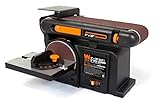
| WEN 6502T combo | 4 x 36 in | 6 in | 4.3 A induction | ~38 lb | 2.5 in | $120–160 |
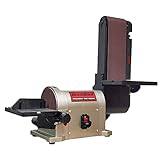
| Rikon 50-112 combo | 4 x 36 in | 6 in | 2/3 HP induction | ~44 lb | 2.5 in | $200–280 |
| Grizzly G1183 combo | 6 x 48 in | 9 in | 1 HP induction | ~110 lb | 2 x 2.5 in | $450–600 |
| Ridgid EB4424 oscillating belt/spindle (the classic “Ridgid benchtop sander”) | 4 x 24 in belt + spindle sleeves | — | 5 A universal | ~42 lb | 2.5 in | $250–330 |
| Wen 6524 / Shop Fox oscillating spindle type | spindles 1/2–2 in | — | 3.5–5 A universal | 30–40 lb | 2 in | $130–200 |
Prices move, but the gap between the entry combos and a 6×48 machine is real: you’re roughly tripling cost for a bigger belt, a heavier cast-iron build, and less vibration — not for a different category of work.
Pick by Situation, Not by Spec Sheet
| Your situation | Best choice | Why |
|---|---|---|
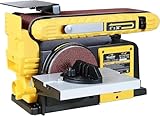
| General small-shop work: boxes, shelves, edge cleanup, occasional metal deburring | 4×36 belt + 6 in disc combo | Covers ~80% of tasks; cheapest per capability |
| Lots of curved work: band-sawn shapes, templates, spoon blanks | Oscillating spindle sander (or Ridgid EB4424-style combo) | Oscillation prevents loading and burning on curves; sleeves are cheap |
| Flattening small panels and frame glue-ups regularly | 6×48 belt + 9 in disc | Wider belt, table stays flat under pressure, better bearings |
| Thin stock and repeatable thickness | Benchtop drum sander (separate machine) | A belt sander can’t hold tolerance across a face |
| Tight space, occasional use, under $150 | 4×36 combo, clamped to a board you store vertically | Bolt it to a plywood base with cleats; hang the whole assembly on the wall |
Head-to-Head: Combo Belt/Disc vs. Oscillating Spindle
These two types get cross-shopped constantly, and they solve different problems. A belt/disc combo excels at straight edges, miters trued on the disc, and fast stock removal. An oscillating spindle sander excels at inside curves and fair curves — the up-and-down spindle motion spreads wear across the sleeve and keeps abrasive cool, which is why curves sanded on a spindle look cleaner than the same curve pushed into a disc.
The Ridgid EB4424 has stayed popular precisely because it bridges the two: it converts between a 4×24 belt and spindle sleeves. The trade-off is setup time — switching modes takes a few minutes — and the universal motor is noticeably louder and sheds brushes over years of use, unlike the induction motors in dedicated combo units that essentially never need motor service.
If your projects are mostly rectilinear (boxes, cabinets, jigs), buy the belt/disc combo. If curves dominate (toys, guitars, scroll work, chair parts), the spindle type earns its bench space first — a disc sander can come later.
Setup and Maintenance: What Keeps Finish Quality High
- Level the table to the disc. Unplug the machine, hold a known-flat steel rule against the disc face at 90°, and check for gaps at the top and bottom of the table slot. Shim or adjust until the gap disappears — a 1–2° error shows up instantly as out-of-square edges.
- Track the belt before first use. Run it briefly and center the belt with the tracking knob; a wandering belt eats housing edges and grooves your work.
- Hook up dust collection properly. Use a 2.5-inch hose directly to the port rather than a 4-inch line necked down — the reduced velocity at a big fitting drops chips before they reach the hood.
- Sand on the downward side of the disc. The left half (on machines rotating counterclockwise) pulls the work into the table; the right half lifts it. This single habit prevents most “sander grabbed my part” accidents and most tapered edges.
- Clean discs and belts with a crepe-rubber stick. Loaded abrasive is the number one cause of burning and poor finish. A $10 cleaning stick extends belt life 3–5x.
Ownership Realities
- What wears first: adhesive-backed sanding discs peel at the edges after a few swaps — buy discs in bulk and keep a sacrificial layer on the platen. Belt splices are the second failure point; buy name-brand belts, not generic bundles.
- Common mistake: pressing harder instead of changing grit. Let the abrasive cut; pressure only generates heat, which burns cherry and maple and loads the belt with resin.
- Grit strategy: for dimensioning, 80–100 grit on the belt; for final edge prep, stop at 150–180 on the disc and hand-sand the rest. Going finer on a machine just burnishes the surface.
- Consumable cost: expect roughly $20–40/year in belts and discs for weekend use — worth factoring alongside the machine price.
FAQ
Is a benchtop sander worth it if I already own a random orbital sander?
Yes, for different jobs. Handheld orbitals finish surfaces; a sander benchtop unit squares edges, trues miters, and shapes parts — tasks a handheld does poorly or dangerously.
Can a benchtop belt sander replace a thickness planer?
No. Belts can’t hold uniform thickness across a face. Use a planer for thickness, the belt for edges and shaping.
How much noise should I expect?
Induction combo units run in the low-to-mid 80 dB range; universal-motor spindle types are louder. Hearing protection is advisable for sessions longer than a few minutes either way.
What’s the minimum bench space for a 4×36 combo?
Plan on roughly 22 x 16 inches plus clearance in front for feeding stock, and either bolt it down or add cleats — these machines walk under load.