Best Band Saws for Cutting Hardwood Blanks for Turning
What's inside
As an Amazon Associate I earn from qualifying purchases. This post may contain affiliate links at no extra cost to you.
Contents
What matters when cutting turning blanks
A band saw for turning needs to do two jobs well: cut stock to a useful shape and leave enough control for a clean, safe cut. For bowl blanks, that often means resawing a short log section or trimming a round into a square or rough circle. For spindle blanks, it means ripping straight stock to size without wandering off the line.
Look first at resaw capacity: the maximum height of material that fits between the table and upper guides. A 6-inch capacity handles many bowl blanks cut from modest logs; 10 to 12 inches gives more room for larger stock, but typically costs more and takes up more shop space. Throat depth—the distance from blade to frame—limits the width of a cut. It matters when cutting broad bowl blanks, but less for narrow spindle stock.
As an Amazon Associate we earn from qualifying purchases at no extra cost to you.
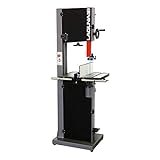

Blade choice is as important as saw size. A sharp 3/8-inch blade with roughly 3 teeth per inch is a practical starting point for roughing out thick hardwood. Coarse teeth clear wet or resinous chips better than a fine blade; fine teeth can clog, heat the wood, and make a slow cut. For resawing, a wider blade is usually steadier, if the saw can tension it correctly.
Compare saw sizes
| Type | Typical resaw capacity | Best fit | Main trade-off |
|---|---|---|---|
| Compact benchtop | About 3 to 6 inches | Small spindle blanks, thin stock, occasional rough shaping | Limited capacity and less mass can make thick hardwood cuts slower |
| 14-inch floor saw | About 6 to 12 inches, depending on riser and model | Most home shops cutting bowl and spindle blanks | May need careful setup or upgraded guides for reliable resawing |
| Larger floor saw | About 12 inches and up | Frequent large-blank work and wide resawing | Higher cost, larger footprint, and more power requirements |
Capacity figures are not a promise of effortless cutting. A saw may physically accept a 10-inch blank but struggle to feed it through hard, wet maple with a dull blade. Motor power, blade condition, tracking, and how steadily you feed all matter.
Choosing a saw for your shop
If you mostly cut spindle blanks from dry boards, a compact saw may be enough. It is the cheaper option, and there is little reason to pay for 12 inches of resaw height you will not use. Check that its table is stable and that the saw accepts a blade suited to the stock; a very narrow blade can flex in thick hardwood and drift from the marked line.
For regular bowl blanks, a 14-inch floor saw is a sensible middle ground. It usually offers more usable capacity, a larger table, and better support for heavy stock. Some 14-inch saws can be fitted with a riser block, but added height is useful only if the frame, motor, and blade setup can handle the cut. If you expect to resaw thick hardwood often, prioritize a saw that can tension a 3/4-inch blade rather than relying on its maximum height figure alone.
Compare 14-inch woodworking band saws by resaw capacity, motor, table size, and blade-tension range. For very large blanks or frequent heavy resawing, consider larger floor-standing band saws, but confirm your shop’s electrical supply and floor space before buying.
Set up for accurate, safer cuts
Before cutting, fit a sharp blade and set its tension and tracking according to the saw’s manual. Set the guides close to the work—roughly 1/8 inch above the blank is a useful starting point—without letting them touch the blade during a cut. Check that the table is square to the blade for straight cuts. A blade that is dull, under-tensioned, or poorly tracked may wander, burn the wood, or come off the wheels.
Inspect rough stock for nails, stones, dirt, and cracks. A hidden metal fragment can damage the blade, while a loose knot or split can shift as the cut opens. Do not try to force an irregular log against the table. Make a stable flat face first, using a jig or a secured cradle when needed. Keep hands out of the blade path, use a push stick for small pieces, and never back a pinched blade out of a cut with the saw running.
For a bowl blank, mark the center and intended circle before cutting. A round log is unstable on a flat table, so first create a safe reference surface or hold it in a purpose-built sled. Leave extra material—often 1/4 to 1/2 inch beyond the final turning shape—to account for cracks, bark, and irregular grain. The lathe, not the band saw, will bring the blank to its finished round.
Blade and workholding choices
Use a coarse blade for thick stock and a finer blade for thin curves. A 3/8-inch, 3-TPI blade is a useful general-purpose choice for rough hardwood blanks; for straight resawing, a 1/2- or 3/4-inch blade can track better if the saw is rated to tension it. Wider blades resist twisting but cannot turn as tight a curve. A narrow blade can follow a bowl outline, but it is a poor choice for a long, straight cut through a thick blank.
Wet wood can cut easily but is heavy and may move as it dries. Green blanks can also gum up a blade, so clear packed chips and let the saw cool if the cut begins to slow or smell hot. Dry, dense hardwood can demand a slower feed rate. If the blade starts bending, stop and check for dull teeth, inadequate tension, or a cut that is too ambitious for the saw; pushing harder usually increases drift rather than fixing it.
When the budget is tight, spend on a correctly sized, sharp blade and safe workholding before paying for extra capacity. A modest saw is fine for small blanks and occasional use. Buy a larger, heavier machine when your regular stock exceeds the smaller saw’s real cutting capacity, not just because a larger number looks reassuring.