3-HP vs 2-HP Table Saw for Long Rip Cuts in Dense Hardwood
What's inside
As an Amazon Associate I earn from qualifying purchases. This post may contain affiliate links at no extra cost to you.
For long rip cuts in dense hardwood, a 3-HP table saw gives you more reserve power, but it does not make a bad setup safe or a dull blade effective. A well-tuned 2-HP saw can handle many furniture-sized jobs if you feed steadily, use a sharp ripping blade, and accept a slower pace. The right choice depends on the stock’s thickness, length, and how often you make the cut.
As an Amazon Associate we earn from qualifying purchases at no extra cost to you.


Contents
What horsepower changes on a long rip
Horsepower matters most when the blade is under sustained load. A long cut through 8/4 hard maple, white oak, or hickory can keep a saw working for several minutes. A 3-HP motor is less likely to bog down as the cut progresses, particularly when the board is wide or the feed rate is brisk. That reserve can produce a more consistent cut and reduce the urge to push harder when the motor slows.
Do not treat the horsepower number as a guarantee of cutting performance. Blade condition, tooth geometry, alignment, and feed rate all matter. A sharp 24-tooth ripping blade can outperform a dull general-purpose blade on a lower-powered saw. Also check whether the rating is continuous-duty horsepower or a less informative peak figure, and confirm the saw’s voltage and circuit requirements.
Where a 2-HP saw is enough
A 2-HP cabinet or contractor-style saw is a reasonable choice for occasional long rips in 4/4 hardwood and moderate-width stock. With a sharp, flat-top ripping blade, many boards in that range can be cut cleanly at a deliberate feed rate. It is also a sensible option if most of your work is plywood, softwood, or shorter hardwood cuts, with only occasional dense lumber.
The trade-off shows up in thick, wide, or especially hard stock. The motor may slow, the blade may leave burn marks, and the cut can become rough if you keep feeding at the same pace. Forcing the board to maintain speed is the wrong response: it raises the risk of binding and kickback, and can overload the motor. Slow down, but if the saw still labors, stop and diagnose the setup rather than leaning harder.
What you gain with 3 HP
A 3-HP saw provides more room to maintain a steady feed through demanding stock. That is useful for frequent production work, repeated rips in 8/4 hardwood, and boards wide enough to keep the blade engaged for a long time. It can also be more forgiving of small changes in grain density, though it cannot compensate for poor technique or a badly aligned fence.
The cost is not limited to the saw. Many 3-HP machines require 230-volt power, so a shop with only 120-volt receptacles may need an electrician and a suitable dedicated circuit. Check the manufacturer’s electrical requirements before buying; do not assume a plug adapter or extension cord makes a circuit adequate. A 3-HP saw may also cost more to purchase and can be excessive for a hobbyist who makes only a few hardwood rips each month.
Quick comparison
| Factor | 2 HP | 3 HP |
|---|---|---|
| Occasional 4/4 hardwood rips | Usually adequate with a sharp ripping blade | More reserve, often unnecessary |
| Frequent 8/4 dense hardwood | Can work, but may need a slower feed | Better suited to sustained heavy cutting |
| Power setup | Some saws use 120 V; verify the specific machine | Often requires 230 V; verify before purchase |
| Main risk when pushed | Motor bogging, burn marks, rough cut | More power can encourage unsafe overfeeding |
| Best fit | Mixed work and occasional hardwood | Regular thick-stock ripping and production use |
Blade and setup can matter more than the upgrade
For ripping, start with a sharp 24-tooth blade designed for rip cuts, rather than a fine-tooth crosscut blade. A thin-kerf blade removes less wood and can ease the load, but it must be compatible with the saw and stable enough for the work. If burning persists, inspect the blade for pitch buildup or damage before assuming the motor is too small.
Check that the blade is parallel to the miter slot and that the fence is aligned according to the saw manufacturer’s instructions. A misaligned fence can pinch the workpiece against the blade, causing heat, burning, and kickback. Support long stock level with the saw table using properly positioned infeed and outfeed support. Support should not steer or lift the board; that can twist it into the blade. Use a riving knife, keep hands out of the blade path, and stand out of the likely kickback line.
For an especially wide or thick board, consider removing some material in stages if the saw’s capacity and setup permit it, or use a bandsaw to resaw stock before final sizing. Multiple passes are not automatically safer: the work must remain stable and controlled, and the saw must be used within its manual’s limits.
A practical buying decision
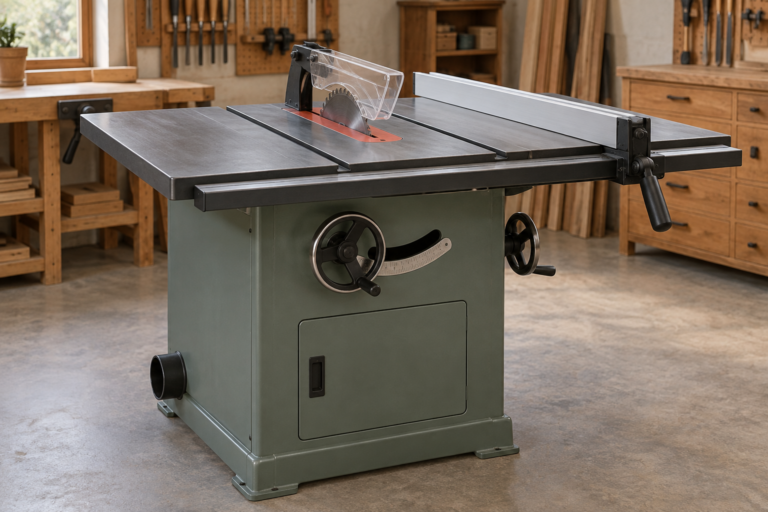
Choose 2 HP if your hardwood work is occasional, mostly 4/4, and you are willing to feed at a controlled pace. Put some of the saved money toward a quality rip blade, dust collection, and stable stock support. A 2-HP table saw is not automatically underpowered for furniture work; the workload determines whether its limits matter.
Choose 3 HP if long rips in thick, dense hardwood are routine, you need repeatable throughput, and your shop can supply the required voltage. A 3-HP cabinet table saw buys more operating margin, not immunity from binding or kickback. If you are unsure, estimate how often you will cut 8/4 stock and check the electrical installation cost alongside the saw price. That full cost—not the horsepower badge alone—is the useful comparison.