Best Jointers for Squaring Rough Lumber in a Small Workshop
What's inside
As an Amazon Associate I earn from qualifying purchases. This post may contain affiliate links at no extra cost to you.
Contents
What a jointer does—and what it doesn’t
A jointer makes one face of a board flat and one edge straight, with the two surfaces square to each other. Those are the reference surfaces you need before planing the opposite face or ripping a parallel edge on a table saw. A jointer does not reliably make a board a consistent thickness; that is the planer’s job. It also cannot make a warped board flat just by taking a heavy cut. The work needs to be supported and fed steadily, with shallow passes that remove high spots.
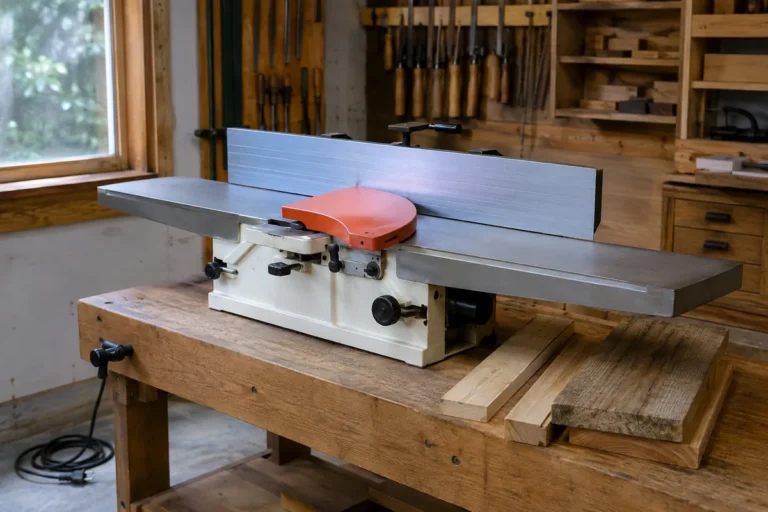
For a small workshop, the buying decision is mostly about board width, bed length, storage, and dust collection. A benchtop machine is easier to fit and move, but its short bed limits how well it supports long, bowed stock. A floor-standing jointer takes more room and costs more, but is substantially more comfortable for long or wide boards.
As an Amazon Associate we earn from qualifying purchases at no extra cost to you.


Choose by the lumber you actually use
Check the actual width of your rough lumber, not its nominal size. A board sold as 8 inches wide may be wider than the capacity of a 6-inch jointer. You can joint one edge on a narrow machine, but you cannot flatten a face wider than its cutterhead without another method or multiple carefully registered passes.
For occasional projects using boards up to roughly 5 or 6 inches wide and 4 feet long, a benchtop jointer is often the sensible budget choice. If you regularly prepare wide cabinet parts, long tabletops, or boards over 6 inches wide, a 6-inch floor model is a more capable minimum; an 8-inch model adds capacity at a higher cost and footprint. Before buying a benchtop machine, compare bed length and extension options, not just the advertised width.
Browse benchtop jointers if portability and price matter more than long-board support. For wider stock and a more substantial bed, compare 6-inch floor-standing jointers.
Benchtop or floor-standing?
| Type | Typical capacity | Best fit | Main trade-off |
|---|---|---|---|
| Benchtop | About 6 inches wide; compact bed | Short stock, occasional work, limited floor space | Less support for long boards; lighter build can transmit vibration |
| Floor-standing, 6-inch | About 6 inches wide; longer beds | Regular furniture and cabinet work | More space, weight, and setup cost |
| Floor-standing, 8-inch | About 8 inches wide; longer beds | Wide rough boards and frequent milling | Higher price and a larger footprint |
These are broad categories, not guarantees of performance. Bed dimensions and cutterhead design vary. A long bed is particularly useful with bowed boards because it supports more of the reference surface as the board passes over the knives. A short bed can still work, but it takes more care: a long board may rock or sag, and the result can remain bowed even when the machine is adjusted correctly.
Features worth paying attention to
Fence stability matters as much as capacity. The fence should lock securely and stay square to the table; a small shift can produce an edge that is not square, which then complicates glue-ups and table-saw cuts. Check that the fence can be adjusted and locked at 90 degrees without awkward handling.
Look for tables that adjust smoothly and remain coplanar. On a jointer, the outfeed table should be set level with the cutting edges at their highest point; the infeed table sets cut depth. If the outfeed is too low, the board may dip as it leaves the cutterhead, creating snipe at the end. If it is too high, the board can catch or stop feeding. A typical roughing pass is around 1/32 inch; use lighter cuts for difficult grain or near-final sizing.
Helical or segmented cutterheads often cost more than straight knives. They can leave a smoother finish on figured grain and may be quieter, but they do not correct poor technique, a twisted board, or a misaligned machine. Straight-knife machines can be a good value, especially for occasional use, provided replacement knives are available and you are comfortable setting them. Check replacement-part prices before buying either type.
Joint safely and avoid common failures
Use push blocks for face jointing and push sticks or an appropriate push device for narrow edges. Keep hands clear of the cutterhead, especially as the trailing end passes over it. Joint with the grain where possible: cutting against rising grain can tear out deep chunks, particularly in figured hardwood. Take a light pass first and inspect the surface before removing more material.
For a board with a cup, put the concave face down so it has a stable base on the table. For a bowed edge, place the board so its center is supported rather than rocking on the ends. Do not try to remove a severe twist in one deep pass; a jointer may flatten one local area while leaving the rest out of plane. If the board is too long, too wide, or too unstable for the machine, use a planer sled or flatten it with a router sled before jointing an edge.
Dust collection is not optional for comfortable routine use. Many jointers use a 2-1/2-inch or 4-inch port, so match the machine to your extractor or collector and verify the adapter is included or readily available. Poor collection lets chips build up around the cutterhead and can impair the cut. Also check the machine’s overall length, stand, and clearance for feeding a board: a jointer that fits against a wall may still need several extra feet of open space at both ends.
A practical buying checklist
Measure the widest and longest boards you commonly mill, then compare those dimensions with the jointer’s capacity and bed length. Confirm that the fence locks square, tables adjust without binding, replacement knives or inserts are available, and the dust port suits your collection setup. If your projects use narrow stock and the machine will see occasional duty, a well-set-up benchtop model is a reasonable compromise. If you regularly process long, wide rough lumber, saving floor space with a short bed may cost more in frustration than the machine saves in money.