Best Air Fryers for Small Kitchens
What's inside
- Best Air Fryers for Small Kitchens: Compact Picks That Still Cook a Useful Portion
- Shortlist by kitchen and cooking situation
- Compare the details that affect fit
- How much basket capacity is actually useful?
- Measure the counter before buying
- Power, outlets, and everyday use
- Cleaning and ownership: what tends to become a nuisance
- Choose by your actual constraint
- Bottom line
- Best Air Fryers for Small Kitchens: Compact Picks That Still Cook a Useful Portion
- Shortlist by kitchen and cooking situation
- Compare the details that affect fit
- How much basket capacity is actually useful?
- Measure the counter before buying
- Power, outlets, and everyday use
- Cleaning and ownership: what tends to become a nuisance
- Choose by your actual constraint
- Bottom line
As an Amazon Associate I earn from qualifying purchases. This post may contain affiliate links at no extra cost to you.
Contents
- Best Air Fryers for Small Kitchens: Compact Picks That Still Cook a Useful Portion
- Shortlist by kitchen and cooking situation
- Compare the details that affect fit
- How much basket capacity is actually useful?
- Measure the counter before buying
- Power, outlets, and everyday use
- Cleaning and ownership: what tends to become a nuisance
- Choose by your actual constraint
- Bottom line
Best Air Fryers for Small Kitchens: Compact Picks That Still Cook a Useful Portion
The best air fryer for a small kitchen is a compact 4-quart basket model for most households: it can cook a practical dinner portion without claiming as much counter space as a 6- or 8-quart unit. Choose a smaller 2- to 3-quart fryer if storage is tight and you mostly cook for one; choose a narrow, oven-style model only if you need racks and can spare extra clearance.
“Compact” needs more than a small capacity label. Check the appliance’s actual width and depth, how far its basket or door extends, whether it fits beneath your cabinets, and what its electrical rating demands. The shortlist below compares established models, but verify the exact dimensions and wattage for the specific version sold in your region: manufacturers sometimes offer similar names with different specifications.
As an Amazon Associate we earn from qualifying purchases at no extra cost to you.


Shortlist by kitchen and cooking situation
- Best balance for a small household: Ninja AF101. A 4-quart basket is a useful middle ground for two modest portions or one larger serving, while the drawer format is easier to fit than a multi-rack oven. Allow room to pull out the basket.
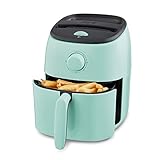
- Best for a very tight counter: Dash Tasti-Crisp 2.6-quart. Its smaller basket and simple controls suit snacks, sides, or one-person meals. It is less convenient for cooking several portions at once.
- Best when you want a narrow footprint and more capacity: Cosori TurboBlaze 6-quart. Its taller basket can be a better fit than a wide oven-style appliance, but the extra capacity still means more height and weight. Measure cabinet clearance before choosing it.
- Best for rack-style cooking: Instant Vortex Plus 10-quart Air Fryer Oven. Its larger body and door swing make it a poor choice for a crowded counter, but racks are useful when cooking separate items or several small batches together.
Compare the details that affect fit
Approximate exterior measurements below are useful for initial planning, not a substitute for checking the current manufacturer specification. Dimensions can vary by version, and a product’s listed footprint does not include the space needed to open a drawer or door.
| Model | Capacity | Approx. exterior size (W × D × H) | Approx. power | What the size means in practice |
|---|---|---|---|---|
| Dash Tasti-Crisp | 2.6 qt | About 10 × 8 × 11 in | About 1,000 W | Small serving capacity; easiest to store between uses |
| Ninja AF101 | 4 qt | About 13 × 11 × 13 in | About 1,550 W | Practical basket size, but needs drawer-pull space |
| Cosori TurboBlaze | 6 qt | About 14 × 11 × 12 in | About 1,725 W | More food per batch; check height and outlet load |
| Instant Vortex Plus oven | 10 qt | About 13 × 14 × 15 in | About 1,500 W | Rack access and door swing need extra open space |
How much basket capacity is actually useful?
Capacity describes the basket or oven volume, not a guarantee that food will crisp well when filled to the brim. Air needs to circulate around the food. A 2.6-quart model is most comfortable for one person or small sides; a 4-quart basket is a versatile starting point for one or two; and 6 quarts makes sense if you regularly cook a larger portion or want fewer batches. For a family, a compact fryer can still work, but expect to cook in rounds.
For example, suppose your usual dinner needs 1.2 pounds of fries. If a small basket holds only 0.6 pound in a loose layer, it takes two batches. At 18 minutes per batch, that is 36 minutes of cooking rather than 18, plus reheating or serving delays. A larger unit may use more counter space and electricity per minute, yet save time when it replaces a second batch. Match capacity to the food you make often, not the biggest number that fits your budget.
Measure the counter before buying
Use this quick fit check rather than measuring only the appliance base:
- Measure the usable counter patch. Include nearby handles, a backsplash, and the outlet location. Avoid placing the fryer where its cord has to stretch across a hot surface.
- Check overhead clearance. Heat and steam need room to escape. Follow the manual’s clearance guidance; do not assume the appliance is safe directly beneath a low cabinet just because it physically fits.
- Mock up the moving parts. Leave space to pull out a basket or open an oven door without hitting a wall, cupboard, or person passing through the kitchen.
- Plan where it cools. A fryer may need to stay on the counter briefly after cooking. If it must be lifted into a high shelf while hot, it is not a convenient fit.
Power, outlets, and everyday use
Many full-size countertop air fryers draw roughly 1,000 to 1,800 watts. On a 120-volt circuit, a 1,500-watt appliance draws about 12.5 amps (1,500 ÷ 120), while a 1,725-watt model draws about 14.4 amps. That can use most of a 15-amp circuit’s capacity. Avoid running a high-wattage fryer at the same time as another powerful appliance on the same circuit, and do not use an extension cord unless the manufacturer explicitly permits it. If breakers trip or you are unsure how a circuit is wired, consult a qualified electrician.
Power also affects where the fryer belongs. Choose a stable, heat-resistant surface and keep the exhaust outlet clear. Compact appliances can still release hot air from the rear or sides, so a tight alcove is not automatically suitable. A dedicated, reachable outlet is safer and less annoying than unplugging a kettle every time you cook.
Cleaning and ownership: what tends to become a nuisance
Basket-style fryers are generally simpler to clean than rack ovens because they have fewer corners and removable parts. A nonstick coating is convenient, but it is the surface most vulnerable to rough treatment. Use nonabrasive sponges and utensils, let parts cool before washing, and follow the maker’s guidance on dishwasher use. Metal tools, aerosol cooking sprays that leave residue, and abrasive scouring pads can shorten the useful life of a coated basket.
Crumbs and grease can collect around the heating element or behind oven-style racks. Unplug the unit and let it cool completely before wiping interior surfaces; never immerse the main appliance. Rack models add useful cooking positions but also add parts to wash and store. Check whether replacement baskets or trays are available before purchase, since a damaged coated component can make an otherwise working fryer frustrating to keep using.
Choose by your actual constraint
| Your situation | Best direction | Trade-off to accept |
|---|---|---|
| One person, limited storage, occasional use | 2–3 qt basket model | Small batches and less flexibility for guests |
| Two people, frequent weeknight cooking | About 4 qt, such as Ninja AF101 | Needs space to withdraw the basket |
| Want fewer batches but have limited width | Taller 6 qt basket model | More height, weight, and power draw |
| Need racks or multiple cooking levels | Compact oven-style model | Larger footprint, door clearance, and more cleanup |
Bottom line
For most small kitchens, start with a 4-quart basket fryer: it balances usable capacity and counter footprint better than either a tiny snack-size unit or a bulky oven. Pick the Dash Tasti-Crisp when storage matters more than batch size, move up to a 6-quart basket if you cook larger portions regularly, and choose a rack oven only when its extra cooking layout is worth the clearance and cleanup. Before ordering, compare the exact model dimensions and wattage with your counter, cabinet clearance, and circuit.