Best Table Saws for Accurate Mitered Casework
What's inside
As an Amazon Associate I earn from qualifying purchases. This post may contain affiliate links at no extra cost to you.
Contents
What matters for mitered casework
Mitered casework asks more of a table saw than ordinary square-edged cabinets. The blade must cut a consistent bevel, the fence must hold a repeatable width, and the saw’s table and miter gauge need to support long parts without letting them twist. A small angle error can leave a visible gap along a long corner: a 0.1-degree error produces roughly 0.035 inch of mismatch across a 20-inch miter face.
For most shops, a well-tuned cabinet saw or contractor-style saw with a stable fence is a better choice than buying a larger motor for its own sake. Accuracy comes from setup and support as much as horsepower. A quality blade, a reliable bevel mechanism, and a safe way to handle long stock matter more than a feature list.
As an Amazon Associate we earn from qualifying purchases at no extra cost to you.


Choose a saw type that fits the shop
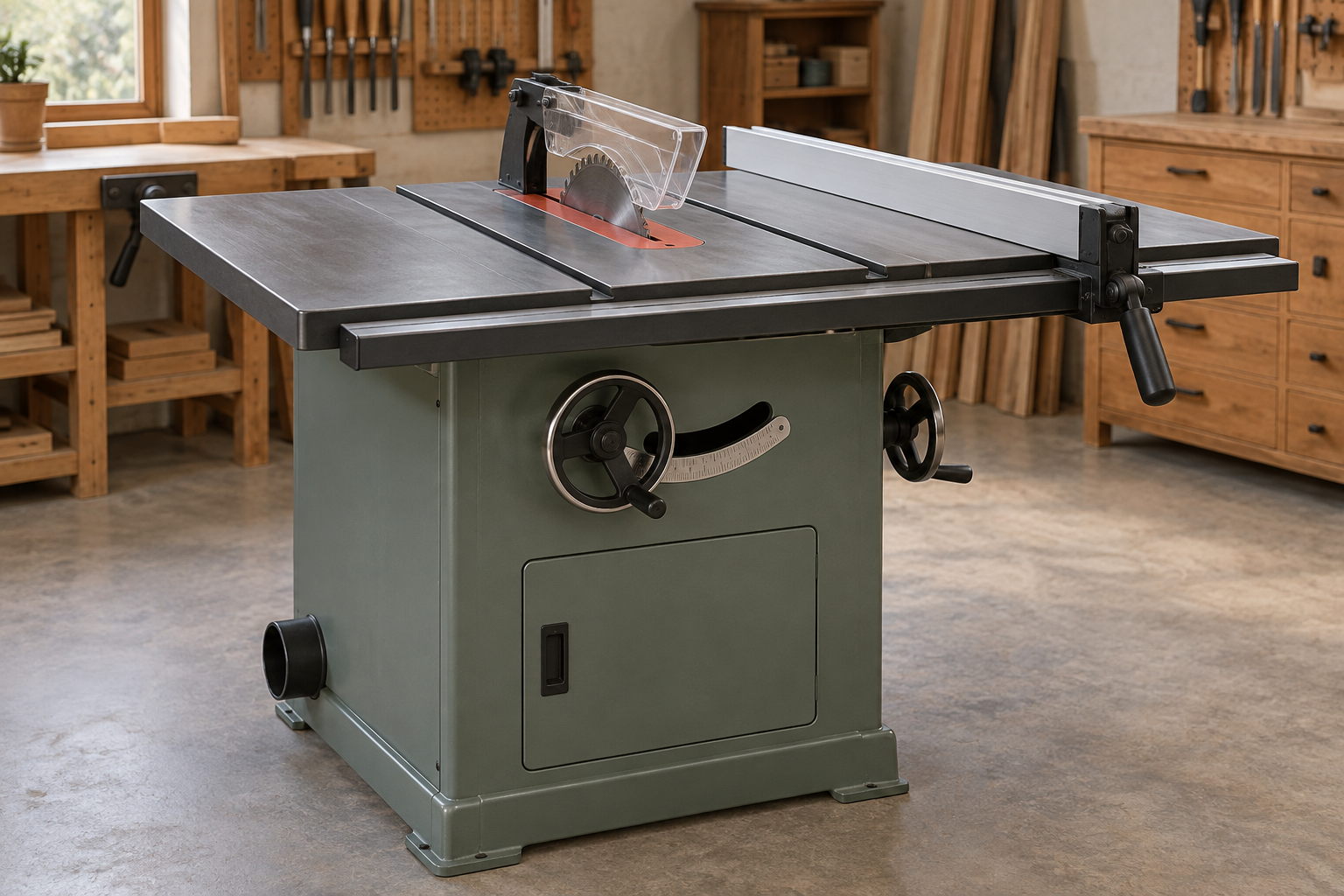
A cabinet saw is the strongest choice for a permanent shop that regularly cuts wide panels and hardwood. Its mass helps it stay put, its trunnions are generally robust, and it is easier to build a large outfeed arrangement around it. The trade-off is cost, floor space, and the need for a suitable electrical circuit. Check the manufacturer’s requirements before buying; some saws can run on a standard 120-volt circuit, while others require 240 volts or a conversion.
A contractor-style saw can be accurate enough for careful casework and costs less. It is a sensible pick for a small shop, especially when paired with a good fence and a stable mobile base. Some models have less table support and may be more affected by vibration, so inspect how the fence locks at both ends and whether the stand can be leveled securely.
Jobsite saws are portable and useful when space is tight, but their smaller tables make long miters harder to control. A careful woodworker can still get good results with extension support and a sled, but this is a compromise for frequent cabinet work. Compare contractor-style table saws with cabinet table saws based on your available power, footprint, and workload rather than assuming the heavier saw automatically cuts more accurately.
How the main options compare
| Saw type | Best fit | Main trade-off |
|---|---|---|
| Cabinet saw | Permanent shop; frequent hardwood and panel work | Price, weight, and electrical requirements |
| Contractor-style saw | Budget-conscious shop needing good accuracy | Less mass and sometimes less table support |
| Jobsite saw | Portable work or very limited floor space | Shorter support surfaces complicate long cuts |
Features worth paying for
Look for a fence that locks parallel to the blade without shifting when pressure is applied near its far end. A clear scale is convenient, but verify it against a tape measure; scales are not a substitute for checking actual cut width. A cast-iron table gives a stable reference surface, while extension wings and a solid stand make it easier to support case sides. For a mitered box, an outfeed table and side support can prevent a long panel from levering against the blade as the cut finishes.
A bevel handwheel that moves smoothly and locks firmly is useful, but it still needs to return accurately to 90 degrees. Check the saw’s blade-to-miter-slot alignment and its 45-degree stop after installation. Some saws use a riving knife that follows the blade tilt; confirm it can be used with the blade and guard arrangement you plan to run. A riving knife helps reduce the risk of stock closing on the back of the blade, but it does not prevent kickback caused by poor technique or trapped offcuts.
Budget for a sharp, flat-ground blade intended for clean crosscuts or fine woodworking. A blade with around 40 to 60 teeth is a reasonable starting point for many plywood and solid-wood tasks, though tooth geometry matters as well as tooth count. A high-quality blade can make a cheaper saw more useful; it cannot correct a blade that is out of alignment with the miter slot. See fine-cut table-saw blades as an upgrade before paying for a premium saw solely for a better-looking cut.
Set up the saw before cutting miters
Unplug the saw before measuring or adjusting it. Use a reliable straightedge or dial indicator to check that the blade is parallel to the miter slot, then set the fence parallel to the slot according to the saw maker’s instructions. A small misalignment can burn a workpiece, push it sideways, or encourage binding. Do not tune by eye alone.
For a 45-degree cut, set the blade with a gauge or digital angle finder, then make a test cut in scrap of the same thickness as the case material. Join two test pieces and check the corner with a reliable square or straightedge. Four sides that meet in a closed case amplify small errors, so test the complete sequence when possible. If the joint opens consistently on the outside, adjust the angle in small increments rather than trying to force the pieces together with clamps.
Use a tall auxiliary fence or a purpose-built miter sled to keep narrow or tall pieces stable against the table. Keep hands away from the blade path, use push blocks where appropriate, and support long stock so it cannot sag or rotate. Never trap a thin offcut between the blade and fence; for bevel cuts, follow the saw manual’s guidance on fence position and use a suitable jig when needed.
Make the buying decision
Choose a cabinet saw if mitered casework is regular work and the shop can accommodate its weight and power needs. Choose a contractor-style saw if the budget is tighter and you are willing to verify alignment, add support, and spend time on setup. A jobsite saw is fine for occasional small cases or a shared shop where portability matters more than convenience on long cuts.
Before ordering, check the fence travel, table dimensions, blade tilt direction, dust collection port, included safety equipment, and the return or service arrangements. If you cannot inspect the saw in person, confirm that replacement parts and alignment instructions are available. For accurate miters, a stable saw that can be tuned and supported is a better purchase than an impressive specification sheet.

