Table Saw vs Track Saw for Breaking Down Plywood in a Small Shop
What's inside
As an Amazon Associate I earn from qualifying purchases. This post may contain affiliate links at no extra cost to you.
Breaking down a 4-by-8-foot sheet of plywood is awkward in a small shop. A table saw can make accurate, repeatable cuts, but a full sheet is heavy and difficult to control on a compact saw. A track saw keeps the sheet on a work surface while the saw moves across it, which usually makes the first cuts safer and simpler. The right choice depends on how often you cut sheet goods, whether you need a table saw for other work, and where you can support the plywood.
As an Amazon Associate we earn from qualifying purchases at no extra cost to you.



Contents
The main difference
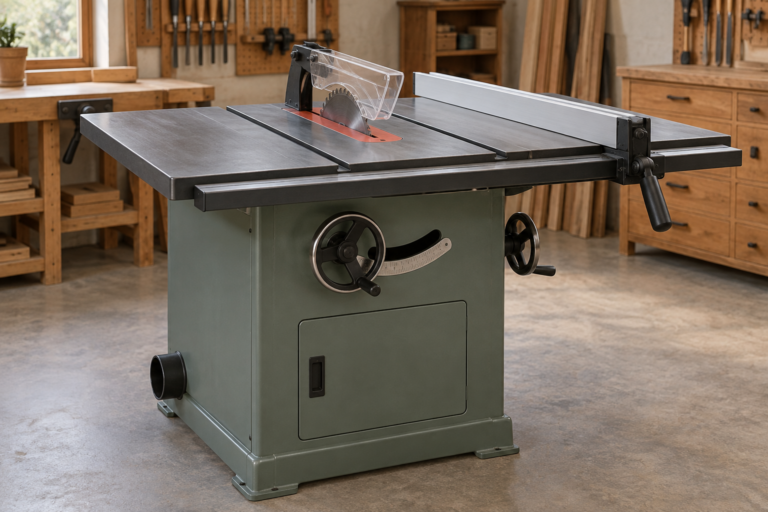
A table saw feeds the plywood through a fixed blade. Its strengths are repeatability, rip cuts, and handling smaller parts once a sheet has been cut down. Its weakness is that the operator must support and steer a large, flexible sheet as it passes the blade. A small saw’s short table and limited outfeed support make that harder, not easier.
A track saw rests on the plywood and follows a straight guide rail. The sheet stays put while you move the saw. That reverses the handling problem: you need a flat, supported place for the sheet, but you do not have to push the whole sheet across a table. A rail around 55 inches long is useful for many crosscuts; a full-length rip across a 48-inch sheet usually needs a longer rail or a carefully planned two-pass setup.
How they compare
| Factor | Table saw | Track saw |
|---|---|---|
| Full-sheet handling | Demanding without generous infeed and outfeed support | Sheet stays on a floor or low platform |
| Space during a cut | Needs room behind and beside the saw | Needs a flat area about the size of the sheet |
| Repeatable narrow rips | Fast with a fence and support | Slower; requires measuring or a parallel guide |
| Cut quality | Good with a sharp, suitable blade and proper setup | Good with a sharp blade and correctly positioned rail |
| Other shop work | Useful for solid wood, dados where permitted, and repeated parts | Primarily for sheet goods and long straight cuts |
| Typical added needs | Outfeed support, infeed help, and safe work area | Rail, clamps or grip strips, and a sacrificial surface |
When a track saw makes more sense
For a one-person shop with limited floor space, a track saw is often the easier tool for the first cut in a sheet. Lay the plywood on rigid foam insulation or a sacrificial platform, set the rail on the cut line, and make a shallow scoring pass before the full-depth cut if the saw allows it. That helps reduce veneer tear-out. Check that the blade depth extends only a few millimeters below the sheet and that the rail is not sitting on a warped or sagging surface.
Support matters. If the sheet bridges a gap, it can flex and pinch the blade near the end of the cut. That can leave a rough edge, pull the saw off line, or cause kickback. Use support beneath the waste and retained pieces, and keep the cut path clear of screws, clamps, and the floor. For cabinet-grade plywood, a fine-tooth blade and a splinter strip in good condition help; they cannot compensate for a dull blade or a loose rail.
Compare a track saw kit with guide rail if you regularly break down full sheets. A rail system costs more than a basic circular saw and straightedge, but it is quicker to set up and easier to repeat accurately. If you cut only a few sheets a year and can tolerate checking the guide alignment, a circular saw with a straightedge guide can be the cheaper, adequate option.
When a table saw makes more sense
A table saw earns its space when sheet breakdown is only part of the job. After cutting a 48-inch-wide sheet into manageable sections, the saw is excellent for ripping those sections to consistent widths. A fence set once is faster than measuring every piece, and a stable outfeed table makes repeated cuts less tiring. For a small shop, a compact saw can handle this work well if you do not ask it to control a full sheet unsupported.
Do not try to muscle a full 4-by-8 sheet through a small saw alone just because the blade can reach it. A sheet can catch on the fence, tip, or pull the operator off balance. A helper can improve control, but should support the sheet without pushing it sideways or pulling it past the blade. Use a riving knife, keep the guard in place when practical, and never stand directly in the likely kickback path. If the shop cannot provide stable support and clear travel for the sheet, make the first cuts with a track saw or have the supplier cut it down.
If you need a saw for general woodworking as well as plywood, compare a compact table saw and outfeed support. The support is not an optional convenience for large panels; it is part of the setup.
A practical buying choice
Choose a track saw first if full sheets are a regular purchase, you work alone, or your shop has no room for long infeed and outfeed paths. Choose a table saw first if you mainly make repeated narrow parts, work with solid lumber, and can safely support stock. If you already own a table saw, adding a track saw can solve the sheet-handling problem without replacing the machine. If you already own a circular saw, a guide and careful support may be enough until your workload justifies a track system.
Before buying either, measure the space you will actually use. A 4-by-8 sheet needs a flat support area, while a table saw needs clear space for the work to travel through and beyond the blade. Also check cut capacity: a track’s usable length must exceed the cut, and a table saw’s rip capacity is the distance from blade to fence, not the size of the tabletop. Those measurements, more than motor power, determine whether the tool will make plywood manageable in your shop.