Best Rail and Stile Router Bits for Cabinet Doors
What's inside
- What a rail-and-stile router-bit set must accomplish
- Best rail and stile router bits by situation
- Head-to-head: the main choices
- Cope-and-stick profile and panel fit
- Door thickness, router, and shank size
- Setup repeatability: the feature that saves the most time
- Durability and ownership realities
- Bottom line
- Related Guides
- What a rail-and-stile router-bit set must accomplish
- Best rail and stile router bits by situation
- Head-to-head: the main choices
- Cope-and-stick profile and panel fit
- Door thickness, router, and shank size
- Setup repeatability: the feature that saves the most time
- Durability and ownership realities
- Bottom line
- Related Guides
As an Amazon Associate I earn from qualifying purchases. This post may contain affiliate links at no extra cost to you.
The best rail and stile router bits for most cabinet-door builders are a matched 1/2-inch-shank cope-and-stick set with a 3/4-inch material capacity, carbide cutters, and a bearing-guided profile that includes a test-piece setup method.
For a dependable general-purpose choice, look first at matched sets from Freud, Whiteside, Amana Tool, or CMT. The brand matters less than whether the rail and stile profiles are designed to work together, the cutters match your door thickness, and the set can be reset accurately after cleaning or sharpening.
As an Amazon Associate we earn from qualifying purchases at no extra cost to you.


Contents
- What a rail-and-stile router-bit set must accomplish
- Best rail and stile router bits by situation
- Head-to-head: the main choices
- Cope-and-stick profile and panel fit
- Door thickness, router, and shank size
- Setup repeatability: the feature that saves the most time
- Durability and ownership realities
- Bottom line
- Related Guides
What a rail-and-stile router-bit set must accomplish
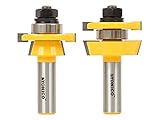
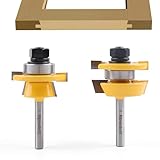
A cabinet door frame is normally made with two operations. The stick bit cuts the inside profile and the groove in the stiles and rails. The cope bit cuts the matching end profile on each rail, including the tongue that fits into the stick-cut groove.
A good set should produce four things at once:
- A flush-looking joint at the rail-and-stile intersection.
- A groove that accepts the panel without excessive looseness.
- A consistent door thickness and outside profile.
- Repeatable results when making several doors.
These are not universal bits. A set intended for 3/4-inch stock may not produce the correct joint in 5/8-inch or 1-inch material, even if the profiles look similar. Always match the set to the actual thickness of your frame parts and the panel system you plan to use.
Best rail and stile router bits by situation
| Situation | Best set type | Recommended specifications | Why it fits |
|---|---|---|---|
| First cabinet-door project | Matched cope-and-stick set with bearings | 1/2-inch shank, 3/4-inch stock capacity, 2-1/2 to 3-inch cutting diameter | Easier setup and less dependence on a perfectly sized router-table fence |
| Occasional furniture builder | Carbide-tipped standard-profile set | Two bits, 1/2-inch shanks, 1/4-inch or 3/8-inch panel groove | Good balance of cost, durability, and profile availability |
| Frequent cabinet production | Premium matched set with replaceable or thick carbide | 1/2-inch shanks, sealed bearings, indexed height references, 3/4-inch capacity | Better wear resistance and faster repeat setup |
| Raised-panel doors | Rail-and-stile set paired with a compatible raised-panel bit | Same panel thickness system; typically 1/4-inch panel groove and 3/4-inch frame stock | Keeps the panel edge and frame groove compatible |
| Shaker or flat-panel doors | Square or small-radius cope-and-stick set | 1/4-inch panel groove, narrow inside profile, 3/4-inch material capacity | Produces a restrained frame without a large decorative edge |
| Limited shop space | Compact bearing-guided set used in a router table | 1/2-inch shank, cutter diameter under about 2-1/2 inches | Requires less storage and is easier to control than a large profile system |
Head-to-head: the main choices
Freud rail-and-stile sets
Freud sets are widely available and commonly use a 1/2-inch shank, carbide cutting edges, and bearing-guided operation. They are a practical choice when you want a recognizable profile and replacement bearings or related panel bits are easy to source. Many sets are aimed at standard 3/4-inch door stock, so check the stated material range rather than assuming every Freud set uses the same dimensions.
Choose a Freud set when repeat purchases and broad accessory availability matter. Before buying, verify whether the set is intended for a raised panel, flat panel, or a particular cope-and-stick profile; those details determine the finished appearance more than the brand name.
Whiteside matched sets
Whiteside is a strong option for woodworkers who prioritize cutter quality and long-term serviceability. Its cabinet-door sets are generally positioned toward users who expect to make multiple doors and want a substantial carbide cutting edge. The profiles are often offered in conventional as well as more decorative versions.
A Whiteside set makes sense for frequent use, especially when the additional purchase cost is small compared with the time required to remake a door. It is still essential to use the exact matching cope and stick pair; combining visually similar bits from different manufacturers can create a tongue or groove that does not seat correctly.
Amana Tool sets
Amana Tool offers cabinet-door tooling in several profiles and shank configurations, including sets designed for router-table work. These are useful when you need a specific frame style, such as a traditional ogee, a simpler edge, or a profile suited to thicker material.
Amana is worth considering when profile selection is more important than buying the least expensive set. Read the technical drawing carefully: panel groove width, stock thickness, cutting height, and bearing position can vary from one set to another.
CMT and other value-oriented matched sets
CMT and comparable established tooling brands can offer good value for occasional cabinet work. They are most attractive when the set has a 1/2-inch shank, carbide cutters, a clearly specified stock thickness, and a replacement-bearing system.
Lower price should not mean accepting a poorly defined profile. Avoid sets that do not provide a dimensioned drawing or that describe the bits only as “universal.” A cheap mismatched set can cost more after wasted frame stock, replacement panels, and repeated setup time.
Cope-and-stick profile and panel fit
The visible profile is only half the decision. The panel groove controls how the door is assembled. A 1/4-inch groove is common for plywood, MDF, and thin solid-wood panels. A 3/8-inch groove provides more engagement but requires a suitably thick panel edge or a panel that has been rabbeted to fit.
For a typical 3/4-inch door frame, a 1/4-inch panel groove leaves approximately 1/4 inch of material on each side of the groove if the groove is centered. This is a useful starting point, but the actual remaining rail width depends on the profile geometry.
Raised-panel bits must match the rail-and-stile set’s groove location. If the panel bit leaves the panel too thick, it will bottom out before the frame joint closes. If it is too thin, the panel may rattle or sit visibly low in the groove. Buy the rail-and-stile and panel bits as a compatible system whenever possible.
Door thickness, router, and shank size
Use a 1/2-inch-shank set for full-size cabinet-door work when your router accepts that shank. It provides more rigidity than a 1/4-inch shank, which matters with large cutter diameters and deeper cuts. A router table is strongly preferred because it supports long frame pieces and keeps the bit perpendicular to the stock.
Check three measurements before ordering:
- Frame thickness: commonly 3/4 inch, but measure dressed stock rather than relying on nominal lumber sizes.
- Panel thickness: commonly 1/4 inch for flat panels or a thicker blank prepared for a raised-panel bit.
- Maximum cutter diameter: confirm that your router table insert, guard, and router speed range can accommodate it.
Never assume that a bit labeled for “cabinet doors” will handle 1-inch or 5/8-inch material. The cope profile and tongue height must correspond to the stick profile at the same stock thickness.
Setup repeatability: the feature that saves the most time
Rail-and-stile work becomes frustrating when the first door fits and the second does not. The most reliable approach is to make dedicated setup blocks from the same material as the door parts.
- Flatten and square one short piece of frame stock.
- Set the stick bit so the groove is centered and make a test cut.
- Set the cope bit using the stick-cut sample, not by eye. The tongue should enter the groove without forcing.
- Cut a second test joint and check that the outside profiles align.
- Mark the bit height, bearing orientation, and cutter used on the setup blocks.
- Save the blocks with the bits so the settings can be reproduced later.
For a batch of six doors, spending 15 minutes on setup blocks can prevent six or more frame pieces from being scrapped. Make all the stick cuts first, then all the cope cuts, and keep the same reference face against the table or fence.
Durability and ownership realities
The carbide edge usually lasts much longer than the bearing. Resin, finish, and fine dust can make a bearing drag or develop play. Inspect the bearing before each project and replace it if it feels rough, wobbles, or spins unevenly.
- Clean pitch from the cutter with a resin-safe bit cleaner; do not scrape carbide edges with steel.
- Keep bits dry and stored separately so cutting edges do not contact one another.
- Do not plunge a large profile bit into a full-width cut in one pass if the manufacturer specifies lighter passes.
- Use climb-cutting only for a very controlled trimming pass, never as the main operation on a router table.
- Retire or sharpen a bit when burning remains after feed rate, dust collection, and cutting depth are corrected.
A quality 1/2-inch-shank set generally costs roughly $70 to $180, depending on profile complexity, carbide quantity, and brand. A premium set can be economical for repeated work: if it costs $120 and makes 60 doors, the tooling cost is $2 per door before sharpening and wear parts. An inexpensive set that ruins one complete door may erase much of its initial saving.
Bottom line
Choose a matched 1/2-inch-shank cope-and-stick set specified for your exact frame thickness, then select the panel groove and profile based on the door style. Freud is a sensible all-around choice, Whiteside and Amana Tool are strong options for frequent or profile-specific work, and CMT or another established value brand can suit occasional builders. The best rail and stile router bits are the ones with a clearly documented mating profile, a compatible panel system, replaceable bearings, and enough cutter capacity for the doors you actually plan to build.