Best Quality Router Bits for Clean Cuts and Long Life
What's inside
As an Amazon Associate I earn from qualifying purchases. This post may contain affiliate links at no extra cost to you.
Contents
Best Quality Router Bits for Clean Cuts and Long Life
The best quality router bits for clean cuts and long life have a precisely ground carbide edge, sound brazing, and a bearing that turns smoothly without play; for regular hardwood work, a reputable solid-carbide or thick-tipped carbide bit is usually worth paying more for, while a modestly priced carbide-tipped bit is often the better value for occasional routing and sheet goods.
What actually justifies a higher price?
“Carbide” alone does not tell you how long a bit will stay sharp. Carbide grade, edge geometry, brazing, and bearing quality all matter—and the best balance depends on what you cut. A clean cut in plywood is not the same test as repeated passes through hard maple or oak.
As an Amazon Associate we earn from qualifying purchases at no extra cost to you.


- Carbide grade and thickness: Carbide composition and grain structure affect wear resistance and toughness. Manufacturers do not always publish the exact grade, so compare stated materials, edge thickness, and intended use rather than assuming every carbide-tipped bit is equivalent. Thick carbide tips offer more material for future sharpening; solid-carbide bits can provide sharp, precise edges but are less forgiving of impact.
- Brazing: On a carbide-tipped bit, the joint between the carbide and steel body needs to tolerate heat and cutting forces. Inspect for an even, clean joint and avoid bits with visible gaps, cracks, or loose tips. A poor joint can fail before the cutting edge wears out.
- Grind and geometry: Symmetrical cutting edges, consistent relief, and a sharp, even grind help the bit cut smoothly and reduce burning and fuzz. For sheet goods, a suitable shear or compression geometry can improve the edge finish, but the correct choice depends on the workpiece and cutting direction.
- Bearings and hardware: On pattern, flush-trim, and some profile bits, the bearing is a wear item. It should rotate freely, without wobble or roughness. A replaceable bearing and accessible retaining screw make maintenance easier; they do not compensate for poor cutting geometry.
Choose by job, not by the biggest set
| Situation | Bit type and construction to look for | Useful buying detail | Value verdict |
|---|---|---|---|
| Occasional edge profiles or roundovers | Carbide-tipped profile bit with a replaceable bearing | Common shank sizes are 1/4 in. and 1/2 in.; match the shank to the collet | A reputable mid-priced bit is usually enough for infrequent use. |
| Frequent hardwood pattern or flush trimming | Carbide-tipped flush-trim bit with a smooth, replaceable bearing | Check the cutting length and bearing position against the template and workpiece | Pay more for consistent grinding, a robust joint, and serviceable hardware. |
| Clean edges in plywood or veneered panels | Sharp, application-appropriate straight, shear, or compression bit | Confirm cutting length and feed direction; compression bits require enough material depth to engage both cutting regions | A specialized bit can reduce edge cleanup, but only when matched to the panel and setup. |
| Repeated production routing or frequent sharpening | High-quality carbide-tipped bit or suitable solid-carbide design | Ask whether the maker supports resharpening and replacement bearings | Higher initial cost can pay off when the bit sees regular use and can be maintained. |
| Small shop with limited storage and occasional projects | A few frequently used profiles rather than a large mixed set | Prioritize common sizes and bits suited to actual projects | Buying fewer, better-chosen bits avoids paying for unused profiles. |
The table’s dimensions are standard shank diameters, not a guarantee that every bit is available in both sizes. Use the shank diameter specified for the bit, and never fit a reducer sleeve unless the router and collet manufacturer explicitly permits it. A 1/2-in. shank is generally stiffer than a 1/4-in. shank, but the router must have the matching collet.
Where established brands fit
Freud, CMT, Whiteside, and Amana Tool are established router-bit brands with broad product ranges. Their catalogs include different constructions and price tiers, so a brand name by itself is not a quality specification. Compare the individual bit’s intended material, cutting geometry, shank, bearing arrangement, and sharpening support.
For a homeowner routing a few softwood or plywood edges each year, a sound carbide-tipped bit from an established maker is typically a sensible purchase. For repeated hardwood work, a better-ground bit with durable carbide and serviceable bearings is more likely to justify its premium. Solid-carbide spiral bits can be a strong choice for suitable routing operations, but they cost more and need careful handling to avoid chipping.
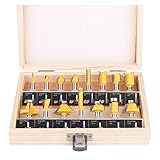
Be cautious with oversized, very inexpensive sets. A large profile assortment may look economical, but if several bits are rarely used, the real value is low. Check each bit for clean grinding, secure tips, and a bearing that turns smoothly before putting it into service.
When does the premium pay for itself?
Compare cost per usable cut, not just the checkout price. Suppose a budget bit costs $20 and remains acceptable for 100 comparable cuts, while a $60 bit lasts 500. The cost is 20 cents per cut for the first bit and 12 cents for the second. The premium bit is cheaper over that workload—provided its finish remains acceptable and it can actually be used for all 500 cuts.
Those figures are an illustration, not a lifespan promise. Hardwood species, abrasives in engineered panels, feed rate, bit diameter, cut depth, router condition, and maintenance can change wear dramatically. A bit used only a few times a year may never repay a higher price through longevity alone; better finish or reduced sanding may still matter, but should be weighed against the project’s needs.
Keep the cutting edge and bearing working
Most premature wear comes from heat, contamination, or misuse rather than an unavoidable defect. Resin and pitch build up on the cutting edge and bearing, raising friction and encouraging burning. Clean bits with a cleaner intended for resin on cutting tools, following its label; avoid soaking bearings or using a method that could damage coatings or brazed joints.
- Inspect carbide edges for chips and the brazed joint for cracks before use. Do not run a bit with a loose or damaged tip.
- Turn the bearing by hand before routing. Replace it if it feels gritty, binds, wobbles, or has noticeable play.
- Use sharp bits, a suitable feed rate, and multiple passes for deep cuts. Forcing a dull bit or taking too much material in one pass creates heat and a rough finish.
- Keep the shank clean and insert it properly into the collet. Follow the router and collet instructions for engagement; do not bottom the shank out.
- Store bits where carbide edges cannot strike each other. Carbide is hard, but its cutting edges can chip from impact.
Bottom line
For occasional work, choose a well-made carbide-tipped bit in the exact profile and size you need; there is little value in paying for production-grade durability if the bit sees only a few cuts. For frequent hardwood routing or precision trimming, favor consistent grinding, sound brazing, thicker carbide where applicable, and replaceable bearings. For plywood and veneered panels, select geometry for the panel and cut direction rather than assuming a premium general-purpose bit will solve every edge-quality problem.