5 Inch Orbital Sander Pads: 5-Hole, 8-Hole & Universal Replacements
What's inside
As an Amazon Associate I earn from qualifying purchases. This post may contain affiliate links at no extra cost to you.
For most 5-inch random orbital sanders sold today — including the common DeWalt, Bosch, Makita, and Ryobi models — the correct replacement is an 8-hole hook-and-loop pad, while the 5-hole pattern mainly survives on older Porter-Cable-era tools. But hole count is only the first of three checks: the pad also has to match your sander’s screw spacing, and its foam density should match the work you actually do. Here’s how to decide all three.
As an Amazon Associate we earn from qualifying purchases at no extra cost to you.


Contents
5-Hole vs. 8-Hole: What the Pattern Actually Controls
The dust holes don’t change how the sander cuts — they only control how much dust your vacuum or bag pulls through the disc. Behind the holes sits one open plenum inside the pad, so pickup works wherever a disc hole overlaps a pad hole.
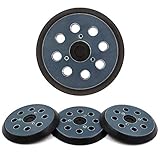
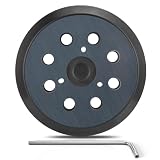
- 8-hole pads spread pickup across more of the disc face, so the outer third of the abrasive stays cleaner and discs tend to last a bit longer before loading up. It’s the current standard, which means discs are cheap and everywhere — bulk boxes routinely run 20–60 cents per disc.
- 5-hole pads concentrate pickup nearer the center; the disc edge sheds more dust onto the work. They still sand perfectly well with a shop vac, but 5-hole discs get less shelf space every year.
- A mismatch isn’t fatal. An 8-hole disc on a 5-hole pad still sticks — the hooks cover the whole face — you just lose extraction where holes don’t overlap.
- Conversion is possible. Because the plenum is open underneath, swapping a 5-hole pad for an 8-hole pad with matching screw spacing effectively converts an older sander to the modern disc format — a cheap way to standardize one disc inventory across tools.
- Mesh/net abrasives bypass the question entirely. Air flows through the whole disc face, so they extract well on either pattern.
| Pattern | Dust Pickup | Disc Availability | Typical Pad Price |
|---|---|---|---|
| 5-hole | Adequate at center, weaker at edge | Legacy; mostly multipacks online | $8–15 |
| 8-hole | Strongest overall; current standard | Widest, including budget bulk boxes | $8–18 |
| Universal / multi-hole | Depends which holes align | Accepts both disc types | $10–20 |
Foam Density: The Flat-vs-Contoured Trade-Off
A pad face is roughly 10 mm of foam over a rigid plastic hub, and how hard that foam is changes the sanding geometry:
- Firm pads keep the abrasive plane flat — they resist dishing veneer, keep edges crisp, and give better control during stock removal on flat panels. On curves they cut flat spots.
- Soft pads conform to profiles, turnings, and moldings, and they’re gentler when scuff-sanding between coats. The cost: they round over edges, can dish soft grain on flats, and cut slightly slower because the foam absorbs some orbital motion.
- Universal replacements are almost always medium density — a reasonable default for mixed shop work.
- A foam interface pad is the smarter buy than a second sander pad for occasional contour work. A 5 or 10 mm interface (hook face on both sides) goes between pad and disc for a few dollars and turns a firm pad soft. The trade-off is less aggressive cutting and weaker edge retention.
- You can gauge density with a thumb press: firm foam barely yields, soft foam compresses a few millimeters.
| Density | Flat Panels | Curves & Profiles | Edge Retention |
|---|---|---|---|
| Firm | Excellent | Poor — cuts flat spots | Crispest |
| Medium (universal) | Good | Fair | Good |
| Soft | Fair — can dish | Good | Rounds edges |
| Any pad + 10 mm interface | Soft feel | Best | Weakest |
Which Pads Fit DeWalt, Bosch, Makita, and Ryobi 5-Inch Sanders
Compatibility is really two separate checks: the screw spacing where the pad bolts to the spindle (usually three screws, brand-specific spacing) and the dust-hole pattern facing your discs. That’s why listings specify models rather than just “5-inch.”
| Brand | Representative 5-In Models | Factory Pattern | Mount | Pad Price Range |
|---|---|---|---|---|
| DeWalt | DWE6421, DWE6423, DCW210B | 8-hole | 3 screws | $10–18 aftermarket; $25–35 OEM |
| Bosch | ROS20VSC, ROS10 | 8-hole | 3 screws | $12–20 aftermarket; soft and hard OEM variants offered |
| Makita | BO5030, BO5041, XOB01Z | 8-hole | 3 screws, Makita spacing | $8–16 aftermarket; ~$20–30 OEM |
| Ryobi | RS290G, P411 (ONE+) | 8-hole | 3 screws | $8–15 aftermarket |
| Porter-Cable (legacy) | 333, 343 family | 5-hole | 3 screws | $8–15, pattern-specific |
- Verify before ordering: count the holes in a disc that came with your sander and the screws under the pad. Manufacturers have changed patterns across generations, and regional 125 mm variants sometimes differ.
- 5-inch and 125 mm are the same class (125 mm ≈ 4.92 in). Pads and discs labeled either way interchange.
- Multi-fit “universal” pads use slotted or extra screw holes to cover several bolt circles — convenient, but confirm your model is on the fit list.
- OEM vs. aftermarket: cheap pads sometimes have thinner hook material and slightly imperfect balance, which shows up as extra vibration and faster hook wear. For a daily-use tool, the OEM pad earns its premium; for occasional DIY use, aftermarket 2-packs are hard to argue with.
Swapping the Pad: A Five-Minute Job
- Pull the plug or battery and peel off the disc.
- Back out the screws — typically three Phillips or Torx through the pad face.
- Lift the old pad and vacuum the cavity. Packed dust here starves extraction no matter which pattern you run. Check the brake ring and fan for damage while it’s open.
- Set the new pad, start all screws by hand, then snug them evenly. The screws thread into a plastic hub — overtightening strips it, which is a much bigger repair.
- Spin the pad by hand to check for wobble, then run the sander 10 seconds with the vac attached to confirm pickup.
What Wears Out First (and How to Slow It Down)
- The hook face goes first. Symptom: discs slide off under light pressure or launch at startup. Hooks are nylon — heat kills them, so let the sander’s weight do the work instead of leaning on it.
- Never run the pad bare. Hooks against bare wood destroy the face in seconds; always keep a disc mounted, even a worn one.
- Foam edges tear and crumble with age and shop heat; a torn edge means wobble and swirl marks. Cracks around screw holes mean the pad is done.
- Cleaning: a stiff nylon brush or crevice tool revives clogged hooks; blow the dust holes clear with compressed air. Skip solvents on the foam.
- The math favors repair. A $10–20 pad lasting two or three years of hobby use costs pennies per session — versus $60–130 for a new sander. A pro sanding daily might replace yearly; either way, it’s the cheapest vibration fix there is.
Picks by Situation
| Your Situation | Buy |
|---|---|
| Older 5-hole sander, drawer full of 5-hole discs | Same-pattern replacement; use up the discs |
| Wants one cheap, easy-to-find disc format | 8-hole pad (converts the sander if screw spacing matches) |
| Flat panels, tabletops, edge sanding | Firm-density pad |
| Turnings, carvings, molding profiles | Soft pad, or medium pad + 10 mm interface |
| Daily professional use | OEM pad for balance and hook life |
| Occasional DIY on a budget | Medium-density aftermarket 2-pack |
| Dust collection is the top priority | 8-hole pad + mesh/net discs + shop vac |
FAQ
Can I use 8-hole discs on a 5-hole pad?
Yes — the disc still sticks because hooks cover the entire face. You’ll lose dust extraction where the holes don’t overlap, so it’s a fine stopgap but worth matching patterns long-term.
Do replacement pads come with screws?
Most do, but check the listing. If yours doesn’t, reuse the originals — and replace any with stripped heads.
Is a universal pad as good as an OEM pad?
Functionally, yes for light-to-moderate use. Where cheap pads fall short is hook density and balance — discs let go sooner and vibration creeps up. For one heavily used sander, OEM is usually worth the extra $10–15.
My discs keep flying off — is the pad dead?
Almost always, yes. Worn or heat-glazed hooks are the cause, and no cleaning fully restores them. Budget $10–20 and five minutes for a new pad.