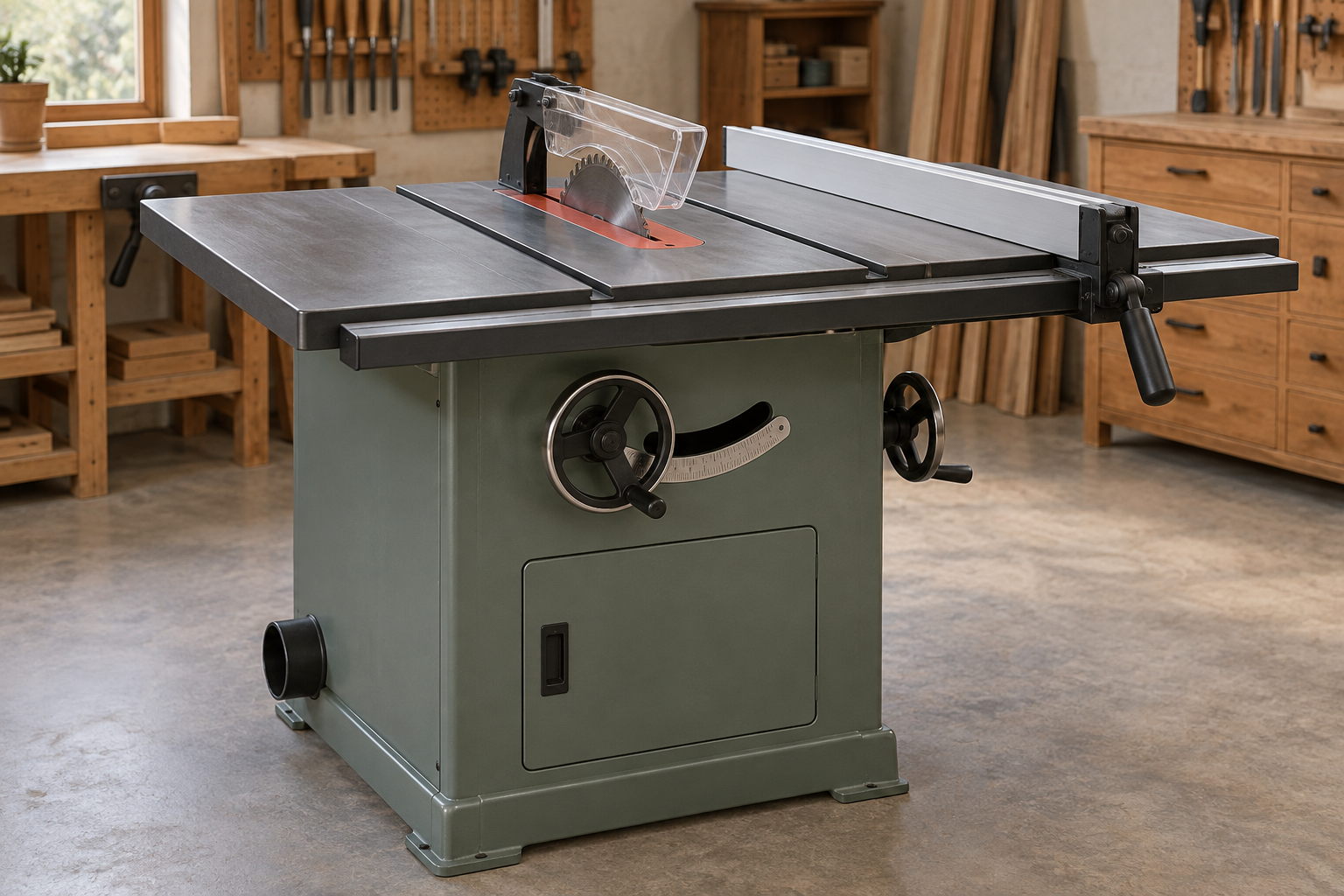
Best Table Saws for Processing Narrow Cabinet Face Frames
What's inside
As an Amazon Associate I earn from qualifying purchases. This post may contain affiliate links at no extra cost to you.
Processing cabinet face-frame parts is less demanding than breaking down sheet goods, but it is unforgiving work. Stiles and rails are often only 1 1/2 to 2 1/2 inches wide, and a small amount of drift at the fence can show up as a crooked cabinet opening. The best table saw is not necessarily the one with the biggest motor. For this work, fence accuracy, a stable table, reliable dust collection, and safe control of narrow stock matter more.
As an Amazon Associate we earn from qualifying purchases at no extra cost to you.


Contents
What Makes a Table Saw Good for Face Frames
A 10-inch saw with a 3-hp motor is more than enough for typical face-frame lumber, including maple, oak, and other dense hardwoods up to about 1 1/2 inches thick. A 1 1/2- to 2-hp saw also handles these cuts if the blade is sharp and the feed rate is reasonable. Extra horsepower becomes useful when the saw also needs to process thick hardwood panels, not because narrow rails and stiles require it.
The fence is the most important component. It should lock without shifting, remain parallel to the blade, and have a smooth face that does not snag small parts. A fence that moves 1/32 inch while locking can produce a visible mismatch across a run of cabinets. Look for a full-length steel fence with a solid locking mechanism rather than a lightweight extrusion that flexes when pushed.
A cast-iron top is another advantage. It reduces vibration and gives narrow stock a predictable surface to ride on. A 27- to 30-inch-deep table is workable for face frames; additional table depth helps when cutting long stiles but is not essential if the saw has proper outfeed support.
Best Saw Types for the Job
| Saw type | Best use | Main advantages | Main drawbacks |
|---|---|---|---|
| Cabinet saw | Dedicated shop and frequent hardwood work | Excellent fence stability, low vibration, strong dust collection | Expensive, heavy, and usually requires a 240-volt circuit |
| Contractor-style saw | Small shops and occasional cabinet work | Lower cost, adequate power, easier installation | More exposed dust, lighter tables, less refined fences on budget versions |
| Hybrid saw | Furniture work without a full industrial setup | Cast-iron top, enclosed base, good balance of price and performance | Usually less powerful and less substantial than a true cabinet saw |
| Compact jobsite saw | Portable or temporary work areas | Low purchase cost, easy storage, built-in stands on some versions | Small tables and fences make repeated narrow cuts less comfortable |
For a permanent shop, a 10-inch cabinet table saw is the strongest choice. Its enclosed base usually collects dust better, and its heavier construction keeps the cut consistent while you make a batch of parts. That consistency is valuable when a kitchen requires dozens of matching rails and stiles.
A hybrid saw is often the sensible middle ground. It can deliver cabinet-saw-like accuracy without the cost and electrical requirements of a large industrial machine. If you build a few projects per year, the cheaper option is fine, provided the fence locks squarely and the table is large enough to support your stock.
Fence and Blade Setup
Use a sharp, full-kerf combination blade or a high-quality 40- to 50-tooth general-purpose blade for sizing face-frame parts. A thin-kerf blade reduces load on a small motor, but it can flex more easily if the stock is twisted or the fence is poorly aligned. For clean hardwood edges, a flat-top rip blade is useful when the cut edge will receive a mortise, tenon, or pocket screw, while a combination blade is more convenient for general work.
Before cutting, check that the fence is parallel to the blade. A practical setup is to make the fence slightly farther from the blade at the rear—about 0.005 to 0.010 inch—so the work does not pinch between the fence and the rising teeth. Too much toe-out, however, can affect accuracy. Verify the measurement with a reliable rule or dial indicator, not only the saw’s scale.
For repeated widths, use a stop block positioned ahead of the blade, never behind it on the rip fence. A stop behind the blade can trap the offcut and create kickback. When several parts must match, make a test cut, measure it, and then run the entire batch without changing the fence.
Handling Narrow Stock Safely
Narrow face-frame parts are safest when the fence supports the work and a push device keeps your hands away from the blade. For pieces narrower than about 6 inches, use a push stick or push shoe. For very narrow strips, a tall auxiliary fence and a narrow push block provide better control than a basic stick.
Keep the riving knife installed and use the blade guard whenever the cut allows it. Set the blade only about 1/8 inch above the stock. A higher blade exposes more tooth and increases the severity of a mistake without improving the cut.
Do not freehand a rail or stile against the blade, and do not reach over the blade to retrieve an offcut. If the stock bows away from the fence, stop the cut and correct the material or setup. For long stiles, use an outfeed table or roller support, but place support so it cannot push the work upward or sideways as the cut finishes.
Buying Recommendations by Shop Size
For a serious cabinet shop or a woodworker processing hardwood every week, choose a cabinet saw with a dependable fence, enclosed dust port, riving knife, and a 3-hp motor. A 3-hp cabinet saw is justified when the same machine also handles thick stock and sheet goods.
For a home shop, a hybrid table saw with a cast-iron table is usually the best value. Spend less on horsepower and more on the fence, a solid miter gauge, and dust collection. A basic 1 1/2-hp hybrid can process face-frame parts accurately for years when fitted with a sharp blade.
A jobsite saw is acceptable when storage or budget rules out a larger machine. Choose one with a rigid fence and a table extension, and expect to spend more time checking alignment. A jobsite table saw with a folding stand is convenient, but it is the least comfortable option for long batches of narrow parts. In that case, build a flat outfeed table and use featherboards to keep every piece against the fence.
