Direct-Drive vs Belt-Drive Table Saws for Furniture Work
What's inside
As an Amazon Associate I earn from qualifying purchases. This post may contain affiliate links at no extra cost to you.
For furniture work, the drive system affects more than noise. It changes how smoothly the blade runs, how much vibration reaches the cut, how easily the saw handles thick hardwood, and what happens when something eventually fails. The basic choice is between a motor mounted directly to the blade arbor and an induction motor connected to the arbor with belts.
As an Amazon Associate we earn from qualifying purchases at no extra cost to you.


Contents
How direct-drive table saws work
In a direct-drive saw, the motor shaft is the blade arbor, or is connected to it with very little intervening hardware. The motor and blade assembly is usually compact, which is why this layout is common on portable, jobsite, and small benchtop saws.
The main advantage is simplicity. There are no drive belts to tension, pulleys to align, or separate arbor bearings to service. A decent direct-drive saw can be light enough for one person to move and ready to use in minutes. For a small shop that stores the saw between projects, that matters more than theoretical smoothness.
Direct-drive saws also tend to cost less. A portable direct-drive table saw is often a sensible choice for cutting plywood, drawer parts, face frames, and furniture components that will be cleaned up at the jointer or router.
The weaknesses show up under sustained load. Small universal motors are loud and can produce a high-pitched whine. They also transmit more motor vibration directly into the arbor. A poorly balanced blade, dirty arbor flange, or slightly bent blade can make the problem much worse.
Direct-drive saws may also bog down sooner in thick hardwood. Cutting a 2-inch oak leg or resawing a wide board is not impossible, but feed rate becomes important. Push too quickly and the motor slows, the cut burns, and the overload protection may trip. Repeated overloads generate heat and shorten motor life.
How belt-drive table saws work
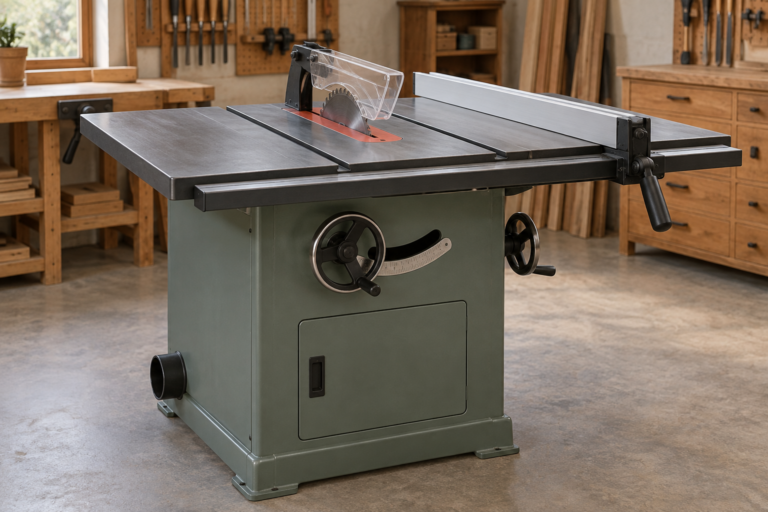
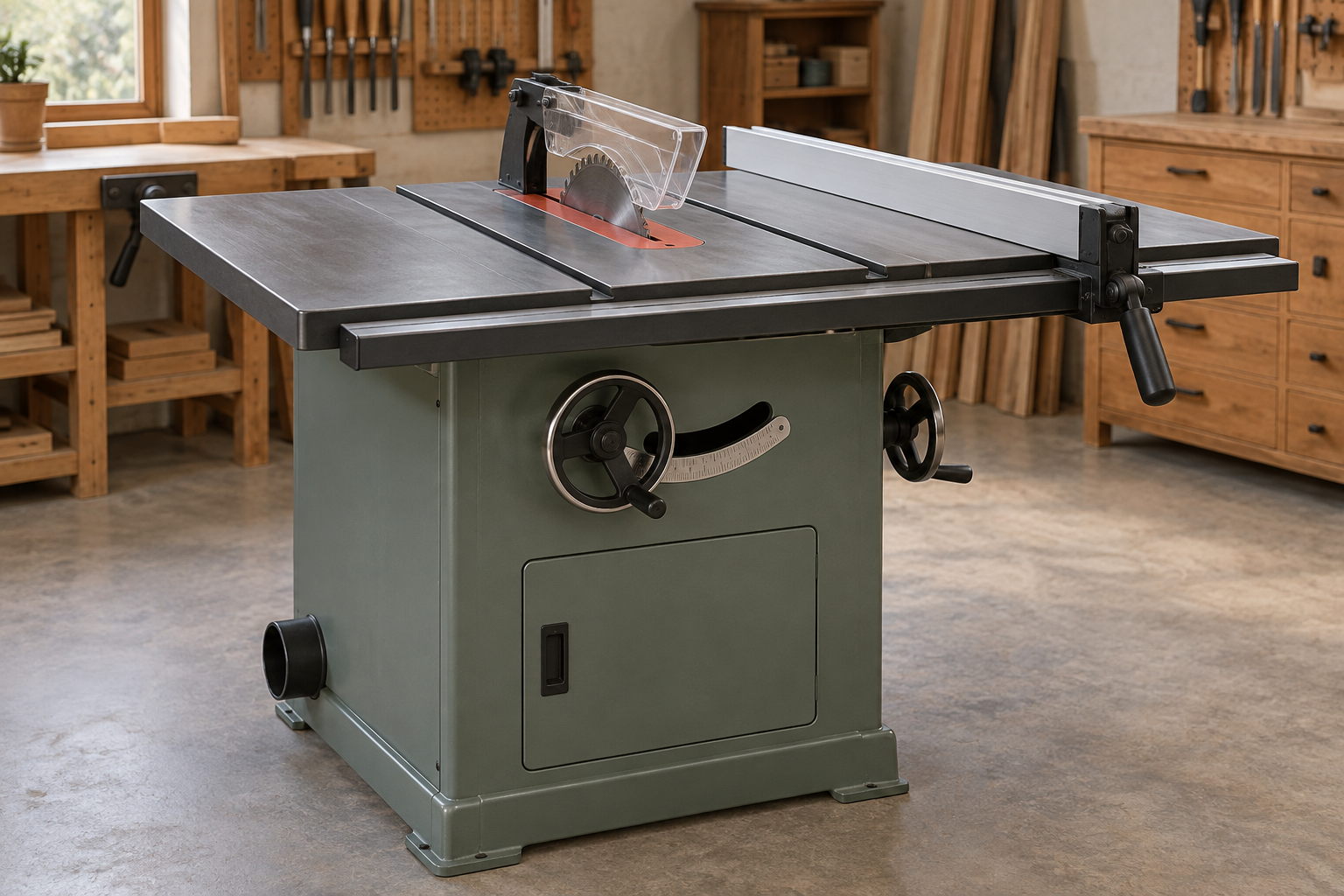
A belt-drive saw uses a separate motor, pulleys, belts, and an arbor assembly. Most full-size cabinet saws use a 3-horsepower induction motor, although the actual power available at the blade depends on the electrical supply, belt condition, and the saw’s design. The belt isolates much of the motor’s vibration from the blade.
That isolation is the reason belt-drive saws are favored for precision furniture work. A heavy cast-iron table and cabinet base resist movement, while the separate motor lets the arbor run with less vibration. A smooth arbor helps a sharp blade leave a cleaner edge and makes it easier to maintain consistent joinery dimensions.
Induction motors are quieter in pitch and better suited to long cutting sessions. They do not scream like a universal motor, although the blade still produces substantial noise. They also tolerate demanding cuts better. With a suitable blade, a properly set-up belt-drive saw can cut thick maple, walnut, and oak at a steady feed rate without the dramatic speed drop common on small portable saws.
The trade-off is size, cost, and maintenance. A cabinet saw may weigh 300 to 600 pounds, require a dedicated 240-volt circuit, and need a permanent location. Belts eventually crack or stretch. Pulleys can become misaligned, and arbor bearings can wear. These are not difficult repairs, but they are more involved than replacing a direct-drive saw’s blade.
Direct drive versus belt drive
| Factor | Direct drive | Belt drive |
|---|---|---|
| Typical saw type | Benchtop, compact, and jobsite | Contractor and cabinet saw |
| Noise | High-pitched motor noise | Lower motor noise, though still loud at the blade |
| Vibration | More likely to reach the blade and table | Usually lower with a rigid base and good alignment |
| Hardwood capacity | Fine for moderate stock and shorter cuts | Better for thick stock and repeated cuts |
| Portability | Excellent to good | Limited, especially with cabinet saws |
| Maintenance | Less mechanical service | Belts, pulleys, and arbor alignment need inspection |
| Typical cost | Lower | Higher, plus possible electrical and dust-collection costs |
Which drive is better for furniture work?
Choose belt drive when the saw is the center of a permanent shop and you regularly cut solid hardwood, thick slabs, or large quantities of parts. The smoother running and greater reserve power make dimensioning more predictable. This is especially useful for table legs, cabinet panels, long rails, and repeated tenon shoulders where a wandering or burning cut creates expensive rework.
A belt-drive saw is not automatically accurate, however. A misaligned fence, warped extension wing, loose arbor flange, or poorly tensioned belt can ruin cuts just as effectively as a cheap saw. Before judging the drive system, check that the blade is parallel to the miter slot, the fence locks square, and the blade is parallel to the fence. A good setup matters more than a horsepower label.
Direct drive is fine when most of your work involves sheet goods, boards under about 1-1/2 inches thick, and relatively short production runs. It is also the practical choice if you need to carry the saw to a jobsite or roll it into storage. A compact table saw with a folding stand can build plenty of furniture when paired with a sharp combination or ripping blade and careful feed pressure.
For a small shop cutting hardwood furniture once or twice a month, spending several times more on a cabinet saw may not improve the finished project enough to justify the space. Put some of that money into a better fence, dust collection, a zero-clearance insert, and quality blades. Those upgrades often produce a more visible improvement than moving from direct drive to belt drive.
What to check before buying
Look beyond the motor type. Check the arbor size, maximum blade diameter, depth of cut at 45 degrees, fence rigidity, miter-slot standard, and the availability of replacement parts. A saw that accepts a standard 10-inch blade gives you a much wider choice of furniture-specific ripping, crosscutting, and thin-kerf blades.
Dust collection is another practical difference. A cabinet-style belt-drive saw with an enclosed base usually captures dust better than an open portable saw, but only when connected to a collector capable of roughly 400 CFM at the machine. A shop vacuum is useful for a portable saw, though it will not capture every chip from an open blade guard.
If you choose belt drive, inspect the belts for cracks and confirm that the pulleys are coplanar. If you choose direct drive, listen for bearing rumble and check that the blade does not wobble when rotated by hand with the power disconnected. In either case, use a riving knife, keep the fence aligned, and do not force a cut when the motor is slowing. Those habits prevent more furniture defects—and more injuries—than the drive system alone.