Cabinet Table Saw vs Contractor Table Saw for Hardwood Milling
What's inside
As an Amazon Associate I earn from qualifying purchases. This post may contain affiliate links at no extra cost to you.
Hardwood milling exposes the differences between cabinet and contractor table saws quickly. Cutting a few oak boards to width is not especially demanding, but processing thick, wide, or bowed stock puts more stress on the motor, fence, arbor, and dust collection system. The right choice depends less on the species alone than on board size, production volume, available power, and how much accuracy you need after each cut.
As an Amazon Associate we earn from qualifying purchases at no extra cost to you.


Contents
The Basic Difference
A cabinet saw uses a fully enclosed steel base, a heavier trunnion assembly, and usually a 3-hp motor. The motor is commonly wired for 240 volts. A contractor saw has an open stand, a lighter saw body, and typically a 1-1/2 to 2-hp motor that runs on a 120- or 240-volt circuit.
That difference affects more than cutting speed. Cabinet saws hold alignment better when you move the machine, lean heavy stock against the fence, or make repeated cuts in dense material. Their enclosed bases also support more effective dust collection. Contractor saws are easier to move and generally cost less, but their lighter stands and smaller motors reveal their limits sooner.
| Feature | Cabinet saw | Contractor saw |
|---|---|---|
| Typical motor | 3 hp, usually 240 volts | 1-1/2 to 2 hp, 120 or 240 volts |
| Rip capacity | Often 30 to 52 inches | Often 24 to 30 inches |
| Weight | 400 to 700 pounds | 200 to 350 pounds |
| Dust collection | Usually much better with a 4-inch hose | Acceptable, but more dust escapes |
| Best use | Frequent hardwood milling and production work | Smaller shops and moderate-duty work |
Hardwood Cutting Performance
Motor horsepower is not the only measure of performance, but it matters when ripping thick hardwood. A cabinet saw with a sharp 10-inch blade can rip 8/4 white oak at a steady feed rate without bogging as easily as a contractor saw. The heavier arbor and trunnions also reduce vibration, which helps prevent rough cuts and burn marks.
A contractor saw can still handle hardwood successfully. With a sharp 24-tooth ripping blade, a well-aligned fence, and reasonable feed pressure, it can rip 4/4 maple, walnut, cherry, and oak all day in a small shop. The trouble starts with dull blades, wet stock, narrow gullets, or forcing 8/4 material through too quickly. A motor that slows substantially under load may trip a breaker, overheat, or leave a scorched edge.
For occasional milling, a quality contractor table saw is often the sensible purchase. Spend the savings on a good ripping blade, a straight fence, and a dust collector. Those upgrades can matter more than another half horsepower.
Accuracy and Alignment
Hardwood projects often require repeated rips within about 1/32 inch, and cabinet components may need closer consistency. Cabinet saws have an advantage because their trunnions are large, rigid, and commonly mounted to the cabinet. Once adjusted, the blade tends to stay parallel to the miter slot and stable under load.
Contractor saws can cut accurately, but they need more attention. Check that the blade is parallel to the miter slot and that the fence is parallel to the blade or has the slight toe-out specified by its manufacturer. A misalignment of only 0.010 inch can create rubbing, burning, or binding. Lightweight stands can also flex when cutting a long, heavy board, causing the fence to shift or the workpiece to lift.
Neither saw eliminates the need to prepare lumber. A board with a bowed edge can pinch the blade even on a premium machine. Joint one edge first, or use a safe straight-line ripping method. Never trust a table saw to straighten a severely warped board by force.
Dust and Shop Requirements
Cabinet saws are the clear winner for dust control. Their enclosed base funnels dust toward the port, and a 4-inch hose connected to a collector rated around 1,000 CFM can capture a useful majority of the waste. Fine dust still escapes at the blade opening, so respiratory protection and overhead collection remain worthwhile.
Contractor saws leave the motor and lower blade area more exposed. Some have enclosed shrouds and collect reasonably well, but a portable-style open stand usually sprays more dust below and around the saw. If your shop has a small collector or a shop vacuum, expect more cleanup. Dust buildup around the motor can also affect cooling over time.
Power, Capacity, and Shop Space
A 3-hp cabinet saw normally needs a dedicated 240-volt, 15- or 20-amp circuit. Confirm your shop wiring before buying. A 120-volt contractor saw is easier to install, but long extension cords, undersized circuits, and shared loads can reduce performance. Use the shortest heavy-gauge cord practical, or install a dedicated circuit.
Large rip capacity is useful for breaking down plywood and wide glued panels, but it does not make rough hardwood safer to process. You still need adequate infeed and outfeed support. A 52-inch fence system can consume several feet of wall space and make a small shop difficult to navigate. A contractor saw with a 24- or 30-inch fence may be the better choice if most work involves furniture parts under 24 inches wide.
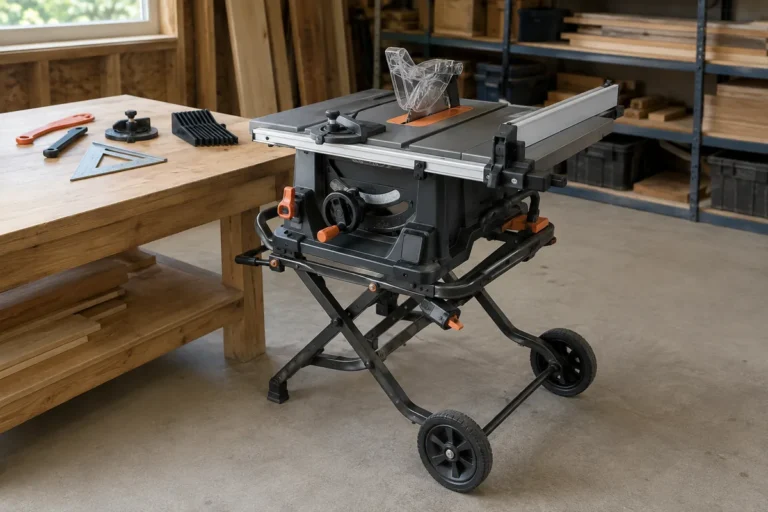
For limited floor space, consider a compact cabinet table saw with a rigid mobile base. Mobility is valuable, but lock the wheels before cutting and verify that the base does not introduce rocking.
Which One Should You Buy?
Choose a cabinet saw if you regularly mill 8/4 hardwood, process several hundred board feet per month, need dependable repeatability, or plan to keep one saw for decades. The extra weight, better dust control, and stronger fence system justify the cost when the machine is used frequently. A 3-hp cabinet table saw is the safer long-term category for a dedicated furniture shop.
Choose a contractor saw if your hardwood work is occasional, your stock is mostly 4/4, your projects are small to medium-sized, or your electrical service and budget are limited. It is not a compromise if you keep blades sharp, support long boards, align the saw carefully, and avoid forcing cuts.
Before buying, budget for the complete setup: blade, dust collection, mobile base, outfeed support, and a safe riving-knife or guard system. A cheaper saw with those essentials is more useful than an expensive saw installed without support or dust control. For most home woodworkers, the workload—not the label on the saw—should determine where the money goes.