Best Table Saws for Small-Batch Hardwood Production
What's inside
As an Amazon Associate I earn from qualifying purchases. This post may contain affiliate links at no extra cost to you.
Small-batch hardwood work asks more of a table saw than occasional plywood cuts do. Dense stock puts a steady load on the motor, and a fence that shifts under pressure can spoil a whole batch of parts. For a small shop, the practical choice is usually a well-tuned contractor-style saw or a compact cabinet saw—not the biggest machine you can fit through the door.
As an Amazon Associate we earn from qualifying purchases at no extra cost to you.


Contents
What matters in a small-batch shop
Prioritize a rigid fence, a flat table, reliable blade alignment, and enough power to cut your typical stock without forcing it. A 10-inch blade is the useful standard: it can cut roughly 3 inches deep at 90 degrees, depending on the saw. That covers most furniture parts, though thick stock may need to be turned over and cut from the other side.
Motor ratings can mislead. Many 120-volt saws are advertised around 1.5 horsepower, but the number alone says little about sustained performance. A 240-volt saw with a suitable circuit is less likely to bog down in demanding cuts. A 120-volt machine is still adequate for moderate work if you use a sharp, appropriate blade, take sensible feed rates, and avoid deep cuts in thick, hard stock.
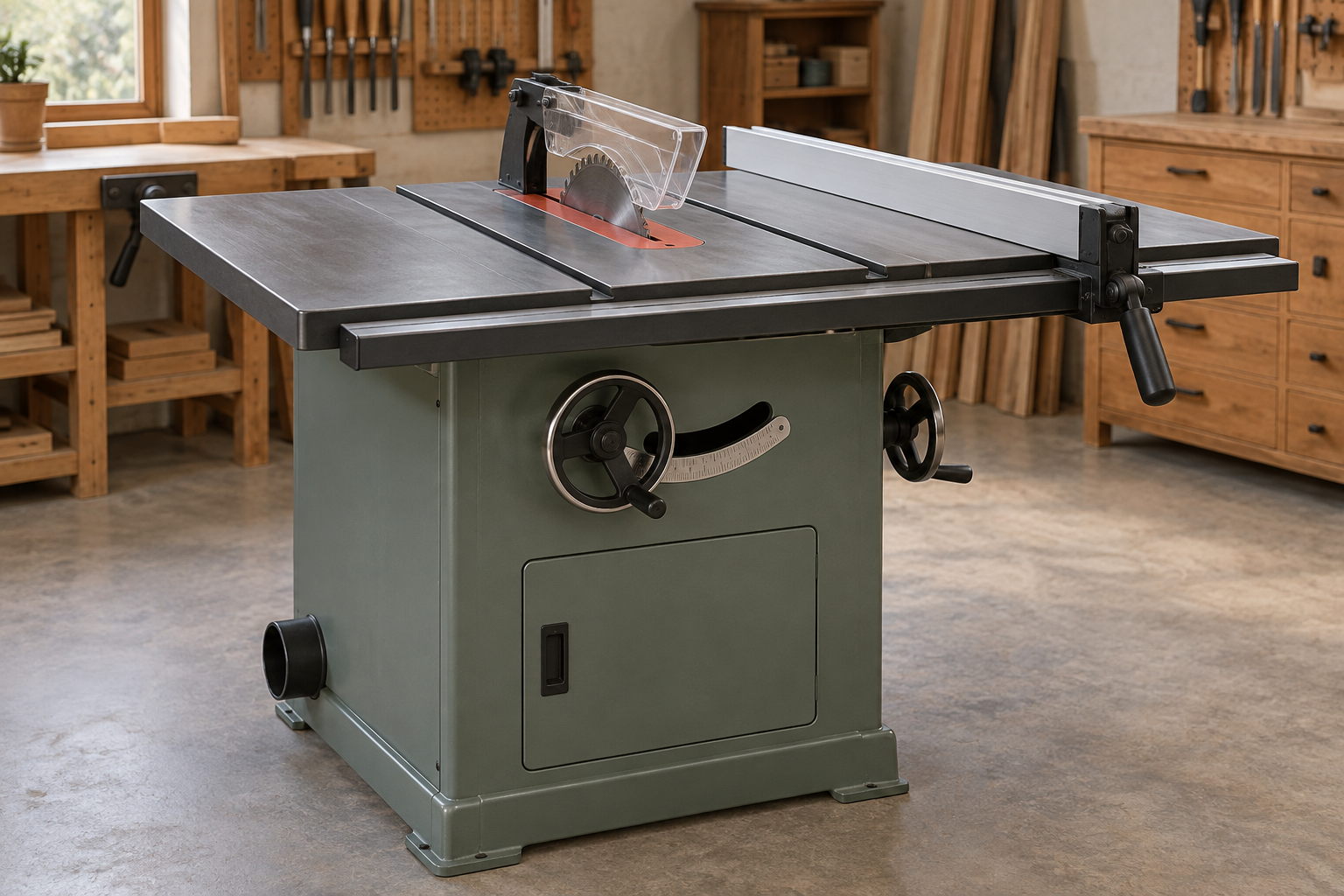
Check the fence for parallel movement and secure locking at both ends. Look for a table that stays flat, accessible blade adjustments, and a riving knife that rises and falls with the blade. Dust collection is rarely perfect; a 4-inch port connected to a shop vacuum or dust collector helps, but expect some cleanup, especially below the table.
Saw types compared
| Type | Best fit | Trade-off |
|---|---|---|
| Compact jobsite saw | Limited space, occasional production, easy storage | Small table and lighter fence can make repeatable wide rips harder |
| Contractor-style saw | Regular hardwood work in a small shop | Needs floor space; 120-volt versions may slow in demanding cuts |
| Cabinet saw | Frequent production and heavier stock | Higher cost, weight, and electrical requirements |
For repeatable parts, outfeed support matters nearly as much as saw size. A stable roller stand or shop-built table prevents long boards from tipping as they leave the blade. For sheet goods, a compact saw’s limited rip capacity can be a real constraint; plan for support and a safe handling method rather than trying to control a large panel alone.
Which saw to buy
Choose a contractor-style saw for the best balance. It offers a larger working surface and a more substantial fence than most portable saws without taking the cost and electrical commitment of a cabinet saw. This is the sensible starting point for a shop making small runs of hardwood furniture parts. Compare 10-inch contractor table saws by fence quality, table support, and available power—not by the highest horsepower claim.
Choose a cabinet saw if the work justifies it. If you regularly rip thick hardwood or make repeated long cuts, the extra mass and stronger drive system can improve the experience. It will not fix a dull blade, poor alignment, or an unstable outfeed setup. Before buying, confirm that the saw fits through the shop entrance and that your circuit can supply the required voltage and amperage. A cabinet saw is a poor bargain if it forces unsafe workarounds or sits unused because setup is difficult.
A compact saw is fine for lighter production. If your stock is mostly under about 1-1/2 inches thick and batches are short, a portable saw can do good work when its fence is dependable and the saw is carefully calibrated. The trade-off is less table area and typically more vibration or bogging in demanding hardwood cuts. Consider portable 10-inch saws with a riving knife if storage and mobility matter more than all-day cutting capacity.
Blade and setup for clean hardwood cuts
The included blade is often a compromise. For furniture work, a sharp 10-inch blade in the 40-to-60-tooth range is a useful general-purpose choice; a dedicated ripping blade can feed more freely along the grain, while a higher-tooth-count crosscut blade can leave cleaner end grain. Match the blade to the cut, and check that its arbor hole and maximum speed suit the saw. More teeth do not automatically mean better results: a fine blade used for long rips can run hot and feed slowly.
Before production, unplug the saw and check that the blade is parallel to the miter slot and that the fence is parallel to the blade. A small alignment error can pinch stock, burn an edge, or encourage kickback. Make a test cut on scrap from the same species and thickness. If the wood burns, first check for a dull blade, slow or uneven feed, and fence alignment; do not push harder to compensate.
Avoid the common production failures
Hardwood can close on a blade when internal stress is released during ripping. Use the riving knife, keep the board against the fence, and stand slightly out of the direct kickback line. Use a push stick or push block when the work approaches the blade, and never reach over or behind a moving blade to retrieve an offcut. For narrow rips, use an appropriate push block and a setup that keeps hands well clear.
Support long boards so they remain level through the cut, but make sure the support cannot lift or steer the work. If a board is bowed, twisted, or unstable, a table saw is not a safe way to straighten it; flatten one face and edge with suitable machines or have the stock prepared before ripping. For small-batch production, consistent stock preparation and a repeatable fence setting save more time than rushing the feed. Compare outfeed support stands if a permanent bench is not practical.