Best Table Saws for Processing Long Boards with an Outfeed Table
What's inside
As an Amazon Associate I earn from qualifying purchases. This post may contain affiliate links at no extra cost to you.
Contents
Choosing a Table Saw for Long Boards With an Outfeed Table
Long boards expose the weaknesses of a table saw quickly. A short workpiece may cut acceptably on almost any saw, but an 8-foot board can bind, lift, drift away from the fence, or drop hard as it leaves the table. For this work, the saw itself matters, but a properly aligned outfeed table matters just as much.
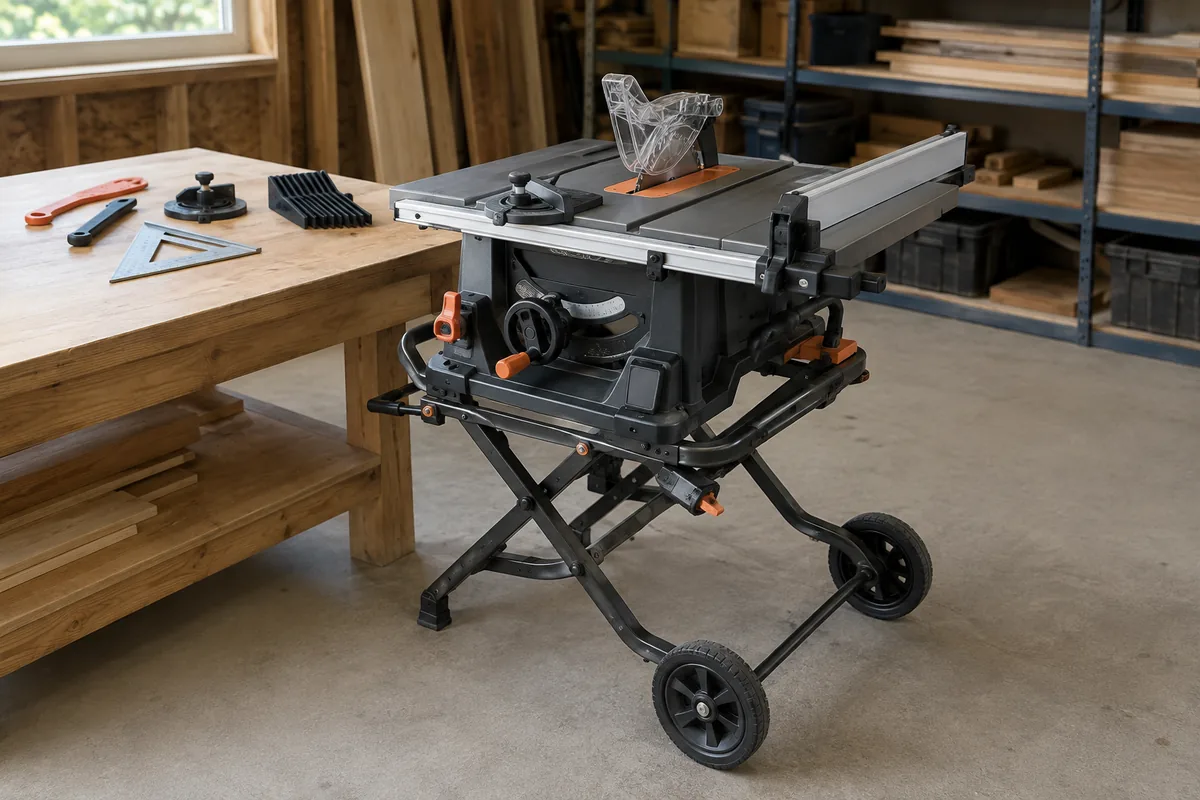
The best setup is a saw with a rigid table, a reliable fence, enough rip capacity for your normal stock, and a stand or base that will not move when the board shifts. A contractor saw can handle most furniture and general shop work. A cabinet saw is better for frequent ripping of thick hardwood, especially when the outfeed table is permanently installed. A compact jobsite saw can work, but it needs more attention to support and alignment.
These are the main table saw types for woodworking worth considering when processing long boards:
| Saw type | Best use | Main advantage | Main limitation |
|---|---|---|---|
| Compact jobsite | Occasional work and portable shops | Low cost and easy storage | Smaller table, lighter fence, less stable |
| Contractor saw | General-purpose home workshops | Good balance of capacity, price, and portability | Usually less rigid than a cabinet saw |
| Hybrid saw | Regular furniture and cabinet work | Enclosed base and better dust control | Heavier and more expensive |
| Cabinet saw | Frequent hardwood ripping and production work | Rigid, powerful, and stable | High price and essentially permanent installation |
Features That Matter More Than Motor Power
A powerful motor does not compensate for a poor fence. Look for a fence that locks parallel to the blade without needing to be pushed into position. A fence that shifts by even 1/32 inch can create tapered boards, burning, or binding. For long stock, a solid T-square-style fence is generally more trustworthy than a thin fence that flexes when the board presses against it.
Check the rip capacity against the boards you actually buy. A 30-inch rip capacity is plenty for most solid-wood furniture parts, while 50 inches is useful for breaking down sheet goods. Extra capacity adds cost and can make the fence heavier, but it does not automatically improve narrow ripping. For boards longer than 6 feet, length is usually the bigger issue than width.
A cast-iron top is valuable because it stays flat and adds weight. A stamped or aluminum top keeps the saw lighter but may transmit more vibration. That is not necessarily a deal breaker on a portable saw; it simply means the saw should be placed on a firm, level surface and supported carefully at both ends.
For thick stock, a 3-horsepower cabinet saw is more comfortable than a 1-3/4-horsepower contractor saw, particularly with dense maple, oak, or 8/4 material. The cheaper saw is fine if you take lighter passes, use a sharp blade, and do not expect production speed. A dull combination blade can make a modest saw appear underpowered.
Building and Positioning the Outfeed Table
The outfeed table should support the board immediately after it passes the blade. Its top should be level with, or no more than about 1/32 inch below, the saw table. If it is higher, the board can catch on the rear edge of the saw. If it is too low, the board drops, pivots, and may pull the operator toward the blade.
For an 8-foot board, a 24-inch-deep outfeed table is a useful minimum. Thirty to 36 inches gives better support, especially when cutting wide or heavy stock. If space allows, add side support as well. A long board that overhangs 6 feet to the left or right can lever the workpiece against the fence and make the cut harder to control.
The table must not interfere with the blade guard, riving knife, rear rail, or dust hose. Leave enough clearance to remove the throat plate and change blades. A permanent shop table can be screwed to the floor or joined to the saw base, but do not make the saw impossible to move unless you are certain of its final location.
A simple torsion-box outfeed table is stiffer than a sheet of plywood on folding legs. Use a flat top, a rigid frame, and adjustable feet or shims. Test it with a straightedge across the saw and table in several directions. A board should slide over the joint without a click or visible dip.
Safe Techniques for Long-Board Ripping
Support the board before starting the cut. Do not begin a 10-foot rip with the first 5 feet hanging unsupported behind you. A roller stand, auxiliary table, or full outfeed table should be positioned so the workpiece remains level throughout the cut. Roller stands are useful, but a misaligned roller can steer the board sideways. Set the rollers slightly below the saw surface and use several of them rather than one high stand.
Keep the fence parallel to the blade and confirm that the rear of the fence is not pinching the board. On a properly aligned saw, the fence may be set a fraction wider at the back, typically around 1/64 inch over the length of the fence. Never use a setup that closes toward the blade.
Use a riving knife whenever the operation allows it. Long boards can release internal tension as they are ripped, causing the kerf to close and grab the blade. Kickback is the most serious failure mode. Do not stand directly behind the board; stand slightly to the side, keep both hands out of the blade path, and use a push stick or push block once your hand approaches the front of the blade.
For repeated narrow cuts, an auxiliary fence can provide a taller, smoother bearing surface. It should be straight, securely attached, and positioned so it cannot contact the blade. For rough stock, joint one edge first. A bowed or crooked edge is difficult to control against any fence and can produce a cut that wanders even when the saw is perfectly aligned.
Which Saw Makes Sense?
For occasional long-board processing, a contractor saw with a dependable fence and a homemade outfeed table is usually the sensible purchase. Spend the savings on a good combination blade, straightedge, featherboards, and support stands. A contractor table saw with a solid fence is often enough for a small furniture shop.
Choose a hybrid or cabinet saw if you routinely rip thick hardwood, want better dust collection, or need the saw to remain stable during long production runs. A cabinet saw is especially worthwhile when it will stay installed with a full-size outfeed table and dedicated circuit.
A portable saw is the cheaper option that can still succeed. Buy one only if portability is important, and budget for a level stand, side support, and careful fence adjustment. A portable table saw stand with outfeed support can solve the stability problem, but it will not turn a flexible fence into a cabinet-saw fence. For long boards, reliable support and alignment are the real upgrades.