Best Portable Jump Starters for Reliable Starts
What's inside
As an Amazon Associate I earn from qualifying purchases. This post may contain affiliate links at no extra cost to you.
The best portable jump starters for most drivers in 2026 are compact lithium units with 1,500 to 2,500 peak amps for 4-6 cylinder gas engines, and 3,000+ peak amps for large V8 gas or diesel engines up to 7.0L, with at least 15,000mAh capacity and full safety protections including reverse polarity and spark-proof technology.
Choosing the right jump starter is not about buying the highest peak amp number you can afford. It is about matching peak current and battery capacity to your engine size, climate, and how you will store and maintain the unit. A small booster that fits in a glove box is perfect for a sedan but will not turn over a 6.7L diesel in winter, while an oversized pro-grade pack is wasted weight if you drive a 2.0L commuter.
As an Amazon Associate we earn from qualifying purchases at no extra cost to you.


Contents
What Actually Matters When Buying a Portable Jump Starter
1. Peak Current vs. Cranking Needs
Peak amps is the maximum burst the pack can deliver for 2-3 seconds to spin the starter. It is different from starting amps or continuous output. For reliable starts, use this baseline:
- Up to 1,500A peak: Sufficient for 4-cylinder gas engines up to about 4.0L and 6-cylinder gas up to 3.5L in moderate climates.
- 1,500A to 2,500A peak: The sweet spot for most SUVs, trucks and 6-8 cylinder gas engines up to 6.0L-7.0L.
- 3,000A to 4,000A peak: Recommended for large V8 gas engines (7.0L+) and diesel engines from 3.0L to 7.3L, especially in cold weather where oil viscosity and battery resistance increase.
- Over 4,000A peak: Primarily for commercial diesel, heavy-duty trucks, and fleet use where a single unit must handle multiple vehicle types.
Cold weather raises the requirement by 30-40%. A pack rated for a 6.0L gas engine at 68°F may only reliably start a 4.5L engine at 0°F.
2. Battery Capacity (mAh / Wh)
Capacity determines how many jump attempts you get per charge and how useful the pack is as a power bank. Measured in milliamp-hours (mAh) at 3.7V, or watt-hours (Wh):
- 12,000 – 15,000mAh (44-55Wh): 15-20 jumps on a 4-cylinder on one charge, good for emergency-only storage.
- 18,000 – 24,000mAh (66-88Wh): 25-35 jumps, can also charge phones/laptops multiple times and run a 12V tire inflator briefly.
- 24,000mAh+ (88Wh+): Approaching airline carry-on limits (100Wh). Best for overlanding, work trucks, or if you want to jump multiple vehicles without recharging.
A larger capacity does not mean more starting power, but it does mean more reserve attempts if your first crank is long.
3. Safety Protections
All reputable 2026 models from brands like NOCO, Hulkman, GOOLOO, and Fanttik include an integrated smart clamp system. Look for these eight protections listed on the spec sheet:
- Reverse polarity protection
- Spark-proof / anti-spark
- Reverse charge protection
- Over-current and over-voltage
- Short-circuit protection
- Over-temperature cut-off
- Over-discharge protection
- Clamp low-voltage lockout (prevents jumping a pack that is too depleted)
Avoid any unit that uses a separate manual override button as the primary way to bypass safety checks. The safest designs automatically detect voltage and only allow a force-start mode via a recessed, long-press button.
4. Storage Size and Cable Length
Portability is the point. Measure your storage spot before you buy. Glove box units are typically 6.5 x 3.2 x 1.5 inches and under 2 lbs. Center console or under-seat units run 9 x 4 x 2 inches and 2.5-4 lbs. Short 10-inch cables are fine for top-post batteries with easy access, but side-post or recessed batteries in trucks and SUVs often need 20-24 inch cables to make a clean connection.
Head-to-Head Comparison: Popular Types in 2026
This table compares common spec tiers you will actually find listed, not marketing claims. Weight, dimensions, and capacity directly affect storage and usability.
| Type / Example Model Class | Peak Current | Rated Engine Compatibility | Battery Capacity | Weight | Dimensions (LxWxH) | Key Extras |
|---|---|---|---|---|---|---|
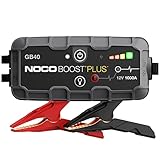
| Compact Glove-Box (NOCO Boost GB40 class, GOOLOO GP2000 class) | 1,000A – 2,000A | Gas up to 6.0L, Diesel up to 3.0L | 13,000 – 18,000mAh (48-66Wh) | 1.7 – 2.4 lbs | 6.7 x 3.2 x 1.7 in | USB-A/C power bank, LED flashlight |
| Mid-Size SUV/Truck (Hulkman Alpha85, NOCO GB70 class) | 2,000A – 3,500A | Gas up to 8.0L, Diesel up to 6.0L | 18,000 – 24,000mAh (66-88Wh) | 2.8 – 4.2 lbs | 8.9 x 4.1 x 2.1 in | 65W USB-C PD, 12V DC out, Boost mode |
| Heavy-Duty Diesel (Hulkman Alpha100, GOOLOO GT4000 class) | 3,500A – 4,500A | Gas up to 10.0L, Diesel up to 10.0L | 24,000 – 32,000mAh (88-118Wh) | 4.5 – 6.8 lbs | 10.5 x 5.5 x 2.8 in | 15V / 10A DC, wall charger included |
| Jump Starter + Inflator Combo (Fanttik T8 Apex, Hulkman Alpha85S class) | 1,500A – 2,000A | Gas up to 8.0L, Diesel up to 6.0L | 16,000 – 20,000mAh (59-74Wh) | 3.5 – 4.8 lbs | 9.2 x 4.8 x 3.0 in | Built-in 150 PSI air compressor, preset pressure |
Decision Matrix: Which Jump Starter Fits Your Situation
Use your vehicle, climate, and storage constraints to narrow the choice quickly.
| Your Situation | Recommended Spec | Why This Choice |
|---|---|---|
| Daily driver, 4-cylinder sedan/crossover, mild climate, limited storage | 1,500A peak, 15,000mAh, under 2.5 lbs | Lightest and smallest to keep in glove box; enough power for small gas engines without overpaying for unused capacity |
| Family SUV / 6-cylinder or small V8 gas (3.5L-5.7L), occasional cold snaps | 2,000A – 2,500A peak, 18,000-22,000mAh | Covers most gas engines with cold-weather headroom; still portable with USB-C for family devices |
| Full-size pickup, large V8 gas or 3.0L-6.7L diesel, winter below 20°F/-6°C | 3,000A+ peak, 24,000mAh+, 20+ inch cables | Diesel glow plugs and high compression demand sustained cranking amps; longer cables reach recessed batteries |
| Workshop, farm, or fleet with multiple vehicle types | 4,000A+ peak, 30,000mAh, replaceable clamps | Maximum compatibility and duty cycle; ability to perform 30+ jumps before recharge |
| Overlanding / road trip where pack doubles as power bank + inflator | 2,000A peak combo unit with air compressor | Eliminates a separate inflator; check that inflator has auto-shutoff and that jump function still works when tire pump battery is low |
Ownership Realities: What Wears Out and How to Maintain It
A lithium jump starter is not maintenance-free. Understanding its limits extends its useful life from 2 years to 5+ years.
- What fails first: The smart clamp cable, not the battery. Repeated bending at the clamp base frays internal wires. The second failure point is the internal lithium pouch cells losing capacity from heat. Storing the pack on a dashboard or in a hot trunk at 140°F+ accelerates degradation.
- Charge discipline: Top off every 60-90 days, even if unused. Lithium self-discharges 2-3% per month, and the smart clamp circuit draws a small idle current. Store at 60-80% charge, not 100%, if you will not use it for months. Most units show 3-4 LED dots; aim for 3 dots for storage.
- Cleaning: Battery corrosion on clamps increases resistance and causes a no-start even when the pack is full. Wipe clamps with a dry cloth after each use. If you see green/white powder, disconnect and clean with a wire brush. Do not apply grease to the clamp jaws.
- Common mistakes: Cranking for more than 3-4 seconds continuously will trigger over-temperature protection. Wait 30 seconds between attempts. Never stack jump attempts back-to-back more than 3 times without a 2-minute cool down. Never use the USB output and jump function simultaneously.
Worked Calculation: How Long Will It Hold a Charge in Storage?
Take a typical mid-size unit with 22,000mAh (81.4Wh at 3.7V). Its standby draw for the protection board is about 0.05mA. Self-discharge is roughly 2.5% per month.
Usable capacity after 6 months without topping off: 81.4Wh x (1 – 0.025 x 6) = 81.4 x 0.85 = 69.2Wh remaining, minus ~0.22Wh for standby = ~69Wh, or about 85% charge. That is still enough for 15-20 small-engine jumps.
After 12 months without charging: 81.4 x (1 – 0.30) = 57Wh, or about 70% charge. Below 50%, many packs will refuse to jump a completely dead battery because their internal voltage is too low to safely engage. This is why quarterly topping off matters more than initial capacity.
Price and Longevity Expectations in 2026
In the current market, compact 1,500A-2,000A units typically fall in the $60 to $110 range, mid-size 2,500A-3,500A units in the $120 to $200 range, and heavy-duty 4,000A+ units in the $180 to $300+ range. Combo inflator models carry a $30 to $60 premium over the jump-only equivalent. Expect a quality lithium pack to last 800-1,000 charge cycles or 3-5 years of seasonal vehicle use before capacity drops below 70%. Replaceable clamp cables and a 1-year minimum warranty with clear over-temperature and short-circuit coverage are worth prioritizing.
Final Picks by Vehicle Need
Best for Most Gas Cars and Small SUVs
A 2,000A compact unit with 18,000mAh, USB-C PD, and full 8-point protection offers the best balance of size and reliability. It fits in a glove box and will start almost any 4-6 cylinder gas engine, even after months in storage.
Best for Large Trucks and Diesel
Choose a 3,500A+ heavy-duty pack with at least 24,000mAh and 24-inch heavy-gauge cables. Look for a manual boost override for batteries below 2V and an operating temperature rating down to -4°F (-20°C).
Best for Minimal Storage Space
An ultra-compact 1,500A unit under 1.8 lbs and 7 inches long is easy to keep with you at all times, which matters more than peak power if the alternative is leaving a larger pack at home.
FAQ
Can a portable jump starter damage my car’s electronics?
When used correctly with spark-proof, reverse-polarity protected clamps, the risk is very low. Connect red to positive, black to a clean unpainted chassis ground away from the battery, not directly to the negative terminal if your vehicle has a battery sensor. Remove the pack within 30 seconds after the engine starts.
How often should I recharge my jump starter?
Recharge after each use and top off every 2-3 months if unused. If your model has a digital percentage display, recharge when it falls below 60%.
Will a jump starter work on a completely dead, 0-volt battery?
Most smart packs require at least 2-3 volts from the vehicle battery to detect polarity. For a truly 0-volt battery, you need a unit with a force-start or override mode, and you must be absolutely certain of correct polarity before engaging it.