Best Planers for Preparing Stock for Precision Joinery
What's inside
As an Amazon Associate I earn from qualifying purchases. This post may contain affiliate links at no extra cost to you.
Contents
What a planer does—and what it doesn’t
A thickness planer makes one face of a board parallel to the opposite face and brings the stock to a consistent thickness. That is essential for fitting drawer parts, door components, and other joinery that depends on repeatable dimensions. A planer does not reliably flatten a twisted or bowed board by itself: it references the face resting on the bed, so it can reproduce the board’s twist on the opposite face.
For twisted rough stock, flatten one face first with a jointer, a router sled, or a hand plane, then run the board through the planer with the flattened face down. A planer and jointer solve different problems; buying a larger planer does not eliminate the need for a reliable way to establish a flat reference face.
Choose by stock and workload
For most small shops, a benchtop planer with a 12- or 13-inch capacity is the practical starting point. It handles common furniture parts and many boards sold as 4/4 or 8/4 lumber. Capacity is a hard limit, though: a board wider than the cutterhead cannot go through, and the actual maximum thickness varies by machine. Check both figures against the stock you expect to prepare.
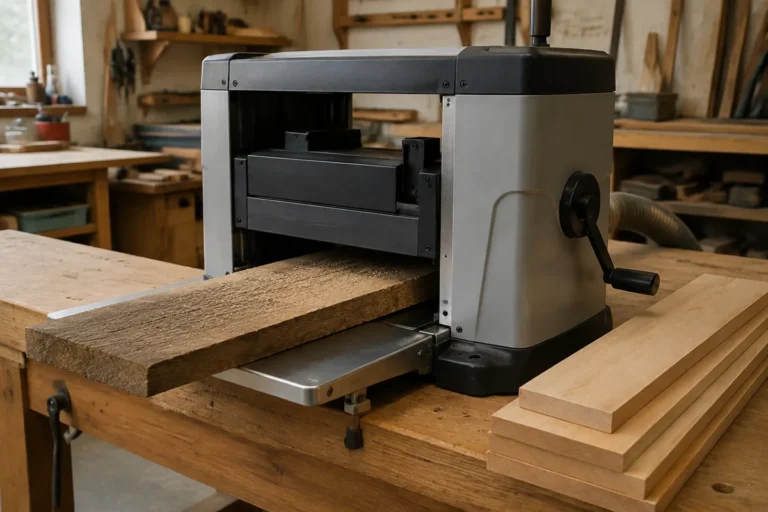
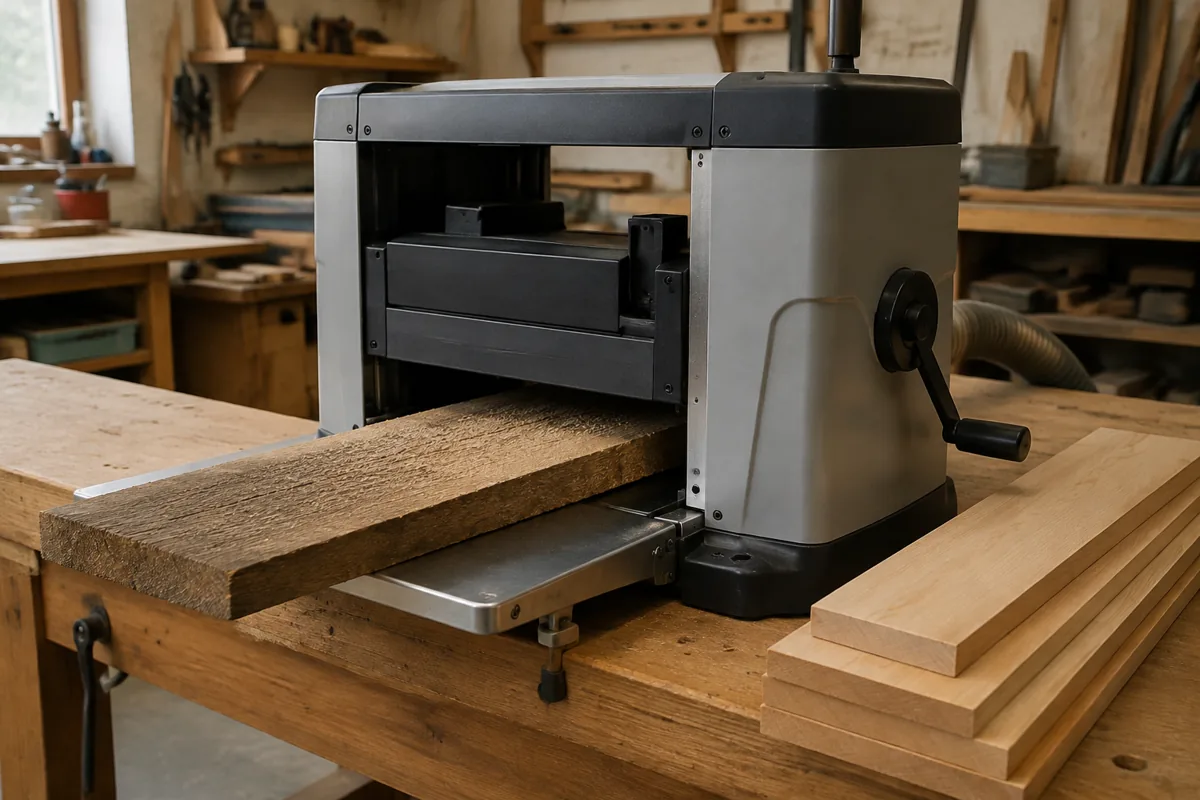
Compare 13-inch benchtop thickness planers if you need a portable, 120-volt machine for occasional or moderate work. They cost less and take up less space than floor-standing machines, but their shorter beds and lighter construction make long boards harder to support without snipe or uneven feeding.
A floor-standing planer makes sense when you regularly process wide or thick stock, run long batches, or need a more substantial bed and cutting system. It costs more, uses more floor space, and may require 240-volt power. Confirm the circuit requirement, footprint, and dust-collection needs before buying; a machine you cannot power or vent properly is a poor fit regardless of its cutting capacity.
Planer types compared
| Type | Best fit | Trade-off |
|---|---|---|
| 12–13-inch benchtop | Small shops and furniture parts | Limited width, shorter bed, more attention needed for snipe |
| 15-inch floor-standing | Regular furniture work and wider boards | Higher cost, larger footprint, often 240-volt power |
| Wider production planer | Frequent batch work on wide stock | High purchase and operating requirements; excessive for occasional use |
These are broad categories, not guarantees of performance. Two machines with the same cutting width can differ in feed rate, cutterhead design, bed support, and how easily knives or inserts are serviced.
Cutterhead, finish, and maintenance
Traditional straight knives are straightforward to understand and can produce a clean finish when sharp and correctly set. Dull or nicked knives leave lines or torn grain, and replacing or adjusting them takes care. A helical or segmented-insert cutterhead uses small replaceable cutting edges angled across the head. It often cuts more quietly and leaves smaller tearout in difficult grain, but usually costs more and still needs clean, sharp inserts.
Do not buy a cutterhead on the promise that it will prevent all tearout. Figured, reversing, or damp grain can still chip. Use a shallow cut, feed the board in the direction that minimizes lifting grain, and test on scrap. If quieter operation and easier edge replacement matter, compare thickness planers with helical cutterheads. For straight-grained stock and a tight budget, a knife-head planer is often adequate.
Planer performance also depends on sharp edges and a clean bed. Resin buildup increases friction and can cause boards to feed unevenly. Clean the bed as needed, inspect knives or inserts for damage, and use dust collection sized for the machine. Chips packed around the cutterhead can spoil the cut and create a safety problem.
Set up for joinery accuracy
Take light passes rather than trying to remove a large amount at once. For a final pass, about 1/32 inch or less is a sensible starting point; reduce the cut further on wide, difficult, or figured stock. Heavy cuts can strain the feed system, worsen tearout, and leave a rough surface. Check the machine’s manual for its maximum depth of cut, which commonly decreases as board width increases.
Support long boards level at both ends. If the infeed or outfeed table sits too high or low, the board can tip as it enters or exits, producing snipe—an extra-deep cut near an end. Keep stock lengths consistent when batching parts, and leave roughly 2–4 inches of extra length when the final dimensions allow; that gives you room to cut away minor end snipe. Not every machine produces the same amount, so test with scrap and adjust table extensions or support stands.
For matched joinery parts, plane several pieces to a common thickness in the same setup, then measure them at multiple points with calipers. Do not assume the depth scale is exact. If pieces differ, check for feed interruptions, uneven support, dull edges, or debris on the bed before changing the setting. Keep hands clear of the cutterhead and use push blocks or other safe handling methods for short stock; never plane pieces too small for the machine’s stated minimum length and thickness.
A practical buying checklist
Before choosing a machine, measure your widest usual board, note the maximum stock thickness, and decide how often you will plane. Check the required voltage, cutterhead replacement costs, available dust extraction, and whether the machine can be moved or stored where you intend to use it. A 15-inch floor-standing thickness planer may be the better long-term choice for regular work on wide furniture parts, but a 13-inch benchtop unit is perfectly reasonable if your stock fits and your workload is modest.
For precision joinery, consistent setup and sound reference faces matter more than buying the biggest planer available. Choose capacity for the work you actually do, flatten one face before thicknessing, and verify dimensions rather than trusting the scale alone.