Best Jointers for Preparing Stock for Mortise-and-Tenon Joinery
What's inside
As an Amazon Associate I earn from qualifying purchases. This post may contain affiliate links at no extra cost to you.
Mortise-and-tenon joints depend on square, straight stock. A tenon can be cut accurately and still fit poorly if the board’s face is twisted, its edge is not square, or its thickness varies. A jointer prepares the reference surfaces that make the rest of the operation predictable. For most furniture work, the best choice is not the biggest machine available, but a jointer with enough width, a reliable fence, flat tables, and knives that can be set accurately.
As an Amazon Associate we earn from qualifying purchases at no extra cost to you.

Contents
What the Jointer Must Do
Preparing stock for mortise-and-tenon joinery usually involves three tasks: flattening one face, making one edge square to that face, and removing small amounts of material without introducing a new twist. The jointer handles the first two. A thickness planer then brings the opposite face parallel, and a table saw or bandsaw usually cuts the tenon.
For typical cabinet and furniture parts, a useful target is a face flat within roughly 1/32 inch over the board’s length before planing. The finished edge should be square within a fraction of a degree. A small error may not matter on a short rail, but a 1/16-inch gap at the shoulder of a long tenon is easy to see and can weaken the joint.
Recommended Jointer Sizes
| Jointer width | Best use | Main limitation |
|---|---|---|
| 6 inches | Most furniture parts, cabinet stock, and rails | Cannot flatten boards wider than 6 inches in one pass |
| 8 inches | Wide furniture parts and heavier hardwood work | Higher cost, more space, and usually greater power requirements |
| 10 to 12 inches | Large solid-wood work and professional production | Expensive, heavy, and unnecessary for many shops |
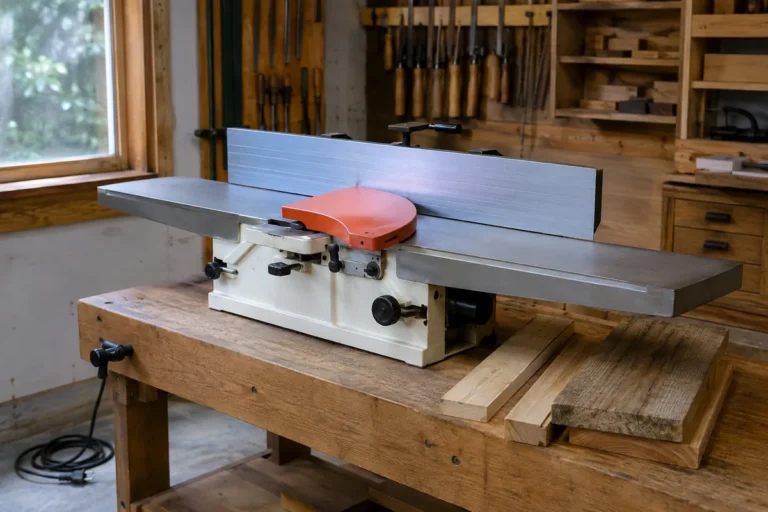
A 6-inch benchtop jointer is adequate for many small shops, especially when the work is limited to table aprons, chair components, face frames, and boards narrower than the cutterhead. The trade-off is short tables and less support for long stock. A benchtop machine can flatten a 4-foot rail, but you must support the board at the infeed and outfeed ends or the board can dip and become concave.
A floor-standing 6-inch jointer generally gives you longer tables, a better fence, and a more rigid stand. Those improvements matter more than the extra motor rating printed on the box. An 8-inch jointer is worthwhile when you routinely use 7-inch-wide stock, flatten thick slabs, or want more support for long cabinet components. It is not automatically more accurate.
Cutterhead and Fence Choices
Helical or spiral cutterheads use many small carbide inserts instead of two or three long knives. They usually leave a quieter cut, tolerate occasional contact with a knot better, and make damaged edges easy to repair by rotating an insert. They also cost more and can leave small ridges if inserts are not seated cleanly. For joinery stock, either cutterhead type can work well when properly adjusted.
Traditional knife heads are cheaper and can produce excellent surfaces. Their weakness is setup time. Knives must project evenly, sit parallel to the table, and remain tight. A knife that is only a few thousandths of an inch high or low can create a ridge, snipe-like step, or uneven edge that affects tenon shoulders.
The fence should lock square without moving when pressure is applied. A fence that shifts from 90 degrees to 89 degrees can make every prepared edge unsuitable as a reference for a mortise layout. Look for a solid locking mechanism, a fence tall enough to support narrow rails, and a table adjustment that does not bind. A built-in 45-degree stop is useful, but it is less important than a dependable 90-degree stop.
For many buyers, a helical-head 8-inch jointer is the premium practical choice. It is not necessary for occasional work, but it reduces knife-setting chores and handles wider hardwood more comfortably.
How to Joint Stock for Tenons
Start by identifying the board’s natural high spots and the direction of its bow. Place the concave side down on the infeed table when flattening a face. Take light cuts, typically 1/32 inch or less. Heavy cuts can force the board against the table and temporarily hide a bow, producing a face that springs back after machining.
Once one face is flat, mark it clearly with a pencil or cabinetmaker’s triangle. Put that face against the fence while jointing an edge. Use steady pressure over the infeed table after the board has passed the cutterhead; pressure on the outfeed side should hold the newly cut surface down without forcing the trailing end into a taper.
After one face and one edge are prepared, use a 13-inch thickness planer to bring the opposite face parallel. This sequence is important. A planer alone makes opposite faces parallel to each other, but it does not correct a twisted or bowed reference face. A tenon cut from unflattened stock can have uneven shoulders even if its thickness is consistent.
Features Worth Paying For
- Long tables: At least 60 inches of combined table length is helpful for furniture rails and legs. Longer tables reduce rocking on 5- to 7-foot boards.
- Accurate fence adjustment: A fence that returns reliably to 90 degrees saves more time than a higher horsepower motor.
- Good dust collection: Jointer chips are large and quickly clog a small shop vacuum. A 4-inch port connected to a collector is preferable.
- Accessible knife or insert adjustment: Routine maintenance should not require dismantling half the machine.
- Rigid stand: Vibration can show as washboard marks and makes it harder to maintain a consistent edge.
A budget machine is fine when you joint short, narrow boards and are willing to check the fence and tables with a reliable straightedge and square. Spend more for a floor-standing machine when you work alone with long stock, use dense hardwood regularly, or need repeatable results across many parts. Avoid choosing solely by motor horsepower: a poorly aligned 1-1/2-horsepower jointer is less useful than a rigid, well-adjusted machine with a smaller motor.
Common Failure Modes
A concave edge usually comes from lifting the board at the outfeed end or applying too much downward pressure before the cutterhead. A convex edge often results from pressing down on the infeed end after the board has passed the cutterhead. Snipe at the beginning or end can come from short tables, poor support, or incorrect hand placement.
Burn marks indicate dull knives, a feed rate that is too slow, or an overly heavy cut. Tear-out is commonly caused by feeding against the grain; reversing the board may improve the surface. Before cutting mortises or tenons, check the prepared face with winding sticks and the edge with a square. That extra minute is cheaper than remaking a rail.