Best Planers for Preparing Hardwood Shelving Stock
What's inside
As an Amazon Associate I earn from qualifying purchases. This post may contain affiliate links at no extra cost to you.
Preparing hardwood for shelving is mostly a thicknessing and reference-surface problem. Boards may be rough-sawn, slightly cupped, or inconsistent in thickness, and shelves show those defects clearly. A thickness planer can produce uniform stock quickly, but it cannot reliably flatten a badly twisted board by itself. For the cleanest results, use a jointer or sled to create one flat face first, then run the board through the planer with that face down.
Contents
What to Look for in a Shelving Planer
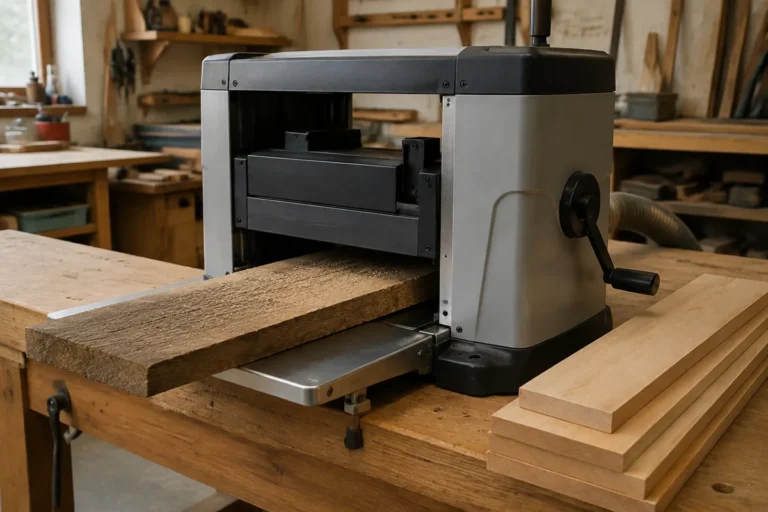
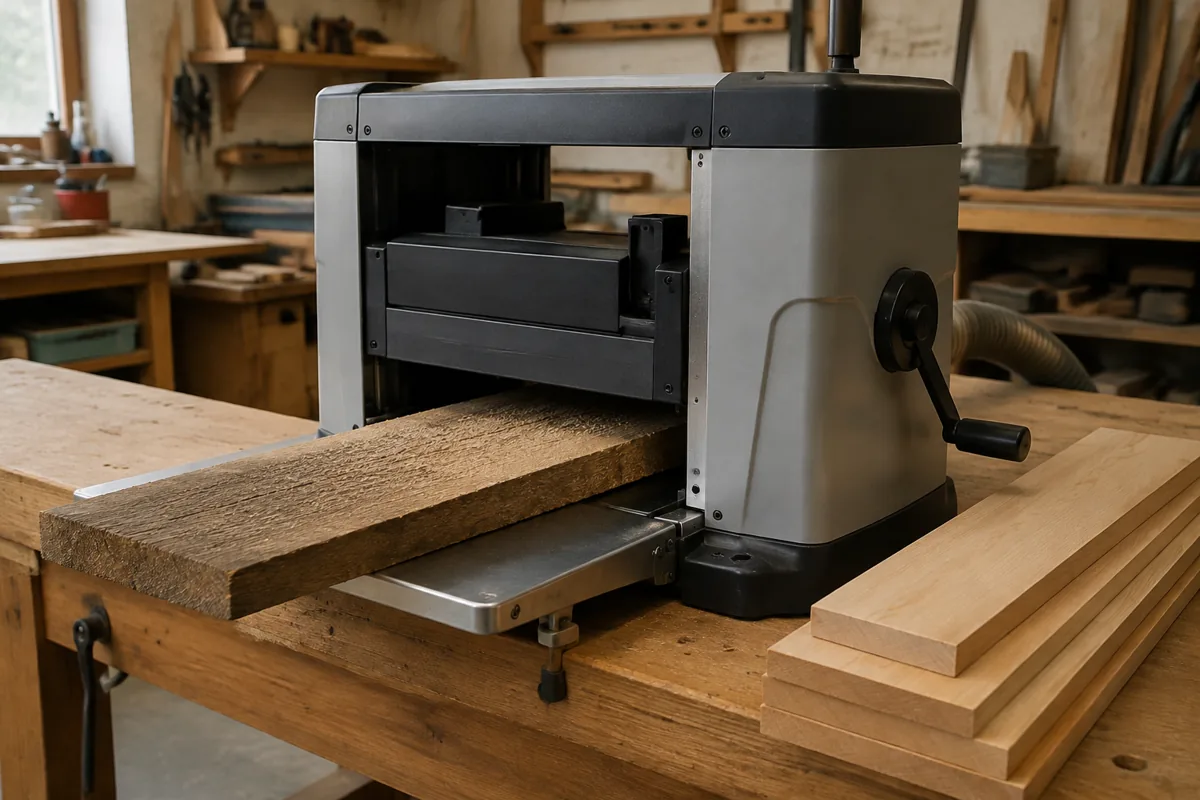
For most home workshops, a benchtop planer with a 12-1/2- or 13-inch capacity is the practical choice. It will handle ordinary shelving boards, is easier to store than a floor-standing machine, and usually accepts stock up to 6 inches thick. A 15-inch stationary planer is more capable, but it needs dedicated floor space, stronger dust collection, and a substantially larger budget.
Pay attention to the minimum and maximum thickness, maximum width, feed rate, cutterhead type, and dust-port size. A machine rated for a 6-inch maximum thickness is useful for heavy work, but shelving stock is commonly 3/4 to 1-1/2 inches thick. More important is whether the planer can feed boards smoothly without excessive snipe at the ends.
Helical and segmented spiral cutterheads generally leave a better surface in figured hardwood and are quieter than traditional straight knives. They also cost more. A straight-knife planer is still a sensible buy if you mainly work with cherry, maple, oak, ash, or other relatively cooperative species and do not mind occasional knife changes.
The Best Planer Types for Hardwood Shelving
| Planer type | Best use | Main advantage | Main limitation |
|---|---|---|---|
| Benchtop, straight-knife | Occasional shelving and general stock preparation | Lowest purchase price and simple knife replacement | More noise, tear-out risk, and possible snipe |
| Benchtop, helical or segmented cutterhead | Regular hardwood work and figured boards | Quieter cutting and better results across changing grain | Higher initial cost; inserts are small and numerous |
| 15-inch stationary planer | Frequent production of wide or thick stock | More rigid tables, stronger feed systems, and better throughput | Expensive, heavy, and demanding of dust collection |
Best Value: Benchtop Planers
A benchtop planer is the right answer for many shelving projects. Look for a model with a 12-1/2-inch cutting width, folding or removable tables, a two-speed feed system, and a cutterhead that can be serviced without specialized tools. A machine in this class typically removes up to 1/16 inch per pass, but hardwood usually behaves better at 1/32 inch or less.
The cheaper option is fine when you are processing a few boards at a time, working mostly with straight-grained lumber, and already have a good dust collector or shop vacuum. Straight knives are inexpensive to replace, and many machines accept reversible knives. The trade-off is noise and a greater chance of tear-out when grain direction changes.
For a dependable general-purpose choice, compare current 12.5-inch benchtop wood planers by cutterhead design, feed speed, and replacement-knife cost rather than motor horsepower alone. A larger motor does not compensate for weak feed rollers or a poorly supported board.
When a Helical Cutterhead Is Worth Paying For
Helical and segmented cutterheads make the biggest difference when shelving is made from figured maple, curly cherry, interlocked oak, or other reversing-grain material. Instead of one long knife striking the entire width at once, multiple carbide inserts take smaller cuts. The result is usually less tear-out and a lower, less harsh cutting sound.
They are not tear-out-proof. Feed direction, cutting depth, dull inserts, and a board with severe grain reversal still matter. Carbide inserts can also leave small lines if one insert is damaged or not seated properly. Replacement inserts cost more than disposable straight knives, but a single damaged insert can be replaced rather than changing an entire knife set.
Choose a helical cutterhead benchtop planer if you regularly prepare expensive hardwood or want a cleaner surface before sanding. It is harder to justify for inexpensive construction lumber or a handful of shelves each year.
When a 15-Inch Planer Makes Sense
A 15-inch stationary planer is justified when you routinely buy wide boards, process several hundred board feet, or need a more rigid machine for continuous work. Its wider tables and heavier frame reduce movement as a board enters and exits the cutterhead. Many also offer a 20- to 30-foot-per-minute finish feed rate and a slower feed for a smoother surface.
These machines are not automatically better for a small shop. They may weigh 400 pounds or more, require a dedicated circuit, and overwhelm a small shop vacuum with chips. Budget for a proper dust collector, a mobile base, and enough infeed and outfeed space. If your shelves are no wider than 10 inches and your work is occasional, a quality benchtop machine is usually the better value.
Search for 15-inch stationary wood planers only after confirming your shop has the electrical service, floor space, and dust collection to support one.
How to Plane Shelving Stock Without Ruining It
Start by inspecting each board for nails, screws, loose knots, and embedded grit. Metal can destroy knives or carbide inserts. If the board is cupped or twisted, flatten one face on a jointer. If it is too wide for the jointer, secure it to a flat sled and use shims so it cannot rock. Plane the opposite face until it is parallel, then return to the first face only if necessary.
Take light passes. Removing 1/32 inch per pass is a useful starting point for hardwood; use 1/64 inch for figured stock or the final two passes. Keep at least 12 to 18 inches of board supported at the infeed and outfeed sides. Unstable support lets the rollers lift or drop the board, producing snipe at the first or last 2 to 4 inches.
To reduce snipe, raise the infeed and outfeed tables correctly, support long boards with stands, and feed a second board closely behind the first when the machine allows it. Do not push a board through with excessive force. If feeding becomes difficult, the cut is too deep, the knives are dull, or the rollers need cleaning.
Surface Quality and Final Dimensions
Plane boards close to the target thickness, then let them rest for several hours or overnight. Removing material can release internal stress, causing a board to cup again. For a nominal 3/4-inch shelf, leave roughly 1/32 inch for final sanding or a light finishing pass. Do not sand away major planer ridges; correct those with sharper knives, a lighter cut, or better feed support.
Before buying, price the consumables as well as the machine. Straight knives may be cheaper initially, while helical inserts last longer and handle difficult grain more gracefully. For occasional shelving, a basic benchtop planer paired with a jointer or flattening sled is generally the most economical setup. For repeated hardwood work, the quieter operation and improved tear-out control of a segmented cutterhead can pay for itself in reduced sanding and fewer spoiled boards.