Best Planers for Dimensioning Thick Beech Boards
What's inside
As an Amazon Associate I earn from qualifying purchases. This post may contain affiliate links at no extra cost to you.
Thick beech boards are demanding stock for a planer. Beech is dense, hard, and prone to showing every cutter mark, but the bigger issue is often the board itself: wide, heavy, possibly cupped, and under internal stress. A machine that handles soft pine easily may struggle when you remove 2–3 mm from a 250 mm-wide beech board.
For this work, look for a stationary thickness planer with a rigid bed, a strong feed system, and enough capacity to leave room for multiple light passes. If the boards are rough-sawn on both faces, you will also need a jointer or another way to create one flat reference face. A thickness planer copies the shape of the underside; it does not reliably flatten a twisted board.
Contents
What Kind of Planer You Need
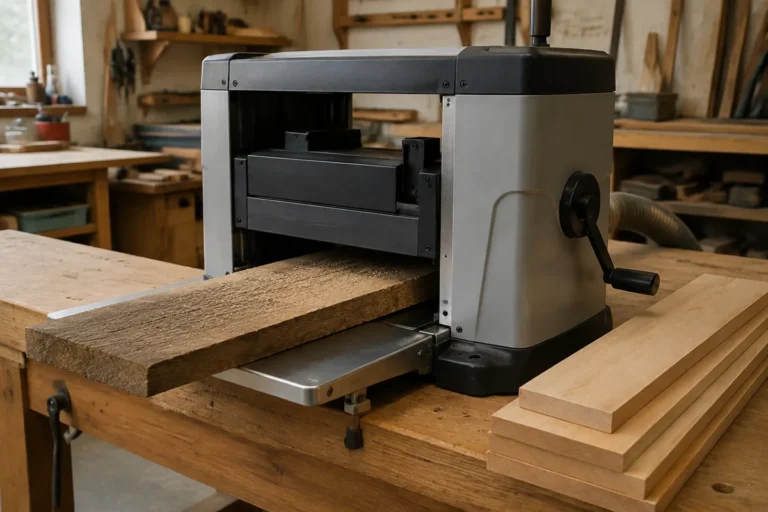
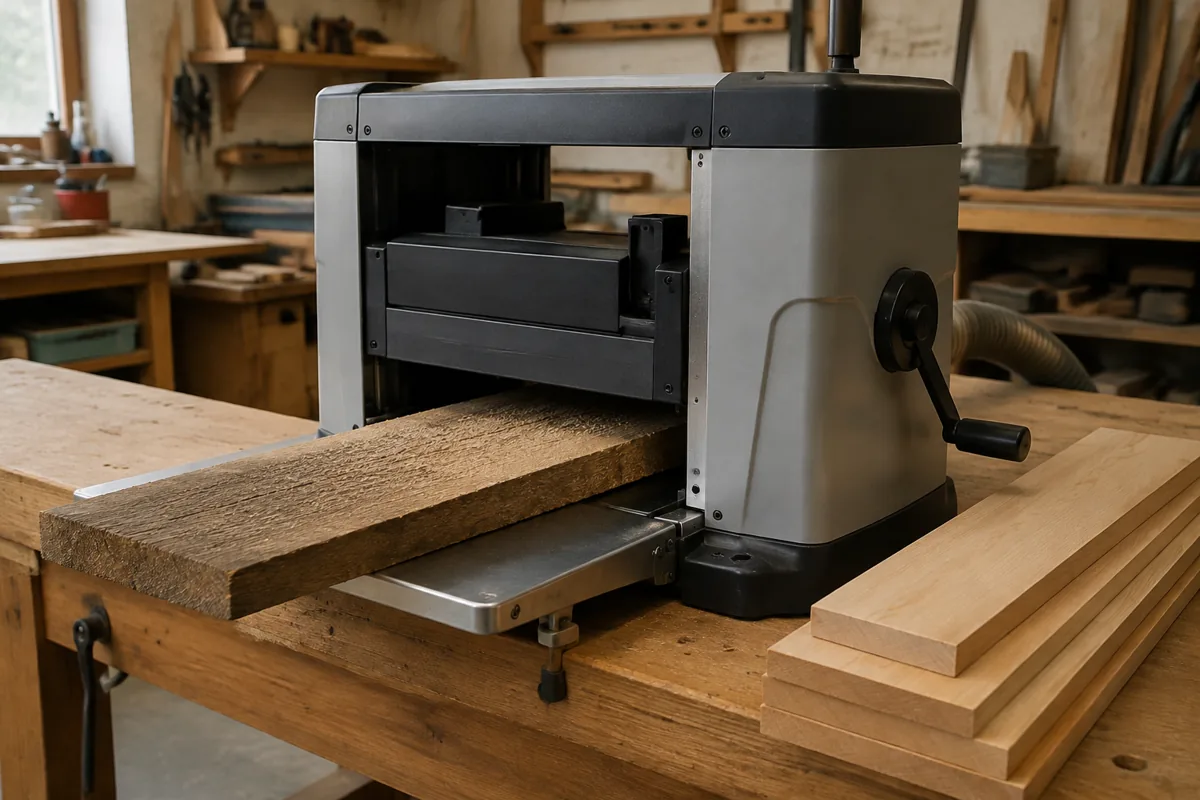
A benchtop thickness planer is usually the sensible choice for occasional furniture work. These machines commonly accept stock around 300–330 mm wide and 150–180 mm thick. That covers many beech boards used for shelves, worktops, table components, and cabinet parts. They are relatively affordable and can produce good results when fed slowly and supported properly.
For regular work with wide or very thick hardwood, consider a stationary cast-iron planer/thicknesser. These machines are heavier, quieter, and more stable. Their longer beds and larger cutterblocks reduce vibration and make it easier to keep long boards moving straight. They also cost considerably more and may require a dedicated 230-volt circuit, three-phase power, or workshop wiring beyond a normal portable machine.
A helical or spiral cutterhead is useful but not essential. It uses many small carbide inserts instead of two long knives. The advantages are lower cutting noise, better performance in reversing grain, and less downtime when one insert gets damaged. Conventional straight knives are cheaper to replace and can leave an excellent finish when sharp and correctly set.
For comparing current capacity and cutterhead options, start with this benchtop thickness planers with helical cutterheads search. Check the actual maximum thickness and width rather than relying on photographs or marketing labels.
Key Specifications for Beech
| Feature | Reason it matters | Practical target |
|---|---|---|
| Width capacity | Determines the widest finished board | At least 330 mm for general furniture work |
| Maximum stock thickness | Leaves room for thick rough boards | 150 mm or more for serious work |
| Motor power | Helps maintain cutter speed in dense timber | 1,800–2,200 W for a benchtop machine |
| Feed speeds | Controls finish quality and tear-out | One or two speeds; slower is better for difficult grain |
| Bed length and support | Reduces tipping and uneven feeding | Long cast or rigidly supported tables |
| Dust extraction | Prevents chips from packing the cutter area | High-flow extractor, not just a small shop vacuum |
Do not judge a planer by motor wattage alone. Feed rollers, gearbox strength, cutter diameter, and the machine’s ability to shed chips are just as important. A powerful motor with weak rollers can still leave ridges or stop when a wide board enters the cut.
How to Dimension Thick Beech
Begin by checking moisture content, embedded metal, and the direction of the grain. Beech is normally stable when properly dried, but a thick board can move after one face is machined. Let stock acclimate in the workshop, then mark the board’s high spots and intended finished thickness.
Flatten one face first with a jointer, sled, router flattening jig, or wide-belt sander. If you skip this step, the planer may produce a board with parallel faces that is still bowed or twisted. Feed the flattened face downward and remove only about 0.5–1 mm per pass. On a very wide or stressed board, start closer to 0.25–0.5 mm.
Use the slowest feed rate available for the final passes. A fast feed can leave visible scallops, especially with a two-knife cutterhead. Alternate the leading and trailing ends between passes to reduce repeated pressure in one direction, but keep the board moving steadily. Never push or pull it once the feed rollers have taken control.
Beech can burn if knives are dull, the feed rate is too slow for the cutter speed, or the board pauses under the cutterhead. Burn marks are not merely cosmetic: they indicate excess friction and can make the next pass less predictable. Sharp knives, clean beds, and a properly adjusted chip breaker matter more than forcing a deeper cut.
Snipe, Tear-Out, and Other Failure Modes
Snipe is the shallow dip cut into the first or last 50–100 mm of a board. It happens when the board lifts or drops as it moves onto or off the cutterhead. Support tables at the same height as the planer bed, keep the board level, and run several boards end-to-end when possible. Sacrificial leader and follower boards can also reduce snipe.
Tear-out is most likely where grain reverses, near knots, or when removing too much material. Take lighter cuts, feed the board in the direction that gives the cleanest grain, and reserve the final 0.25–0.5 mm for a finishing pass. If both faces contain difficult reversing grain, a spiral-head thickness planer is easier to live with, though it will not eliminate tear-out entirely.
Chips packed around the cutterhead can cause uneven cuts and overload the motor. Use a suitable dust extractor, keep the hood and ejection port clear, and do not run a thick beech board without extraction if the machine depends on airflow to move chips. Wear hearing and eye protection; planers are among the loudest machines in a small shop.
When a Cheaper Planer Is Enough
A basic two-knife benchtop planer is fine if your boards are under about 250–300 mm wide, you process only a few boards at a time, and you are willing to sharpen or replace knives regularly. It is also the better financial choice when most of your work is pine, poplar, or already-flattened hardwood.
Spend more on a heavier machine when you routinely process beech wider than 300 mm, need consistent thickness across long runs, or cannot tolerate frequent snipe and vibration. If you are buying your first serious setup, budget for a woodworking dust extractor for a planer and accurate measuring tools before upgrading to exotic cutterheads. A stable setup, sharp knives, and light passes usually improve beech results more than extra motor power alone.