
Key takeaways
- Compare the best diamond sharpening plates for chisels and plane irons, with grits, sizes and specs for DMT, SHARPAL, Ultra Sharp and Trend.
What's inside
- Table of Contents
- Why Diamond Plates Suit Chisels and Plane Irons
- DMT Dia-Sharp D8C Coarse Bench Stone
- DMT DuoSharp Plus Extra Fine and Fine Bench Stone with Base
- SHARPAL 162N Double-Sided Diamond Sharpening Stone
- Ultra Sharp Diamond Sharpening Stone Set
- Trend Diamond Sharpening Stone Kit DWS/CP8/FC
- How to Choose a Diamond Sharpening Plate
- FAQ
- Conclusion
As an Amazon Associate I earn from qualifying purchases. This post may contain affiliate links at no extra cost to you.
- Top Pick: DMT Dia-Sharp D8C Coarse Bench Stone
- Runner-up: DMT DuoSharp Plus Extra Fine and Fine Bench Stone with Base
- Also consider: SHARPAL 162N Double-Sided Diamond Sharpening Stone
If you want the short answer, a diamond plate is the fastest way to keep bench chisels and plane irons sharp: it cuts quickly, stays flat without maintenance, works with plain water or dry, and doubles as a flattening plate for waterstones. The strongest all-round setup pairs a coarse plate around 325 grit for repair work with a fine plate around 1,200 grit for honing, and the five plates below cover that progression in single plates, double-sided stones, and one three-plate set.
As an Amazon Associate, we earn from qualifying purchases.
This guide compares diamond plates only: rigid steel plates with an electroplated diamond surface. That separates them from the waterstones and honing guides covered elsewhere on this site, and keeps the focus on what matters for flat tool backs: flatness, grit range, plate size, and how the plate is held steady.
Contents
- Table of Contents
- Why Diamond Plates Suit Chisels and Plane Irons
- DMT Dia-Sharp D8C Coarse Bench Stone
- DMT DuoSharp Plus Extra Fine and Fine Bench Stone with Base
- SHARPAL 162N Double-Sided Diamond Sharpening Stone
- Ultra Sharp Diamond Sharpening Stone Set
- Trend Diamond Sharpening Stone Kit DWS/CP8/FC
- How to Choose a Diamond Sharpening Plate
- FAQ
- Conclusion
Table of Contents
- Why Diamond Plates Suit Chisels and Plane Irons
- DMT Dia-Sharp D8C Coarse Bench Stone
- DMT DuoSharp Plus Bench Stone with Base
- SHARPAL 162N Double-Sided Diamond Stone
- Ultra Sharp Diamond Sharpening Stone Set
- Trend Diamond Sharpening Stone Kit
- How to Choose a Diamond Sharpening Plate
- FAQ
- Conclusion
- Product and ASIN Reference
Why Diamond Plates Suit Chisels and Plane Irons
A chisel or plane iron is only as good as its flat back and polished bevel, and both depend on a sharpening surface that is itself flat. Waterstones dish with use and need regular flattening; diamond plates are machined flat and stay that way, so the surface you lap a chisel back on in year three is the same surface you started with. That single trait is why many woodworkers move their coarse and medium work to diamond.
Diamond also cuts every steel used in woodworking tools, including the harder alloys in premium chisels and plane irons that feel slow on softer abrasives. There is no soaking, no slurry, and no oil to keep away from wood surfaces; a plate works dry or with a splash of water and wipes clean. Coarse plates in the 300 to 325 grit range remove nicks and re-establish bevels quickly, and the same plate flattens waterstones.
The trade-offs are worth naming. Diamond plates stop at around 1,200 grit in most ranges, leaving a working edge rather than the mirror polish a fine waterstone or strop produces, so many sharpeners finish elsewhere. New plates also feel aggressive and shed loose surface diamond during a break-in period before settling into their long-term cutting rate.
DMT Dia-Sharp D8C Coarse Bench Stone

The DMT Dia-Sharp D8C is the reference point for a single-purpose coarse plate: a continuous diamond surface in 325 mesh, sized at a full 8 by 3 inches so a wide plane iron registers across it without hanging off the edge. Continuous means the diamond covers the whole face with no interruptions, the surface style that suits lapping flat backs and flattening waterstones, since there are no holes or slots for a corner to catch in.
DMT bonds monocrystalline diamond to a precision-ground steel plate, and the coarse 45-micron grade is rated for restoring damaged edges, setting bevels, and flattening conventional stones. For a chisel with a chipped corner or a second-hand plane iron with a bellied back, this plate does the heavy removal before finer grits take over. It sits in the premium tier, is made in the USA, and includes non-slip feet so it can work loose on a bench or in a holder. It anchors the coarse end of any mixed setup.
Specs:
- Grit: Coarse, 325 mesh (45 micron)
- Surface: Continuous monocrystalline diamond
- Plate size: 8 x 3 x 0.38 inches
- Construction: Diamond bonded to a steel plate
- Lubricant: Water or dry
- Base: Non-slip feet included
- Origin: Made in the USA
DMT DuoSharp Plus Extra Fine and Fine Bench Stone with Base
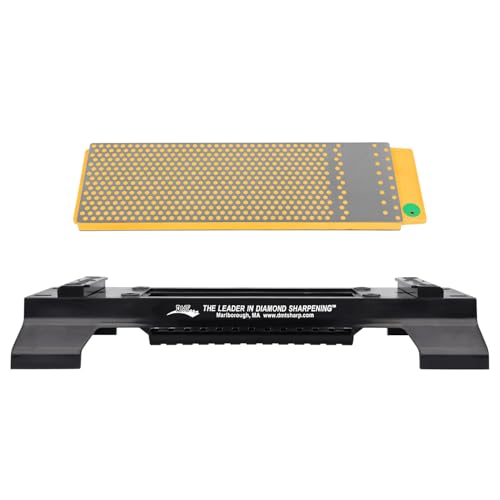
Where the D8C is a single grit, the DuoSharp Plus WM8EF-WB puts two honing grits on one double-sided plate: Fine at 600 mesh on one face and Extra Fine at 1,200 mesh on the other. That pairing covers the refining half of sharpening, taking an edge established on a coarse plate up to a clean working finish. The DuoSharp surface is interrupted, with diamond across a patterned face, and this Plus model adds a continuous zone for small or pointed tools that would drop into the interruptions.
The package includes DMT’s bench stone base, which holds the plate steady and raises it off the bench for knuckle clearance when honing long plane irons. At 8 inches long and 2.63 inches wide, the surface handles standard plane irons and bench chisels, though the widest irons have less room to travel than on a 3-inch plate. It sits in the premium tier and is made in the USA. For a woodworker who already owns a coarse stone or grinder for repairs, this plate covers day-to-day honing in one purchase.
Specs:
- Grits: Fine 600 mesh (25 micron) and Extra Fine 1,200 mesh (9 micron)
- Surface: Interrupted diamond with a continuous zone for pointed tools
- Plate size: 8 x 2.63 inches
- Includes: Bench stone base
- Lubricant: Water or dry
- Construction: Monocrystalline diamond on a precision flat plate
- Origin: Made in the USA
SHARPAL 162N Double-Sided Diamond Sharpening Stone

The SHARPAL 162N takes the opposite pairing to the DuoSharp: one plate spanning the whole bench workflow, with a Coarse 325 grit face for setting edges and repairing damage and an Extra Fine 1,200 grit face for honing. At 8 by 3 inches it matches the D8C for working room, so wide irons and chisel backs sit fully on the surface, and the plate is built from monocrystalline diamonds electroplated onto a stainless steel base.
Two included accessories set it apart in the mid-range tier. The storage case doubles as a non-slip base that holds the plate during use, and a detachable angle guide is included for sharpening at preset angles, more relevant to knives than to guided chisel work but useful in a mixed shop. SHARPAL states the plate sharpens dry with no oil or water required, though it can also be used with water. A three-year manufacturer warranty backs the plate. For a first diamond purchase that must handle both repair and routine honing, the 162N is the most self-contained option here.
Specs:
- Grits: Coarse 325 (45 micron) and Extra Fine 1,200
- Surface: Monocrystalline diamond, double-sided
- Plate size: 8 x 3 inches (203 x 76 mm)
- Construction: Diamond electroplated on a stainless steel base
- Includes: Storage case with non-slip base, angle guide
- Lubricant: Dry or with water, no oil needed
- Warranty: 3-year manufacturer warranty
Ultra Sharp Diamond Sharpening Stone Set
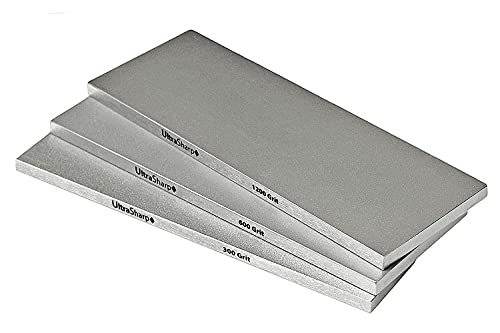
The Ultra Sharp set takes the multi-plate route: three separate 8 by 3 inch plates in 300, 600, and 1,200 grit, so each sharpening stage gets its own full-size surface instead of a shared face. The 300 grit plate handles grinding, nick repair, and waterstone flattening; the 600 refines the bevel; the 1,200 hones to a working edge. Because the plates are separate, a coarse plate worn by flattening duty never compromises the fine plate, and each can be replaced on its own.
An adjustable stone holder is included and clamps plates and stones from 6 to 9 inches long, keeping the set usable without a dedicated base per plate. Each plate weighs about 2.2 pounds, giving it a planted feel in the holder. The set sits in the premium tier, backed by a lifetime manufacturer warranty, the strongest coverage in this group. For a shop setting up a complete diamond station from scratch, this is the most complete package here, though three plates take more drawer space than one double-sided stone.
Specs:
- Grits: 300 coarse, 600 medium, and 1,200 extra fine
- Format: Three separate single-grit plates
- Plate size: 8 x 3 inches each
- Plate weight: About 2.2 pounds each
- Includes: Adjustable stone holder for 6 to 9 inch stones
- Lubricant: Water or dry
- Warranty: Lifetime manufacturer warranty
Trend Diamond Sharpening Stone Kit DWS/CP8/FC

Trend’s kit pairs a double-sided 8 by 3 inch bench stone with the accessories sharpening actually consumes. One face is 300 grit coarse for flattening backs, restoring edges, and lapping other stones; the other is 1,000 grit fine for honing. The diamond is electroplated and set in nickel, and the grit size is laser engraved on each face, preventing the common mistake of working on the wrong side mid-session.
The kit includes a storage pouch, a non-slip mat that keeps the stone planted on the bench, and a cleaning block for clearing the surface when it loads with swarf. Trend is a British tool brand with a long sharpening catalog aimed at woodworkers, and this kit sits in the mid-range tier. The 1,000 grit fine side stops slightly short of the 1,200 grit faces elsewhere here, so edges finish a touch less refined, but as a single purchase covering flattening, grinding, and honing, it is a tidy setup.
Specs:
- Grits: 300 coarse (50 micron) and 1,000 fine (15 micron)
- Surface: Electroplated diamond set in nickel, double-sided
- Plate size: 8 x 3 inches
- Markings: Laser-engraved grit identification
- Includes: Storage pouch, cleaning block, non-slip mat
- Lubricant: Water, lapping fluid, or dry
- Tier: Mid-range
How to Choose a Diamond Sharpening Plate
Start with grit progression, because it decides how many plates you need. Repair and flattening call for 300 to 325 grit; routine sharpening of a sound edge happens at 600; honing finishes at 1,000 to 1,200. A double-sided plate pairing 325 with 1,200, like the SHARPAL, covers the ends in one tool, while a three-plate set gives each stage a dedicated surface. If you already own fine waterstones, a single coarse plate for flattening and repairs may be the only diamond you need.
Size comes next. An 8 by 3 inch plate keeps a 2-inch plane iron and its honing guide on the surface through a full stroke, with room to lap chisel backs flat. Narrower plates around 2.63 inches wide work, but the guide’s rollers run closer to the edge. Surface style matters too: continuous surfaces suit lapping and flattening, while interrupted surfaces clear swarf quickly during bevel work.
Finally, consider how the plate is held. A base or holder that stops the plate skating across the bench is close to essential for guided honing, so factor in whether one is included. Lubrication is simple: water or dry. And plan the last step separately, since diamond tops out around 1,200 grit; a strop or fine stone remains the finishing move.
FAQ
Can a diamond plate replace waterstones for chisels?
For flattening, grinding, and honing up to about 1,200 grit, yes. A diamond plate covers the coarse and medium stages faster than stones and never needs flattening itself. What it does not do is polish beyond its finest grit, so woodworkers chasing the sharpest edge still finish on a fine stone or strop. Many shops run both: diamond for heavy work, one fine stone for the last step.
Which grit diamond plate is best for flattening chisel backs?
A coarse plate around 300 to 325 grit on a continuous surface is the standard choice. The coarse grade removes metal at a useful rate across the whole back, and the continuous face supports the tool evenly with no slots to catch a corner. Once the back is flat and the scratch pattern uniform, move to 600 and then 1,200 grit to refine it; after that, only the area near the edge needs attention at each sharpening.
Do diamond plates wear out?
They wear in rather than wearing flat. New plates cut aggressively and shed loose surface diamond during a break-in period, then settle into a slower, consistent rate that lasts for years. Pressing hard shortens plate life and can strip diamond, so let the abrasive do the work with light pressure. Cleaning a loaded plate with water and a brush, or a cleaning block where one is supplied, restores cutting speed.
Can I use a honing guide on a diamond plate?
Yes, and plates pair well with guides because the surface height never changes as it does with a dishing stone. Check plate width against your guide: guides with side rollers need the rollers to track on the plate or on a flat surface level with it. An 8 by 3 inch plate gives the most room for guide and iron to travel together through a full stroke.
Conclusion
Diamond plates earn their place in a woodworking shop by staying flat, cutting fast, and asking for almost no upkeep. The DMT D8C is the specialist for flattening and repair, the DuoSharp Plus covers honing in a premium double-sided plate with its own base, the SHARPAL 162N spans repair and honing in one mid-range package, the Ultra Sharp set builds a complete three-stage station with lifetime coverage, and the Trend kit bundles a capable plate with its mat, pouch, and cleaning block. Match the grit range to your work, keep pressure light, and any of the five will keep chisels and plane irons cutting cleanly.
Related guides
More from Amazon
Programs that pair well with the guide above. Offers and eligibility are set by Amazon and may change.
A free business account with business pricing and bulk-buying tools for work, shop or home office.
Create a business accountFree shipping on eligible items, Prime Video and more. Eligible new members can start with a free trial.
Start a Prime free trialAudiobooks and podcasts to listen to on the go. Eligible new members can start with a free trial.
Try Audible freeAd-free music streaming. Eligible new subscribers can start with a free trial.
Try Music Unlimited freeAs an Amazon Associate we earn from qualifying purchases.
Write Your Review
No reviews yet. Be the first to share your experience!