
Key takeaways
- Compare the best sharpening stones for chisels and plane irons, from the budget King KW65 combo to Shapton, DMT diamond and Norton polishing stones.
What's inside
- Quick Picks
- Table of Contents
- King KW65 1000/6000 Combination Whetstone
- Shapton Ha No Kuromaku Ceramic Whetstone 1000
- DMT D8C Dia-Sharp Bench Stone, Coarse
- Norton 4000/8000 Combination Waterstone
- Suehiro Dual-Sided 1000/3000 Sharpening Stone
- How to Choose a Sharpening Stone for Chisels and Plane Irons
- FAQ
- Conclusion
As an Amazon Associate I earn from qualifying purchases. This post may contain affiliate links at no extra cost to you.
- Top Pick: Shapton Ha No Kuromaku Ceramic Whetstone 1000
- Runner-up: DMT D8C Dia-Sharp Bench Stone, Coarse
- Also consider: Norton 4000/8000 Combination Waterstone
The fastest way to keep chisels and plane irons cutting cleanly is a simple grit progression on flat stones: a medium stone around 1000 grit to set the bevel, a fine stone in the 3000 to 6000 range to refine it, and an optional polishing step at 8000 grit for the keenest edge. For most benches, the Shapton Ha No Kuromaku 1000 is the strongest single-stone starting point because it is a splash-and-go ceramic that stays flat longer than softer soaking stones. On a tighter budget, the King KW65 1000/6000 combination stone covers sharpening and honing in one block. Add the DMT D8C coarse diamond plate when edges are nicked or a bevel needs regrinding, and finish on the Norton 4000/8000 combination waterstone when a polished bevel matters. The Suehiro 1000/3000 dual-sided stone fills the middle ground for woodworkers who prefer a traditional soaking stone with a finer second side.
As an Amazon Associate, we earn from qualifying purchases.
Contents
- Quick Picks
- Table of Contents
- King KW65 1000/6000 Combination Whetstone
- Shapton Ha No Kuromaku Ceramic Whetstone 1000
- DMT D8C Dia-Sharp Bench Stone, Coarse
- Norton 4000/8000 Combination Waterstone
- Suehiro Dual-Sided 1000/3000 Sharpening Stone
- How to Choose a Sharpening Stone for Chisels and Plane Irons
- FAQ
- Conclusion
Quick Picks
- Best overall: Shapton Ha No Kuromaku Ceramic Whetstone, 1000 grit (K0702) — a hard, fast-cutting splash-and-go stone with a case that doubles as a holder.
- Best budget: King KW65 1000/6000 Combination Whetstone — two useful grits, a plastic base, and a long track record in home workshops.
- Best for repairs and regrinding: DMT D8C Dia-Sharp Bench Stone, Coarse — a continuous diamond surface that removes metal quickly and never dishes.
- Best for polishing: Norton 4000/8000 Combination Waterstone — a fine pairing that refines and polishes bevels on chisels and plane irons.
- Best two-grit soaking stone: Suehiro Dual-Sided 1000/3000 Sharpening Stone — a compact Japanese stone with a rubber base for steady work.
Table of Contents
- Quick Picks
- King KW65 1000/6000 Combination Whetstone
- Shapton Ha No Kuromaku Ceramic Whetstone 1000
- DMT D8C Dia-Sharp Bench Stone, Coarse
- Norton 4000/8000 Combination Waterstone
- Suehiro Dual-Sided 1000/3000 Sharpening Stone
- How to Choose a Sharpening Stone for Chisels and Plane Irons
- FAQ
- Conclusion
- Product and ASIN Reference
King KW65 1000/6000 Combination Whetstone
The King KW65 is the classic first water stone for hand-tool woodworkers. One face is 1000 grit, the standard medium grit for raising a burr and setting a fresh bevel on a dull chisel or plane iron. The reverse face is 6000 grit, fine enough to hone that bevel to a working polish without buying a second stone. It is a soaking stone, so it goes into a tray of water until the stream of bubbles slows, and it builds a light slurry as it works. That softer bond is forgiving for beginners learning to hold an angle, and the included plastic base keeps the stone from sliding around the bench. For a shop that sharpens a handful of bench chisels and one or two planes, this single block covers routine maintenance from dull to sharp. It sits in the budget tier, and its main trade-offs are the soaking step and faster wear compared with hard ceramic stones, which means it needs flattening more often.
Specs
- Grit: 1000 on one face, 6000 on the other
- Type: Combination water stone, soaking required before use
- Model: KW65 (HT-65)
- Includes: Plastic base
- Origin: Made in Japan
- Tier: Budget
Shapton Ha No Kuromaku Ceramic Whetstone 1000
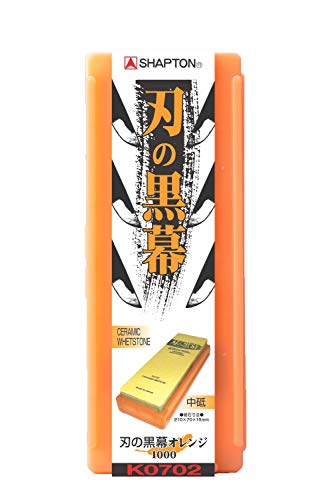
The Shapton Kuromaku 1000, model K0702, is the stone many woodworkers settle on after outgrowing a starter combo stone. It is a ceramic splash-and-go stone: a sprinkle of water on the surface is enough to start sharpening, with no tub of soaking water taking up bench space. Shapton advises a short soak of five to six minutes before the very first use only. The hard ceramic bond cuts quickly, resists dishing far longer than soft soaking stones, and holds a flat reference surface, which matters when the flat back of a chisel or the wide bevel of a plane iron has to register evenly. At 210 by 70 millimeters, the face is long enough for honing-guide strokes and wide enough for most plane irons. The color-coded orange storage case doubles as a stone holder with a non-slip footing. As a single-grit stone it handles the core sharpening step; pairing it with a fine polishing stone completes the progression. It sits in the mid-range tier.
Specs
- Grit: 1000, medium
- Type: Ceramic water stone, splash-and-go
- Model: K0702
- Dimensions: 210 x 70 x 15 mm
- Includes: Storage case that doubles as a stone holder
- Origin: Made in Japan
- Tier: Mid-range
DMT D8C Dia-Sharp Bench Stone, Coarse

The DMT D8C covers the jobs water stones do slowly: grinding out a nick, re-establishing a damaged bevel, or flattening the back of a new chisel. Its continuous surface carries monocrystalline diamond rated at 325 mesh, or 45 micron, bonded to a flat steel plate that measures 8 by 3 inches. Diamond cuts every tool steel, including the hard alloys used in premium plane irons, and the plate cannot dish or groove, so the reference surface stays true without any flattening routine of its own. It works dry or with water, needs no soaking or oil, and ships with non-slip feet. Because it is a coarse plate, it is a starting point rather than a finisher: edges come off it ready for a medium water stone. Many shops also reach for a coarse diamond plate to lap water stones flat again, which makes the D8C a double-duty bench tool. It sits in the mid-range tier and is made in the USA.
Specs
- Grit: Coarse, 325 mesh / 45 micron
- Type: Continuous diamond surface on a steel plate
- Model: D8C Dia-Sharp
- Dimensions: 8 x 3 x 0.38 inches
- Includes: Non-slip feet
- Lubricant: Water or dry use, no oil
- Origin: Made in the USA
- Tier: Mid-range
Norton 4000/8000 Combination Waterstone

The Norton 4000/8000, model 24336, is a finishing stone for bevels that are already shaped. The 4000 grit face refines the scratch pattern left by a 1000 grit stone, and the 8000 grit face polishes the bevel to the level that makes paring end grain and fine planing noticeably cleaner. It is a Japanese-style water stone, so it soaks before use and works with a water lubricant that rinses away easily. At 8 by 3 inches, the face gives wide plane irons full support across each stroke, and the stone arrives in a blue plastic hinged box that protects it in the drawer and serves as storage between sessions. Woodworkers who stop at 6000 grit can work perfectly well, but this stone is the step up for anyone chasing the sharpest possible edge on smoothing planes and paring chisels. It is a single-purpose purchase, since neither face is coarse enough to repair a dull edge on its own. It sits in the premium tier.
Specs
- Grit: 4000 on one face, 8000 on the other
- Type: Combination water stone, soaking required before use
- Model: 24336
- Dimensions: 8 x 3 x 1 inches
- Includes: Blue plastic hinged storage box
- Origin: Norton Abrasives (Saint-Gobain)
- Tier: Premium
Suehiro Dual-Sided 1000/3000 Sharpening Stone
The Suehiro dual-sided stone pairs the two grits that handle most routine sharpening in a single compact block. The 1000 grit side sets and refreshes bevels on chisels and plane irons, and the 3000 grit side refines the edge a clear step beyond a basic hone, leaving a finish that many woodworkers take straight to the wood for general bench work. Suehiro, based in Niigata, Japan, is a long-established maker of synthetic water stones, and this stone follows the traditional pattern: soak it before use, keep the surface wet, and let the slurry do the cutting. A rubber base is included to hold the stone steady on the bench. Its compact footprint suits small shops and tool kits where a full-size stone is awkward to store, though very wide plane irons demand careful, even strokes on any narrower stone. For woodworkers who want a genuine Japanese soaking stone in a two-grit format without moving to separate single-grit stones, this is a sensible middle path in the mid-range tier.
Specs
- Grit: 1000 on one face, 3000 on the other
- Type: Dual-sided water stone, soaking required before use
- Includes: Rubber base
- Size: Compact bench format
- Origin: Made in Japan by Suehiro
- Tier: Mid-range
How to Choose a Sharpening Stone for Chisels and Plane Irons
Start with the grit progression. Sharpening bench tools is a sequence, not a single step. A coarse option around 220 to 400 grit, or a coarse diamond plate, is only needed for damage and regrinding. The everyday work happens at 1000 grit, where the bevel is shaped and a burr is raised. Refining happens between 3000 and 6000 grit, and polishing at 8000 grit is the optional final step. A buyer starting from nothing gets the most coverage from a 1000 grit stone plus one finer stone, or from a combination stone that pairs those ranges.
Match the stone type to your routine. Soaking stones such as the King, Norton, and Suehiro picks need a tub of water and a few minutes of patience, and in return they offer a softer feel and fast slurry. Splash-and-go ceramic stones such as the Shapton need only a sprinkle of water and store dry, which suits quick touch-ups. Diamond plates need no flattening and cut the hardest steels, but even fine diamond leaves a scratch pattern most woodworkers follow with a water stone.
Check the size against your widest iron. A stone should be at least as wide as the widest blade in the kit, and longer stones make honing-guide strokes easier to keep consistent. Three-inch-wide stones cover wide plane irons comfortably, while narrower stones ask for diagonal strokes to use the full face evenly.
Plan for flattening. Every water stone wears hollow eventually, and a dished stone rounds bevels instead of sharpening them. A coarse diamond plate or a dedicated flattening stone restores the surface in minutes. Stones with harder bonds, like the Shapton ceramic, hold flatness longer between sessions.
Think in tiers. Budget combination stones cover the full progression in one purchase. Mid-range stones buy harder bonds, faster cutting, and better flatness. Premium finishing stones add the final polish step. Any of these five picks can anchor a working setup, and they can be combined over time rather than bought all at once.
FAQ
What grit sharpening stone is best for chisels and plane irons?
A 1000 grit stone is the core grit for bench chisels and plane irons, because it shapes the bevel and raises a burr without removing metal too slowly. Follow it with a refining grit between 3000 and 6000 for a working edge, and add 8000 grit only when the finest polish is wanted for paring or smoothing work.
Do water stones need to be soaked before use?
Traditional water stones such as the King KW65, the Norton combination stone, and the Suehiro stone are soaked in water until bubbles stop rising, usually a matter of minutes. Splash-and-go ceramic stones such as the Shapton Kuromaku need only water sprinkled on the surface. Diamond plates need no soaking at all and can be used dry or with water.
How often do sharpening stones need flattening?
A water stone should be checked with a straightedge whenever edges start coming out uneven, and flattened as soon as a visible hollow develops. Soft soaking stones dish faster than hard ceramic stones. A coarse diamond plate or a dedicated flattening stone restores the surface, and regular light flattening is quicker than rescuing a badly worn stone.
Can one stone sharpen both chisels and plane irons?
Yes, provided the stone is wide enough for the widest plane iron in the kit and long enough for controlled strokes with a honing guide. Combination stones that pair a medium grit with a fine grit, such as 1000 with 3000 or 6000, handle the complete routine for both tool types in a single block.
Conclusion
A reliable sharpening setup for chisels and plane irons comes down to a flat 1000 grit stone, one finer step for refining, and a way to keep the stones flat. The Shapton Kuromaku 1000 is the strongest anchor for most benches, the King KW65 covers the same ground in the budget tier, the Suehiro 1000/3000 suits fans of traditional soaking stones, the DMT D8C handles repairs and heavy work, and the Norton 4000/8000 adds the final polish. Choose the combination that matches how often the tools are sharpened, and the edges will take care of themselves.
Related guides
More from Amazon
Programs that pair well with the guide above. Offers and eligibility are set by Amazon and may change.
A free business account with business pricing and bulk-buying tools for work, shop or home office.
Create a business accountFree shipping on eligible items, Prime Video and more. Eligible new members can start with a free trial.
Start a Prime free trialAudiobooks and podcasts to listen to on the go. Eligible new members can start with a free trial.
Try Audible freeAd-free music streaming. Eligible new subscribers can start with a free trial.
Try Music Unlimited freeAs an Amazon Associate we earn from qualifying purchases.
Write Your Review
No reviews yet. Be the first to share your experience!