
Key takeaways
- Compare the best mortise chisels on steel, hardness, bevel, handle and ferrule design, with five verified picks for frames and deep mortises.
As an Amazon Associate I earn from qualifying purchases. This post may contain affiliate links at no extra cost to you.
A mortise chisel is not just a wider bench chisel. Its blade is far thicker than it is wide, with a tall, almost trapezoidal cross-section that survives levering waste out of deep mortises and keeps the tool tracking straight while you chop. That geometry lets you cut a clean mortise for a table leg or a timber-frame joint without the blade flexing under mallet blows.
As an Amazon Associate, we earn from qualifying purchases.
This guide compares five genuine mortise chisels sold on Amazon on the details that separate them: the blade widths offered, the steel type and hardness each maker actually publishes, the factory bevel, the handle material, and how the handle is reinforced with ferrules or a striking hoop. It also notes which tools are sold singly and which come as sets.
This article contains affiliate links, so if you buy through a link here the site may earn a commission at no extra cost to you.
Quick Answer
The Narex Richter mortise chisel in 1/2 inch is the top pick: its drop-forged chrome-vanadium blade is cryogenically treated and tempered to a maker-stated minimum of 62 HRc, with double stainless ferrules and a leather washer protecting the ash handle. For a ready-made range, the Narex 863600 set covers 4 to 12 mm at Rc 59.
The Picks in Detail
Narex Richter Mortise Chisel, 1/2 Inch (Single)

Specs
- Blade width: 1/2 inch (12.7 mm); sold singly in several widths, with 3/8 inch also listed
- Steel: chrome-vanadium, drop-forged and cryogenically treated
- Stated hardness: minimum 62 HRc, as published by the maker for the Richter line
- Bevel: 25-degree primary bevel; maker recommends a 30 to 35-degree secondary bevel for mortising
- Blade profile: thick mortise section with tapered sides to reduce binding
- Handle: ash wood
- Ferrule design: double solid stainless-steel ferrules, pinned, with a leather washer
- Sold as: single chisel
The Richter is Narex’s premium line, and the mortise version carries the same recipe as its bench chisels: chrome-vanadium steel, drop forging, and a cryogenic treatment cycle the maker credits for the line’s wear resistance. The published hardness floor of 62 HRc is the highest figure in this comparison, two to three points above the chrome-manganese tools below, and it is the spec to look at if your edges keep rolling halfway through a run of mortises in oak or ash.
The handle hardware is the other half of the design. Two solid stainless ferrules, one pinned, plus a leather washer stack up at the top of the ash handle to spread mallet impact and resist splitting. The 25-degree factory bevel is a starting grind; honing the steeper secondary bevel the maker recommends turns it into a chopping edge. Sold one width at a time, this is the chisel to buy in the size your joinery uses most.
Narex 863600 Mortise Chisel Set of 4 (4, 6, 10, 12 mm)

Specs
- Blade widths: 4, 6, 10 and 12 mm
- Steel: chrome-manganese alloy steel
- Stated hardness: Rc 59, as published by the maker
- Bevel: single bevel
- Blade profile: thick trapezoidal mortise section, wider at the face than at the back
- Handle: stained European beech wood
- Ferrule design: steel ferrule with a steel striking hoop at the top of the handle
- Set weight: 880 grams, per the listing
- Sold as: four-piece set, model 863600
If you want one purchase that covers furniture-scale mortising, this is the straightforward option. The four widths map onto common tenon thicknesses for frame-and-panel work, drawer frames and chair construction, and every chisel is a true mortise pattern. The chrome-manganese steel at Rc 59 is the same recipe Narex uses across its classic Czech line: a toughness-first temper that tolerates levering and mallet work, at the cost of slightly more frequent honing than the Richter steel above.
The stained beech handles use the line’s hoop-and-ferrule construction, with a steel hoop over the top so mallet strikes land on metal rather than end grain. For most benches, this set plus one wider single covers hand mortising without duplication.
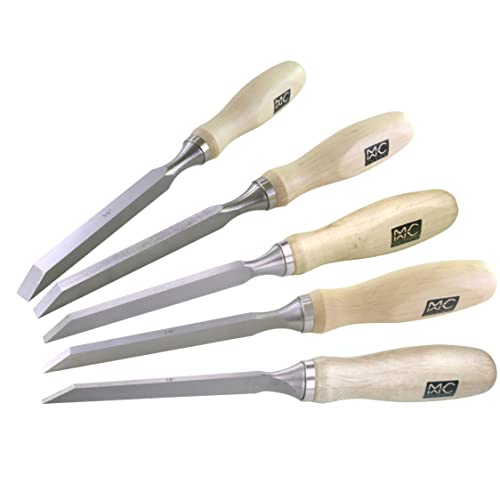
Cabinetmakers Mortise Chisel Set of 3 (1/4, 3/8, 1/2 Inch)
Specs
- Blade widths: 1/4, 3/8 and 1/2 inch
- Steel: chrome-vanadium steel
- Stated hardness: not stated
- Bevel: not stated
- Handle: hornbeam wood
- Ferrule design: not stated
- Sold as: three-piece set
This unbranded set is the imperial-sized alternative, and for shops that lay out joinery in inches it removes the mental conversion the metric sets demand. A 1/4 inch chisel matches the standard mortise for three-quarter-inch frame stock, while the 3/8 and 1/2 inch sizes step up for door frames and heavier legs. The chrome-vanadium blade steel is the same alloy family as the Richter line, and hornbeam is a dense, impact-resistant handle wood.
The trade-off is documentation. The listing publishes no hardness figure, bevel angle or ferrule details, so there is no maker-stated spec to compare against the Rc 59 and 62 HRc numbers elsewhere in this guide. Buyers who sharpen to a known spec will feel that gap; buyers who simply want three correctly sized mortise chisels with wooden handles may not.
Narex Czech Steel Mortise Chisel, 12 mm (811212, Single)

Specs
- Blade width: 12 mm (1/2 inch); the line runs from 4 to 16 mm in singles
- Steel: alloy steel (chrome-manganese in the maker’s line specification)
- Stated hardness: Rc 59, as published by the maker for the line
- Bevel: single bevel
- Handle: stained European beech wood
- Ferrule design: steel ferrule with a steel striking hoop
- Item weight: 8.4 ounces, per the listing
- Sold as: single chisel, model 811212
The 8112 series is the classic Narex mortise chisel sold one at a time, and 12 mm is the size most benches reach for first, covering half-inch mortises for table legs, bed frames and door stiles. Spec for spec it matches the 863600 set above, since both come from the same chrome-manganese, Rc 59 line with stained beech handles and hoop-and-ferrule construction; the difference is purely how you buy it.
That makes this single the natural way to extend a set, replace a damaged chisel, or test the line before committing to a box of four. The same listing family runs up to 16 mm, where furniture mortise chisels shade into light timber-frame work. If you already own bench chisels, one or two of these singles is a defensible minimal kit.
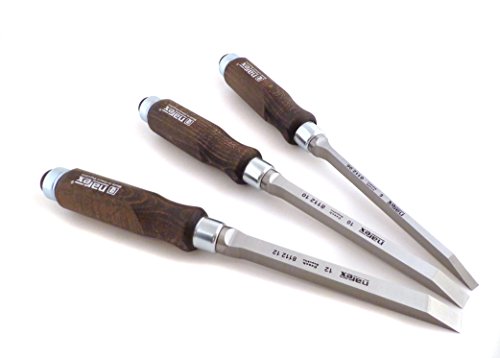
Narex Czech Steel Mortise Chisel Set of 3 (6, 10, 12 mm)
Specs
- Blade widths: 6, 10 and 12 mm
- Steel: chrome-manganese steel
- Stated hardness: Rc 59, as published by the maker
- Bevel: single bevel, ground at 25 degrees in retailer specifications for the line
- Handle: stained European beech wood
- Ferrule design: steel ferrule with a steel striking hoop
- Sold as: three-piece set
This three-piece bundle of the same classic Narex line drops the 4 mm chisel from the 863600 box and keeps the three widths that do most furniture mortising: 6 mm for small frames, 10 mm for aprons and rails, and 12 mm for leg and stile work. Steel, hardness and handle specification are the line’s standard, so the comparison with the four-piece set is purely about size coverage, not quality tier.
Choose this set if your work rarely goes below 6 mm mortises, which describes a lot of casework and table building. Choose the four-piece set instead if you build drawers, boxes or sash work where the 4 mm width earns its place. Either way, expect to hone the factory edges first.
How to Choose
Start with width, because a mortise chisel cuts a mortise its own width and no other. Match the chisel to the tenon thickness your joinery uses, usually about a third of the stock thickness: 6 mm for small frames, 10 or 12 mm for table legs and door parts, wider singles toward timber-frame dimensions. A set makes sense when your projects vary; singles make sense when one or two widths do nearly all your work.
Next, read the steel and hardness figures the maker actually publishes. Chrome-manganese at Rc 59, as in the classic Narex line, is a toughness-oriented temper that shrugs off levering. The Richter’s chrome-vanadium at a stated minimum of 62 HRc trades some of that forgiveness for edge life. Where a listing states no hardness, treat edge retention as an unknown.
Finally, look at the top of the handle and plan your sharpening. Mortise chisels live under a mallet, so a steel striking hoop, a pinned ferrule or a leather washer stack matters: all exist to keep the handle from splitting. And a 25-degree primary bevel is a paring grind; mortising edges hold up better with a steeper secondary bevel.
Who Should Skip
Skip this entire category if your mortises are cut by a hollow-chisel mortiser, a router jig or a Domino; a hand mortise chisel duplicates a process you have already mechanised. Skip it, too, if you only clean up machine-cut mortises, because a bench chisel does that paring work with a thinner blade.
Also skip the premium single if you are equipping a first bench. The classic-line sets deliver the same geometry and a published Rc 59 spec across several widths for a simpler start, and the Richter’s extra hardness only pays off once your sharpening routine is consistent. And if your joinery is exclusively large-scale timber framing, these furniture-weight tools are undersized; look at dedicated framing chisels and slicks instead.
FAQ
What is the difference between a mortise chisel and a bench chisel?
The blade section. A mortise chisel is much thicker than it is wide, with tall sides that resist bending when you lever waste out of a deep mortise, while a bench chisel has a wide, thin blade made for paring. Using a bench chisel to mortise risks a bent blade or a split handle; using a mortise chisel to pare is simply clumsy.
What size mortise chisel should I buy first?
Buy the width that matches the tenons you cut most, which for furniture work is usually 10 or 12 mm, or 1/2 inch. The common rule is a mortise about one third the thickness of the stock, so a 12 mm chisel suits most table legs and door stiles. Add narrower widths later for frame and drawer work.
Why do mortise chisels need a steeper bevel?
Chopping end grain with a mallet concentrates force on a small edge, and a fine 25-degree edge can roll or chip under that load. A secondary bevel in the 30 to 35-degree range leaves more steel behind the edge, which is why Narex recommends that range for the Richter mortise chisels.
Can I strike any wooden-handled chisel with a mallet?
Only if the handle is built for it. Mortise chisels carry a steel hoop, a substantial ferrule or a leather washer at the top of the handle to absorb strikes and stop the wood splitting. A handle with no such reinforcement, as on many paring chisels, should be pushed by hand only.
Final Verdict
For a single best buy, the Narex Richter in 1/2 inch pairs the hardest published steel in this group with the most thoroughly reinforced handle, and it is the chisel to choose for the width you use weekly. For a range in one purchase, the Narex 863600 set covers 4 to 12 mm in proven Rc 59 steel, while the three-piece sets and the 811212 single let you build a kit width by width. The unbranded imperial set fills the inch-sized gap, with the caveat that its maker publishes no hardness figure. Match the width to your tenons first, then let stated hardness and handle hardware settle the rest.
Related guides
More from Amazon
Programs that pair well with the guide above. Offers and eligibility are set by Amazon and may change.
A free business account with business pricing and bulk-buying tools for work, shop or home office.
Create a business accountFree shipping on eligible items, Prime Video and more. Eligible new members can start with a free trial.
Start a Prime free trialAudiobooks and podcasts to listen to on the go. Eligible new members can start with a free trial.
Try Audible freeAd-free music streaming. Eligible new subscribers can start with a free trial.
Try Music Unlimited freeAs an Amazon Associate we earn from qualifying purchases.



Write Your Review
No reviews yet. Be the first to share your experience!