Best Band Saws for Making Curved Furniture Legs from Hardwood
What's inside
As an Amazon Associate I earn from qualifying purchases. This post may contain affiliate links at no extra cost to you.
Making curved furniture legs from hardwood is one of the jobs where a band saw earns its floor space. It removes waste quickly, follows a fair template curve, and leaves enough material for sanding or routing. The right saw is not necessarily the biggest one, though. For most leg work, blade control, table support, and reliable adjustment matter more than maximum resaw height.
Contents
What to Look For in a Band Saw
A 14-inch band saw is the practical starting point for serious furniture work. Its typical 12- to 14-inch throat gives enough room for a leg blank and a template, while a 6- to 12-inch resaw capacity handles most chair, table, and cabriole-leg stock. A 10-inch saw can work for smaller legs, but its table and guides are usually less substantial.
Look for at least 1 horsepower if you regularly cut dense hardwood such as maple, ash, oak, or beech. A 3/4-horsepower saw is adequate for occasional work and moderate stock thickness, but it will slow down more noticeably in 2- to 4-inch hardwood. More power does not compensate for a dull blade or poor setup; it mainly reduces bogging when you feed steadily.
Throat depth is the distance from the blade to the frame. For curved legs, 12 inches is workable and 14 inches is more comfortable. Resaw height is less important unless you cut thick leg blanks from wide boards. Remember that the published maximum usually assumes a narrow blade and a carefully adjusted guide assembly. Usable capacity can be lower when a thick, stiff blade is installed.
For a general-purpose machine, compare 14-inch woodworking band saws with these priorities:
| Feature | Good target | Why it matters for curved legs |
|---|---|---|
| Motor | 3/4 to 1-1/2 hp | Maintains blade speed in dense hardwood |
| Throat depth | 12 to 14 inches | Leaves room to rotate a blank around a template |
| Resaw capacity | 6 to 12 inches | Allows thicker stock and future veneer work |
| Table size | At least 14 by 14 inches | Supports tall or awkward leg blanks |
| Blade adjustment | Easy tracking and guide adjustment | Reduces drift, wandering, and uneven cuts |
Which Type of Band Saw Makes Sense?
A benchtop band saw is the cheaper option and can be fine for short furniture legs made from blanks under about 2 inches thick. It takes less space and is easier to move, but its small table, limited throat, and lighter blade tensioning make it harder to control a tall blank. Choose one only if your projects are compact and you are willing to cut close to the line in several passes.
A floor-standing 14-inch saw is the best fit for most hardwood furniture builders. It gives you a stable base, a larger table, better guide access, and enough capacity for both curved legs and ordinary resawing. A basic model with a solid cast-iron table is often a better purchase than a feature-heavy machine with a weak stand or awkward blade adjustment. See current options for floor-standing 14-inch band saws.
Two-speed machines are useful if you also cut plastics or nonferrous metal, but speed selection is not essential for wooden legs. For hardwood, the important controls are a properly tensioned blade, a sharp tooth edge, and a fence or guide that does not flex. A mobile base is convenient, but it should lock firmly; vibration during a curved cut shows up as a rough, uneven edge.
Blade Choice and Setup
Use a 1/4-inch or 3/8-inch blade with roughly 4 to 6 teeth per inch for most leg curves. The narrower blade turns tighter radii, while the wider 3/8-inch blade tracks more confidently on broad curves. A 1/2-inch blade is useful for straight resawing but is usually too stiff for tight cabriole details.
For 2-inch hardwood, a 3 or 4 TPI skip-tooth blade clears sawdust well. For thinner stock or a cleaner edge, use 6 TPI. Avoid extremely fine blades in thick hardwood: they clog with dust, heat up, and encourage slow feeding. Keep a spare blade available. A blade that is dull, cracked, or missing teeth will make even a good saw appear underpowered.
Set the upper guides about 1/8 inch above the workpiece. The thrust bearing should sit just behind the blade without touching it during free running. Side guides should be close enough to prevent deflection but not pinch the blade. Check blade tracking before every substantial project, and use the tension scale only as a starting point; actual tension depends on blade width and the saw.
How to Cut the Leg Blanks
Make a full-size template from MDF or thin plywood. Mark the centerline and the finished outline, then transfer the shape to the hardwood with a sharp pencil or knife. If making several matching legs, keep the template intact and use a bearing-guided router after rough sawing, or use the template to mark every blank consistently.
Cut outside the finished line by about 1/16 to 1/8 inch. That allowance gives you room to remove saw marks without accidentally reducing the leg profile. Do not force the stock through a tight curve. If the blade binds, back out only while the blade is running, then make a relief cut from the waste area into the kerf. Relief cuts prevent the waste from closing around the blade and reduce the chance of a wandering cut.
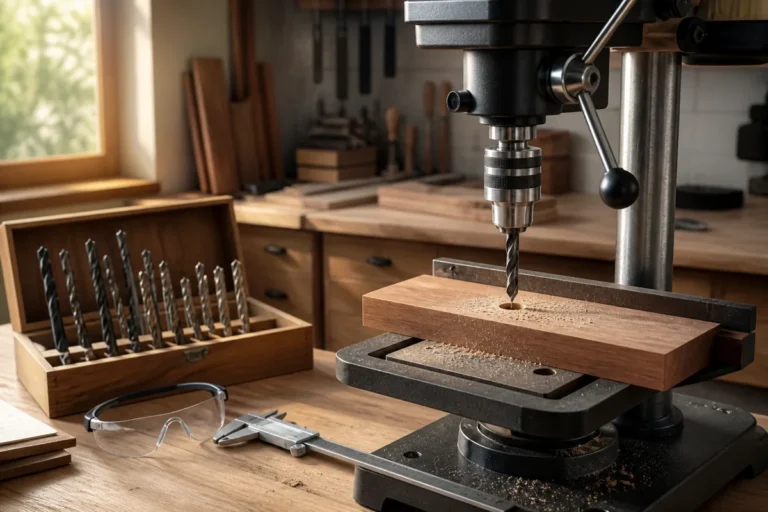
For a very tight inside curve, drill a relief hole in the waste with a drill press and Forstner bit before sawing. The hole should be no larger than the waste area allows, and its edge must remain outside the finished profile. This removes stress from the turn and leaves a smoother transition.
Common Failure Modes
If the cut wanders, first check blade sharpness, tension, and guide clearance. Feeding faster than the blade can remove wood makes the blade bend toward the waste. Pushing sideways to correct a curve usually makes the cut worse; steer with gentle, continuous pressure instead.
If the saw burns maple or oak, the blade may be dull, too fine, or moving too slowly through the cut. Excessive burning can harden the edge and make later sanding difficult. If the workpiece vibrates, check that the stand is level and the table is locked. A fence is helpful for straight entry cuts, but remove it or keep it clear when following a freehand curved layout.
For most home workshops, buy a stable 14-inch floor-standing saw, add quality 1/4- and 3/8-inch blades, and spend time learning to tension and track them. A less expensive benchtop saw remains a sensible choice when your legs are small and your production demands are low. The machine should match the stock and curve radius, not an impressive specification sheet.