Band Saw vs Jointer for Milling Irregular Hardwood Boards
What's inside
As an Amazon Associate I earn from qualifying purchases. This post may contain affiliate links at no extra cost to you.
For irregular hardwood boards, a band saw and a jointer solve different problems. The band saw removes bulk and creates a workable edge; the jointer makes a face flat and an edge straight and square. If the board is live-edge, bowed, twisted, or too wide for your planer, choosing the wrong machine can waste good wood or create an unsafe setup.
As an Amazon Associate we earn from qualifying purchases at no extra cost to you.



Contents
What Each Machine Actually Does
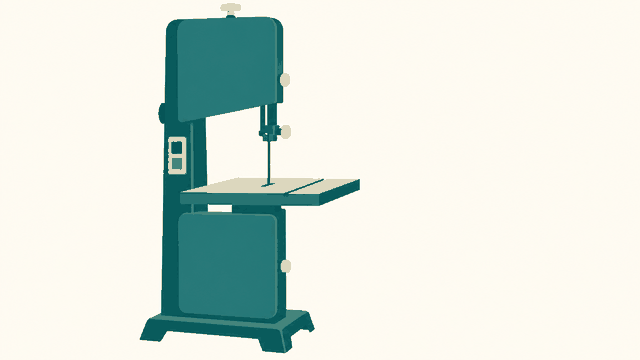
A woodworking band saw cuts with a continuous blade running around two wheels. It is good at removing a crooked edge, cutting around defects, resawing thick stock, and making curved cuts. It does not automatically produce a flat face or a perfectly straight edge. The result depends on the fence, blade, setup, and your ability to guide the board.
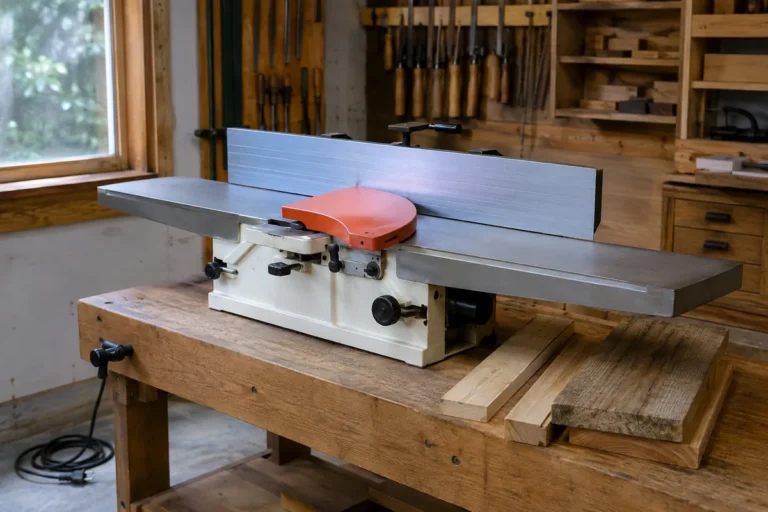
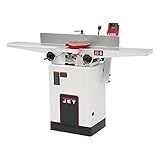
A jointer uses a cutterhead below a long, adjustable table. The infeed table supports the rough board, the knives remove material, and the outfeed table supports the newly cut surface. A jointer can produce one flat face and one edge at 90 degrees to that face. It cannot flatten the entire board at once if the board is wider than the cutterhead, and it is a poor choice for stock that rocks badly or has no stable reference surface.
| Task | Better machine | Why |
|---|---|---|
| Remove a live edge or crooked side | Band saw | Removes only the waste you need without forcing the board against a cutterhead. |
| Flatten one face | Jointer | Its tables and cutterhead establish a flat reference surface. |
| Make an edge straight and square | Jointer | The fence and table create a consistent 90-degree edge. |
| Resaw thick stock into slabs | Band saw | It can cut vertically through stock that is too thick for a planer. |
| Prepare a board for glue-up | Both | The band saw may remove waste first; the jointer makes the final mating edge. |
When the Band Saw Should Come First
Start with the band saw when the board has a bark edge, severe bow, a large crook, or a section you need to cut away. Trying to joint a heavily irregular board often creates a small contact patch on the infeed table. The board can rock into the cutterhead, producing a gouge, a tapered face, or a dangerous kickback-like movement.
For a rough side, mark a straight line that leaves at least 1/16 to 1/8 inch of waste. Cut just outside the line rather than trying to follow it perfectly. A 3/4-inch blade with roughly 3 to 4 teeth per inch is a practical general-purpose choice for many hardwood boards. A narrow blade turns more easily, but a wider blade tracks straighter for long rip cuts. Keep the cut slow enough that the motor does not labor and the blade does not deflect.
After sawing, leave enough material for the jointer to clean up. If the board is valuable or badly warped, do not cut directly to the finished width. Removing an extra 1/8 inch may be cheaper than trying to straighten an edge that wanders in and out.
When the Jointer Is the Right Tool
Use the jointer after the board has at least one reasonably stable face or edge. Joint the concave face first, taking light passes until the board no longer rocks. Typical cuts of 1/32 inch are safer and easier to control than aggressive cuts. On figured hardwood, a 1/64-inch finishing pass can reduce tear-out, although sharp knives and a suitable cutting angle matter more than simply taking many passes.
Once one face is flat, joint one edge against the fence. Check the edge with a reliable square and inspect it with a straightedge. A jointer is not a thicknessing machine: it will not make the opposite face parallel to the jointed face. For that, use a planer after flattening the first face.
Jointer width is a hard limit. A 6-inch jointer cannot flatten a 10-inch board, regardless of motor power. A wide jointer works well for larger stock but costs considerably more and takes more shop space. For many home shops, a 6-inch machine is enough for table legs, cabinet parts, and narrower boards, while a 8-inch jointer offers a useful increase in capacity without reaching industrial size. Compare current options in 6-inch woodworking jointers.
Wide, Twisted, and Very Uneven Boards
For a board wider than your jointer, use a planer sled, router flattening jig, or a hand plane to establish the first flat face. A sled should support the board so it cannot rock; hot-melt glue or shims can hold it temporarily. Once one face is flat, run the board through a planer with the flat face down. Remove roughly 1/32 inch per pass and alternate checking for twist.
A planer alone is not a substitute for a jointer on twisted stock. It follows the existing bottom surface, so it can produce a board that is smooth but still warped. Likewise, a band saw can cut a straight-looking edge that is not square to either face. The two machines often work best as a sequence rather than as competing purchases.
Which Machine to Buy First
Buy a band saw first if your projects involve slabs, live-edge boards, resawing, curved parts, or rough lumber with substantial waste. A 14-inch class saw is more versatile for resawing, but a smaller saw is fine for furniture parts if its cutting height is adequate. Check maximum resaw capacity, blade tracking, guide adjustment, and whether replacement blades are easy to obtain. A useful 14-inch woodworking band saw is a better long-term choice than a small saw with barely enough capacity.
Buy a jointer first if you mainly build cabinets or furniture from already rough-sawn boards and need square glue joints. A benchtop jointer is cheaper and takes less room, but its short tables make long boards harder to control. A floor-standing jointer with longer tables is easier to use on boards over 5 or 6 feet.
Before either cut, inspect for nails, screws, embedded grit, loose knots, and internal cracks. Stand to the side of the feed path, use push blocks on the jointer, keep hands away from the cutterhead and blade, and support long stock with infeed and outfeed stands. The cheaper machine is fine when its capacity matches your boards; buying more width or resaw height than your work requires only consumes money and floor space.