Best Jointers with Adjustable Depth-of-Cut Controls
What's inside
As an Amazon Associate I earn from qualifying purchases. This post may contain affiliate links at no extra cost to you.
A jointer’s depth control determines how aggressively it removes wood in one pass. That matters when flattening a twisted board, but also when you need to avoid tear-out, snipe, or a cut that leaves the board too thin. Many benchtop and floor-standing jointers let you set depth by raising or lowering the infeed table. Some also have a clear scale or a positive stop; neither feature replaces checking the actual cut.
As an Amazon Associate we earn from qualifying purchases at no extra cost to you.


Contents
What adjustable depth of cut means
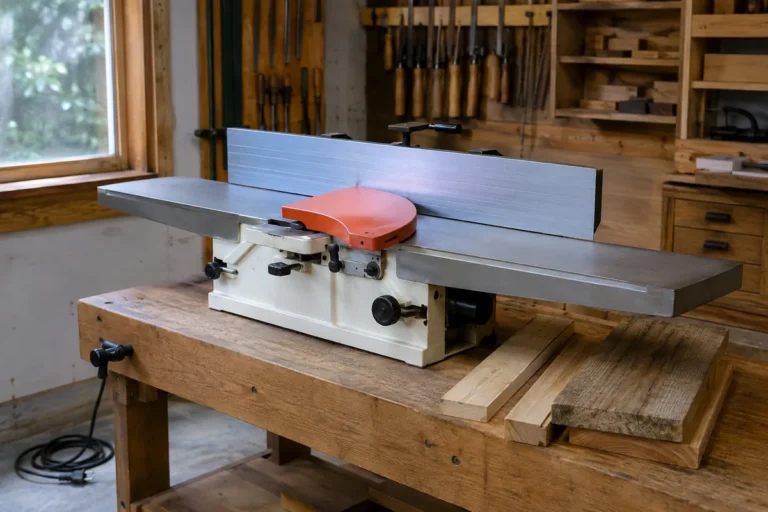
The depth of cut is the height difference between the infeed and outfeed tables. The outfeed table should sit level with the knives or cutterhead at their highest point; lowering the infeed table sets how much material the knives remove. A typical woodworking jointer offers roughly 1/8 inch of maximum cut, though capacity varies by machine.
For routine face or edge jointing, start around 1/32 inch per pass. Use 1/16 inch when the board is stable and the cutterhead is sharp. A full-depth cut is for limited situations, not a default setting: it demands more power, increases the chance of tear-out, and can make a narrow board difficult to control. Take several light passes rather than trying to correct severe bow or twist in one go.
Features worth comparing
Depth adjustment is useful only if the table moves smoothly and holds its setting. Before buying, check the adjustment mechanism, scale readability, table length, cutterhead type, and whether the machine has a workable fence. A hard-to-read scale is inconvenient, but a table that shifts under load is a more serious problem.
| Feature | What to look for | Practical trade-off |
|---|---|---|
| Depth adjustment | Handwheel or lever with a clear scale and little backlash | A scale speeds setup; verify it with a test cut. |
| Maximum cut | About 1/8 inch is common; check the machine’s stated limit | Maximum capacity does not mean maximum recommended pass. |
| Table length | Longer tables support longer boards | Benchtop machines save space but need careful workpiece handling. |
| Cutterhead | Knives or indexed carbide inserts | Insert heads often simplify routine edge maintenance; replacement costs differ. |
| Fence and width | Rigid fence and capacity suited to your stock | A wider cut capacity cannot compensate for short tables or poor support. |
Choose by workshop and workload
For a small shop that mainly straightens cabinet parts, trim, and boards under about 4 feet long, a benchtop jointer is often adequate. Look for a machine with an easy-to-turn depth control, a stable fence, and tables long enough for the stock you actually use. The lower price and smaller footprint are real advantages. The trade-off is less support for long boards, so use roller stands or a helper and keep the workpiece level through the cut.
Browse benchtop jointers with adjustable depth controls if space and budget matter more than long-board capacity. Check the table length and fence adjustment in the specifications rather than judging by motor power alone.
For frequent furniture work, a floor-standing jointer with longer tables is easier to use accurately on wider or longer stock. A 6-inch jointer suits much common furniture lumber; an 8-inch machine handles wider boards but costs more and takes up more room. A wider machine is not automatically the better buy if most of your stock is narrow. Compare floor-standing options by table length, fence rigidity, and cutterhead serviceability as well as cut width.
If you want simpler knife maintenance and often work with figured wood, consider a jointer with a helical or spiral-style insert cutterhead. Small inserts can be rotated or replaced individually, but replacement inserts add ongoing cost. Traditional straight knives can be less expensive to maintain, though setting them accurately takes care and dull knives can produce fuzzy grain or ridges.
Set depth accurately and avoid common failures
Do not rely on the depth scale as a precision instrument. With the machine unplugged, set the infeed table, then use a straightedge or a depth gauge to check the table relationship. Make a test cut on scrap and measure the material removed. If the cut is deeper on one edge, inspect table alignment, knife or insert height, and workpiece support before adjusting the depth again.
For a board with a pronounced crown or twist, mark the high spots and take shallow passes while keeping pressure over the infeed table at entry and the outfeed table once the board reaches it. Avoid pressing down hard at the ends; that can flex the board and leave a tapered cut. Joint one face flat, then use a planer to make the opposite face parallel. A jointer is not a substitute for a planer when thickness consistency matters.
Common warning signs include chatter marks, ridges along the board, burnished patches, and a cut that changes depth mid-pass. Chatter can come from dull knives, loose parts, an uneven feed, or taking too much material. A board that rocks on the tables may be twisted, while a board that catches can be too short, too thin, or poorly supported. Follow the machine’s minimum workpiece dimensions and use push blocks; never joint stock that is unsafe to control.
Make the buying decision
For occasional edge-jointing, a basic benchtop machine is fine if its table and fence are stable and you are willing to work in light passes. Spend more for longer tables when you regularly prepare long boards, or for a larger capacity when your stock routinely exceeds 6 inches. Treat an adjustable depth control as essential, but judge the machine by how consistently it holds that setting—not by the number printed on its scale.
Before ordering, confirm the machine’s actual maximum cut, dust-port size, fence angle range, and whether the stand is included. Also check available replacement knives or inserts. A jointer that fits your stock and can be adjusted repeatably will do more for finished results than a larger maximum cut you rarely use.