How to Set Jointer Depth of Cut for a Rough Board
What's inside
As an Amazon Associate I earn from qualifying purchases. This post may contain affiliate links at no extra cost to you.
Setting a jointer’s depth of cut is a small adjustment with a big effect on safety, surface quality, and how much wood you waste. For a rough board, start with a shallow cut—usually 1/32 inch or less—then take another pass if needed. A deeper cut is not a shortcut if it causes tear-out, chatter, or a board that rocks on the tables.
Contents
What depth of cut means
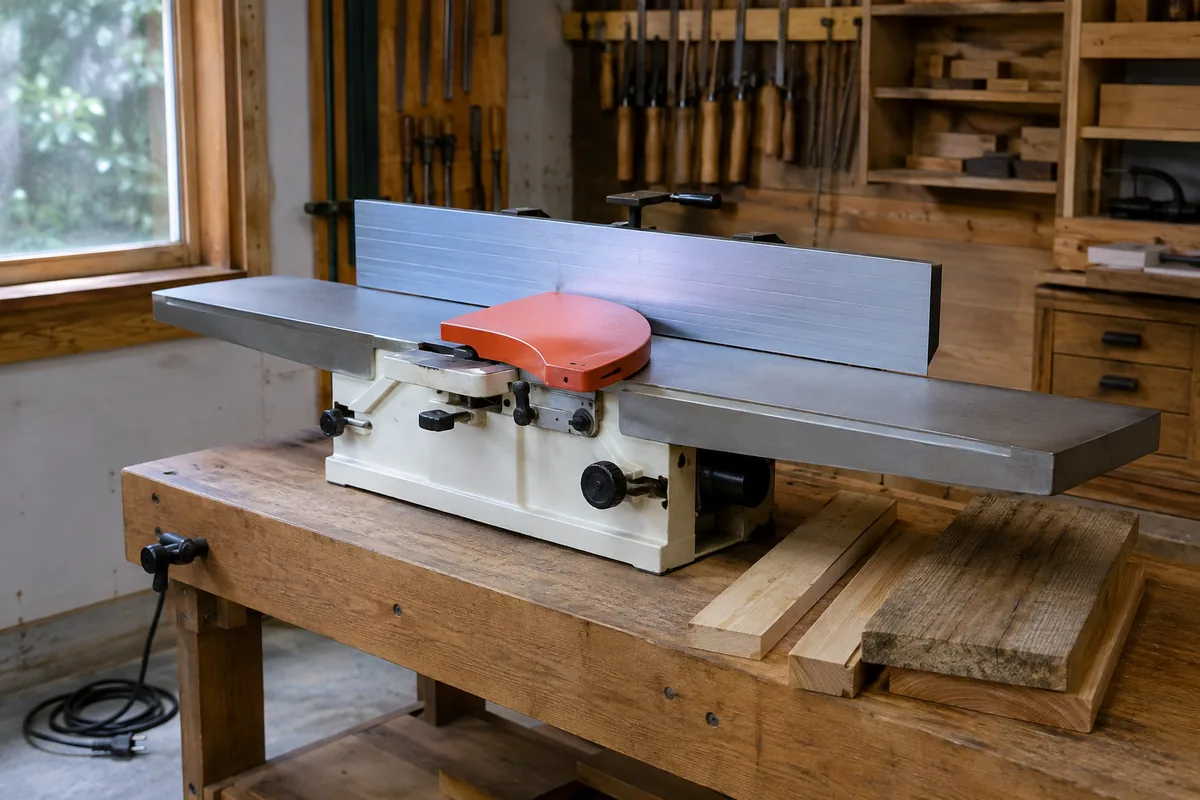
On a jointer, the depth setting is the height difference between the infeed table and the cutterhead knives or inserts. The outfeed table should be level with the knives’ highest cutting point. Lowering the infeed table creates the cut: the board loses that much material on each pass.
Depth of cut is not the same as how much stock you need to remove overall. If a board is twisted or cupped, correcting it may require several shallow passes. The goal is to establish one flat face and, if needed, one square edge—not to make the entire board smooth in a single pass.
Choose a sensible starting depth
For most rough boards, begin at 1/32 inch (about 0.8 mm). Use closer to 1/64 inch (about 0.4 mm) for figured, brittle, or tear-out-prone wood, or when the machine is a small benchtop jointer. A 1/16-inch cut can be reasonable on a wide, straight-grained board when the jointer is rigid, sharp, and rated for the width. Check the machine manual: some compact jointers limit the maximum cut to 1/8 inch, but that maximum is not a recommended setting for every board.
Do not try to remove a large cup or twist by lowering the table until the board seems to fit. A heavy cut increases the chance of kickback, motor bogging, and snipe-like dips at the ends. It also makes the board harder to control. Instead, flatten one face in stages, then use a thickness planer to bring the opposite face parallel.
Set and check the table
Disconnect the jointer before putting hands or a gauge near the cutterhead. Raise or lower the infeed table using its adjustment wheel or lever, then lock it if the machine has a table lock. Read the scale as a starting point, not as proof of accuracy; scales can drift, and the actual cut depends on knife height and table alignment.
To verify the setting, use a straightedge or a dial indicator designed for jointer setup. With the machine unplugged, bridge the outfeed table and cutterhead area and check that the outfeed table is even with the knives’ top dead-center position. Follow the manual’s procedure for locating that point. If the outfeed table is too low or high, adjust it before judging cut depth. A misaligned outfeed table can leave ridges, steps, or a board that dips as it exits.
Make a test pass on scrap of similar thickness and species. Measure the difference between the board’s original thickness and the cut area with calipers, or use a marking gauge to compare surfaces. If the cut is too aggressive, raise the infeed table to reduce the depth. Change the setting in small increments; a quarter turn of an adjustment wheel can mean very different amounts on different machines.
Match the cut to the board
Wood condition matters as much as width. A board with reversing grain may tear out even at 1/64 inch. Try feeding it from the opposite end, which changes the cutting direction relative to the grain. If both directions tear, use lighter cuts or a different flattening method. Sharp knives or fresh inserts help; dull cutters tend to leave a rough surface and demand more force.
Board width also affects the decision. Stay within the jointer’s rated capacity and avoid taking the full width of a very wide, heavy board through a small machine. A benchtop jointer may handle narrow stock well but lack the mass and table support for wide, warped boards. For those, a router sled, hand plane, or larger jointer may be the safer practical choice. A digital caliper is useful for checking thickness changes, but a basic ruler and careful test cuts are enough for many jobs.
Depth-setting trade-offs
| Cut depth | Best use | Main trade-off |
|---|---|---|
| 1/64 inch | Figured grain, small jointers, final cleanup | More passes; less tear-out risk |
| 1/32 inch | General starting point for rough boards | Good balance of stock removal and control |
| 1/16 inch | Straight-grained stock on a capable machine | Fewer passes, but more load and greater risk of defects |
These are working ranges, not guarantees. A board with severe twist may need many shallow passes, while a flat board may need only one light cleanup pass. If the machine vibrates, slows noticeably, or leaves repeated ridges, stop and check the setup, cutter sharpness, and feed rate rather than pushing harder.
Feed safely and read the cut
Keep the board flat on the tables and use push blocks, especially as the trailing end approaches the cutterhead. Keep hands clear of the cutter opening and never joint stock shorter than the minimum length specified in the manual. Remove loose bark, nails, and grit first; they can damage knives or become projectiles. Wear eye and hearing protection, and use dust collection or a suitable dust mask.
Feed steadily, without forcing the board. A scalloped surface can mean the board is moving too quickly, the knives are dull, or the cutterhead has a setup problem. Deep scallops, sudden changes in motor sound, or the board lifting off the table are reasons to stop and reassess. Do not compensate for poor support by increasing pressure near the cutterhead.
When a setup tool is worth buying
If you set up knives or inserts yourself, a jointer knife-setting gauge can make cutterhead adjustments more repeatable. It is not necessary just to choose a shallow cut for occasional projects, and it does not replace checking the outfeed table. For a first pass, the machine scale, a careful test cut, and a straightedge are often sufficient. Spend on a gauge when repeated knife changes or uneven results make its time savings worthwhile.